43% More Leases, 80% Win Rate, FDA Cleared: Vertical AI's Production Week
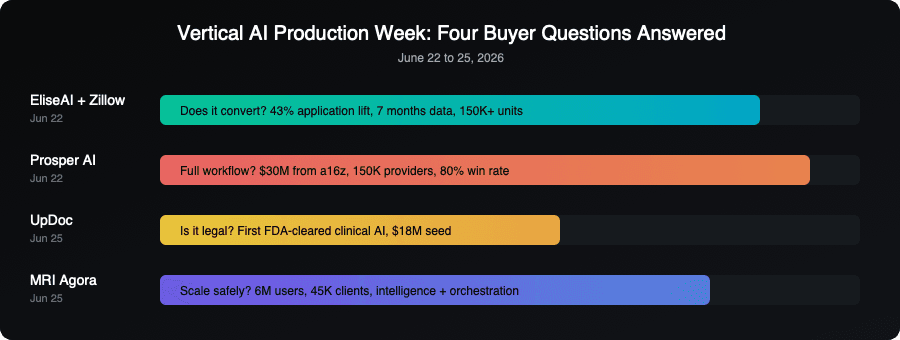
Four vertical AI announcements in 72 hours each answered a buyer question: does it convert, can it handle the full workflow, is it legal, can it scale safely.
By SpringVanta
Renters who chatted with an AI leasing agent on Zillow were 43% more likely to submit an apartment application. That number comes from seven months of production data, not a pilot. EliseAI and Zillow Rentals released the findings on June 22, covering October 2025 through April 2026 across their shared multifamily portfolio. Renters who engaged with the AI were also 19% more likely to book a tour and 24% more likely to sign a lease.
Three days later, on June 25, MRI Software launched Agora Intelligence and Agora Orchestrator, a pair of tools that turns real estate data into autonomous workflow execution for 6 million users across 45,000 clients. The same day, UpDoc announced the first FDA clearance for a clinical AI platform built on patient-facing large language models, with deployments at Cleveland Clinic, UCSF Health, and Allegheny Health Network. And three days before the Zillow data dropped, Prosper AI closed a $30 million Series A from Andreessen Horowitz to run the entire patient journey, from scheduling to insurance verification to billing, for 150,000 healthcare providers.
Four announcements in one week. Each one answers a specific question that buyers have been asking about vertical AI.
Does it actually convert?
The EliseAI and Zillow data is the strongest production evidence I have seen from a vertical AI deployment. Seven months is not a pilot. The 43% application lift means renters who engaged with the AI leasing agent were materially more likely to take action, not just browse.
The mechanics are straightforward. Zillow Rentals embeds an EliseAI-powered assistant directly in the listing. Renters ask questions, get answers instantly, schedule tours, and receive follow-up, all without waiting for a human leasing agent. The tool handles 28% of calls that previously went unanswered and the majority of inquiries that arrive outside business hours.
Minna Song, co-founder and CEO of EliseAI, said: "AI Assist responds to every one of them. The data shows what can happen when every single lead gets a helpful reply instantly."
The detail that makes this credible: the tool is available to Zillow's multifamily partners with over 450 units at no additional cost. This is not a premium upsell. It is built into the listing experience, which means the data reflects real-world renter behavior, not a gated beta.
Terri Eager, a senior manager at Falkin Platnick Realty Group, put it plainly: "EliseAI is working while we're sleeping, engaging with people we otherwise would not be engaging with."
For operators evaluating AI intake: if your tool cannot show conversion data measured over months, not days, ask why.
Can it handle the full workflow?
Prosper AI raised $30 million to prove that scheduling was never the whole job. The platform answers patient calls, books appointments directly into the EHR, verifies insurance benefits, automates patient billing, and calls insurance companies on the phone when there is no API to query. What comes out the other side is what a16z partner Jay Rughani calls a "financially cleared patient appointment."
The distinction matters. First-generation healthcare voice AI stopped at scheduling. Prosper handles scheduling, insurance verification, and billing in one system because healthcare administrative staff do not work in silos. They handle whatever call comes in. Xavier de Gracia, Prosper's co-founder, told Fierce Healthcare: "Healthcare providers don't want separate tools for scheduling, insurance verification, and billing. They want a single platform capable of managing the workflows that determine whether care happens and whether providers ultimately get paid."
The numbers: 150,000 providers, 40 healthcare organizations as customers, 5x revenue growth in six months, 80% competitive win rate, and more than $1.3 billion in patient care powered. The platform claims to reduce administrative costs by over 40%.
SiliconANGLE reported that the platform averages 99% accuracy across patient requests, with built-in quality assurance tools that let providers test agents with simulated calls before launch. When an agent cannot answer reliably, it escalates to a human staffer.
The pull-through pattern that convinced a16z: providers would deploy Prosper for scheduling, then quickly ask it to handle insurance verification, then billing. That expansion only happens when the technology works across the full workflow.
Is it legal?
UpDoc received FDA clearance for the first Software as a Medical Device that uses patient-facing large language models. The 510(k) clearance (K253281) covers insulin management for Type 2 diabetes. A clinician sets treatment parameters, and the AI adjusts medication, orders follow-up labs, and documents everything in the EHR between scheduled visits.
The clearance is specifically for clinical AI, which UpDoc defines as AI that delivers care that historically required a licensed clinician. This is not scheduling. Not billing. Not documentation. The platform initiates insulin titration within physician-approved parameters and triggers lab orders to confirm safety.
CEO Sharif Vakili framed the regulatory choice as deliberate: "We fundamentally believe that clinical AI should be held to the highest standard." The company could have launched without FDA clearance, as some competitors have. Doctronic, another AI health platform, bypassed the FDA under Utah's state AI regulatory sandbox and faces resistance from the Utah Medical Licensing Board.
The $18 million seed round includes the American Diabetes Association, Eli Lilly, Mayo Clinic, and Section 32. RevCycleAI noted that the billing infrastructure for autonomous between-visit care does not fully exist yet, even though the reimbursement codes do. Chronic Care Management, Remote Physiologic Monitoring, and Principal Care Management codes all potentially apply, but health systems need documentation and attribution infrastructure to capture them at volume.
The buyer takeaway: regulatory clearance is becoming a competitive moat. Companies that invest in compliance earn distribution into health systems that cannot risk uncertified tools.
Can it act autonomously at enterprise scale?
MRI Software serves 6 million users across 45,000 clients in 170 countries. The company has been in real estate software for over 50 years. When MRI launches an AI platform, the deployment surface is an entire industry, not a startup beta.
Agora Intelligence monitors every workflow across leasing, finance, and operations daily, then delivers role-specific briefings. Each briefing tells the user what changed, why, and what to do about it. The system classifies findings as risks, trends, watches, or opportunities, ranked by business impact.
Agora Orchestrator picks up where Intelligence leaves off. It executes workflows automatically, reading the real estate context behind each situation. A hesitant renewal signals a different response than a committed one. For complex cases, Orchestrator works through them step by step with the team, surfacing context and making reasoning visible. Every action is logged and traceable.
CEO Patrick Ghilani identified the real challenge: "Connecting AI agents to systems is becoming easier. The bigger challenge is ensuring those agents operate in ways organizations can trust." The platform includes confidence levels, data completeness scores, and source attribution on every finding, plus role-level permissions and a Responsible AI Framework.
This is enterprise-grade vertical AI with governance built in from the start, not bolted on. The BriefGlance analysis noted that the launch moves the industry from passive data analysis to proactive automated action, which is a different category of product.
What this means for buyers
These four announcements each answer a different question, but they share one thing: none of them are pilots, demos, or promises. EliseAI has seven months of conversion data. Prosper has 150,000 providers and an 80% win rate. UpDoc has FDA clearance. MRI has 6 million users and a governance framework.
If you are evaluating vertical AI for intake, scheduling, or workflow automation, here is what changed this week:
Demand production data, not pilot results. Ask vendors for conversion metrics measured over months, not weeks. EliseAI's 43% lift means nothing if your vendor cannot produce equivalent numbers for your use case.
Test the full workflow, not just the first step. Prosper's land-and-expand pattern, starting with scheduling and pulling through to insurance and billing, proves that single-task AI creates more integration debt than it saves. Evaluate whether the platform can handle the entire journey.
Check regulatory status before deploying clinical AI. UpDoc's FDA clearance took nine months. If your vendor claims clinical capabilities without regulatory clearance, ask how they handle liability.
Verify governance before scaling autonomous workflows. MRI built audit trails, confidence scores, and role-level permissions into Agora from day one. If your AI tool cannot explain why it took an action, it is not ready for enterprise deployment.
The vertical AI market spent 2025 proving that the technology works. This week, it started proving that the business works too.
Sources: AI PropTech News (EliseAI/Zillow data, June 22); a16z and Fierce Healthcare (Prosper AI, June 22); PR Newswire and RevCycleAI (UpDoc FDA clearance, June 25); PR Newswire/Morningstar and BriefGlance (MRI Agora, June 25); SiliconANGLE and MobiHealthNews (Prosper AI independent coverage).