Citations Aren't Recommendations: AI Search Visibility Got Real Tools in 48 Hours
69% of AI citations recommend competitors instead of you. Bing, Adobe, and Google shipped measurement tools in 48 hours to close the gap.
By SpringVanta
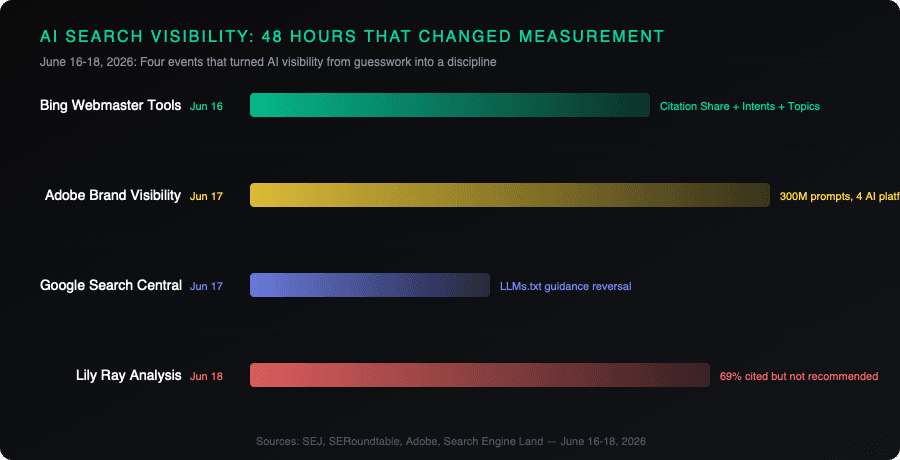
Four things happened between June 16 and June 18 that collectively turned AI search visibility from a guessing game into a measurable discipline. The timing wasn't coordinated, but the convergence tells you where this market is going.
Lily Ray analyzed 100 B2B "best [category]" queries across Google's AI Overviews at three checkpoints between April and June 2026. When a brand published its own self-promotional listicle and that listicle got cited as a source, the brand was left out of the actual recommendation 69% of the time. The competitors named in those same listicles got recommended instead.
So a company publishes "Best 10 CRM Tools" with itself at number one. Google pulls it in as a citation source. Then Google recommends HubSpot, Salesforce, and Monday.com, and ignores the publisher entirely. The listicle works as a citation, but the citation actively promotes competitors.
That finding dropped on June 18. In the 48 hours before it, three vendors shipped products that make this exact problem visible and fixable.
Bing ships citation share
On June 16, Microsoft added four features to the Bing Webmaster Tools AI Performance dashboard: Intents, Topics, Citation Share, and Compare. Citation Share is the standout. It shows the percentage of all citations for a specific grounding query that point to your site. If Bing's AI cited ten sources for a query and three were yours, you see 30%.
Until now, AI citation reporting was raw counts. You could see that your pages were cited, but not how big your slice was relative to everyone else's. Citation Share adds the relative measure. Intents groups citations by search intent (Informational, Commercial, Navigational, Research). Topics clusters them thematically. Compare lets you overlay time periods.
Microsoft describes Citation Share as an observational metric, not a ranking or traffic share. It doesn't name competitors. But it does give you the first first-party view into how much of an AI answer's evidence base comes from your domain versus the rest of the web.
Barry Schwartz at Search Engine Roundtable summed it up with three words: "Google - your turn."
Adobe builds the commercial layer
On June 17, Adobe announced Brand Visibility, the first product from its $1.9 billion Semrush acquisition. It combines Semrush's AI visibility intelligence with Adobe's LLM Optimizer into what Adobe calls a closed-loop GEO system.
The product draws on nearly 300 million real-world AI search prompts, tracks brand mentions across ChatGPT, Google AI Mode, Microsoft Copilot, and Perplexity, and uses AI agents to surface content recommendations that can be deployed without engineering support. It also benchmarks competitive share-of-voice.
The data Adobe released alongside the launch puts the urgency in perspective. AI traffic to U.S. retail sites grew 1,324% between October 2024 and May 2026. Travel saw 2,215% growth in the same window.
Loni Stark, VP of strategy and product at Adobe, framed the problem for MarTech: "We used to get back the same thing, a SERP page with links on it. Now, the answers appear to be random, but they aren't at scale. But companies don't have tools to do it."
Liz Miller, an analyst at Constellation Research, noted that Adobe customers have "held Adobe's feet to the fire" over how long past acquisitions took to integrate. This one shipped fast because the need is urgent enough that speed mattered more than perfection.
Google acknowledges the multi-engine world
Also on June 17, Google quietly updated its generative AI SEO guidance on Search Central. The previous guidance discouraged the use of LLMs.txt files and special markup for AI optimization. The new guidance says: "It's completely fine if you decide to create and maintain LLMS.txt files (or other similar files) for other services or systems that use these files. Doing so won't harm (nor help) your visibility or rankings in Google Search, as Google Search ignores them."
Google Search still ignores LLMs.txt. But the previous wording was broad enough that SEOs read it as a blanket discouragement across all AI surfaces. The update narrows the scope to Google Search specifically and acknowledges that other services may use these files.
Roger Montti at Search Engine Journal called it a shift from discouragement to neutrality. The change is small in substance but significant in what it signals: Google now publicly recognizes that websites optimize for AI surfaces beyond its own.
Why citations are a broken metric
The Lily Ray finding lands on top of all three product launches and reframes them. If 69% of your citations recommend your competitors, then counting citations as a success metric is actively misleading you. You're celebrating being cited while Google uses your content to recommend someone else.
Ray's analysis covered 100 B2B "best [category] software" queries at three dates (April 15, May 15, June 8, 2026). She separated two metrics that the industry tends to conflate: being cited as a source versus being named as a recommendation in the AI answer itself.
The results were consistent. For "best help desk software," Pylon's self-promotional listicle got cited as a source under Help Scout's recommendation. Pylon was not recommended. Its listed competitors Zendesk, Freshdesk, and Help Scout were. For "best survey software," Pollfish was cited heavily with two separate listicles. SurveyMonkey, Qualtrics, Google Forms, and Typeform got recommended instead.
The pattern repeated across project management tools, HR software, CRM, SEO tools, and learning management systems. Lesser-known brands that published self-promotional listicles got used as citation material while better-known competitors captured the recommendation slots.
Ray also found that brands with more referring domains, higher domain ratings, and more mentions across ChatGPT and AI Overviews consistently won the recommendation slots. The citation layer pulls from whatever ranks. The recommendation layer appears to weight external authority signals much more heavily.
This is why Bing's Citation Share and Adobe's Brand Visibility matter beyond feature announcements. They give you the data to see whether your citations are actually translating into recommendations, or whether you're feeding the machine for your competitors.
What to do with this
If you've been tracking AI citations as a primary metric, stop treating them as a proxy for visibility. A citation where your competitors get recommended and you don't is not a win. It's a loss wearing a victory badge.
Three things you can do this week:
Check Bing Webmaster Tools if you haven't. The AI Performance dashboard is free, the new Citation Share feature is rolling out globally, and it gives you first-party data on how Copilot and Bing AI use your content. Even if Bing isn't your primary search engine, the citation patterns will be directionally useful.
Audit your self-promotional listicles. If you're a smaller or mid-tier brand publishing "best X" articles with yourself at number one, you may be providing citation material that Google uses to recommend your competitors. Ray's data suggests this is especially true if your domain authority and backlink profile are weaker than the brands you're listing alongside yourself.
Test what users actually see. Adobe's data on 300 million AI search prompts is proprietary, but you can run your own test. Pick ten queries your customers would use, run them through ChatGPT, Google AI Mode, Copilot, and Perplexity. Note whether you're cited, recommended, or absent. The gap between citation and recommendation is where strategy lives now.
The bigger picture
For two years, AI search visibility meant screenshots and manual spot-checks. If your brand showed up in a ChatGPT answer, you took a screenshot and called it a win. If it didn't, you tried different content and hoped.
That era ended this week. Bing gives you first-party citation data. Adobe gives you a commercial product that tracks 300 million prompts across four major AI platforms. Google stopped pretending other AI surfaces don't exist. And Lily Ray gave us the research that explains why all of it matters: citations and recommendations are different things, and tracking the wrong one can cost you business.
The companies that figure out the difference first will have a head start that compounds. The ones still counting citations may be optimizing for the wrong outcome without knowing it.
Sources:
- Lily Ray, "Why Calling Yourself The Best Could Be Helping Your Competitors Win In AI Search," Search Engine Journal, June 18, 2026
- Matt G. Southern, "Bing Rolls Out AI Citation Share In Webmaster Tools," Search Engine Journal, June 16, 2026
- Barry Schwartz, "Bing Webmaster Tools AI Reporting Adds Intents, Topics, Citation Share & Compare," Search Engine Roundtable, June 17, 2026
- Adobe, "Introducing Adobe Brand Visibility: A Unified Solution for the AI Search Era," Adobe News, June 17, 2026
- Mike Pastore, "Adobe brings GEO to CX Enterprise with Adobe Brand Visibility," MarTech, June 17, 2026
- Don Fluckinger, "Adobe previews answer engine optimization, agentic AI creative tools," TechTarget, June 18, 2026
- Roger Montti, "Google's Updated Guidance Now Says It's 'Fine' To Use LLMs.txt For AI SEO," Search Engine Journal, June 17, 2026
- Danny Goodwin, "Google AI Overviews cite self-serving listicles, but recommend competitors 69% of the time," Search Engine Land, June 18, 2026