Salesforce Buys Fin for $3.6B: The Agentic CX Land Grab
Salesforce paid $3.6B for Fin because its Apex model resolves 76% of support tickets. Agentforce was stuck at 40-60%. Here's what the deal means for buyers.
By SpringVanta
Salesforce just paid $3.6 billion for a company whose AI agent resolves support tickets better than Salesforce's own. That's the whole story.
On June 15, 2026, Salesforce signed a definitive agreement to acquire Fin (formerly Intercom) for roughly $3.6 billion. Fin's AI agent, powered by a proprietary model called Apex, resolves 76% of customer support volume end-to-end across chat, email, WhatsApp, SMS, phone, and Slack. Salesforce's own Agentforce Contact Center, which went GA in March, reports containment rates of 40-60% for repeatable requests. Salesforce bought the product that outperforms the one it built.
That gap, and what it means for anyone buying customer support tools right now, is what makes this deal worth reading past the headline.
What $3.6 billion actually bought
Fin is not a startup. Founded in 2011 as Intercom in Dublin, it reported about $267M in revenue in 2024, employs roughly 1,400 people, and serves more than 30,000 companies including Asana, Shutterstock, and Riot Games. The company rebranded from Intercom to Fin on May 12, 2026. Thirty-four days later, it was acquired.
The product Salesforce paid for is an AI agent that handles support queries end-to-end without human handoff for covered query types, in 45-plus languages. Fin reports that its agents resolve, on average, 76% of support volume autonomously, with some deployments exceeding 85%.
Those numbers are vendor-stated. They have not been independently audited, and the methodology behind them is not public. But they are consistent enough across Fin's customer base that Salesforce was willing to pay roughly 9 times estimated ARR to own them.
The deal is expected to close in Q4 of Salesforce's fiscal year 2027, which means roughly early calendar 2027, subject to regulatory approval.
Why Apex is different from a chatbot
Most enterprise AI customer service tools work by putting a prompt layer on top of a general-purpose LLM. You ask GPT or Claude to answer support questions using whatever context you pass in. That approach deploys fast but produces a predictable failure: the agent hallucinates answers the knowledge base doesn't support.
Fin took a different architectural bet. Its CX Model Suite runs seven specialized models in sequence rather than one generalist. Each handles a discrete stage: language detection, issue summarization, knowledge retrieval, result reranking, answer generation, feedback parsing, and escalation routing.
The generative core, Apex 1.0, was post-trained entirely on production customer service data, not general internet text. That means it optimizes for resolution accuracy in support contexts rather than broad language fluency. Fin reports 65% fewer hallucinations compared to Claude Sonnet 4.6 on support tasks, and a 2.8% higher resolution rate than the latest frontier models from OpenAI and Anthropic.
Again: vendor-reported, unaudited. But the architecture explains why the numbers land where they do. Splitting retrieval, ranking, validation, and generation across specialized models is a fundamentally different approach than prompting one model to do everything.
The escalation routing step is where it gets technically interesting. Instead of using a second LLM to decide whether to transfer a conversation to a human, Fin uses a fine-tuned ModernBERT transformer. It runs a multi-task classification model that evaluates whether to continue, offer escalation, or escalate immediately. It achieves more than 98% routing accuracy and runs half a second faster than an equivalent LLM-based routing step. At the volumes Fin's largest customers operate, that half-second compounds.
The benchmark paradox
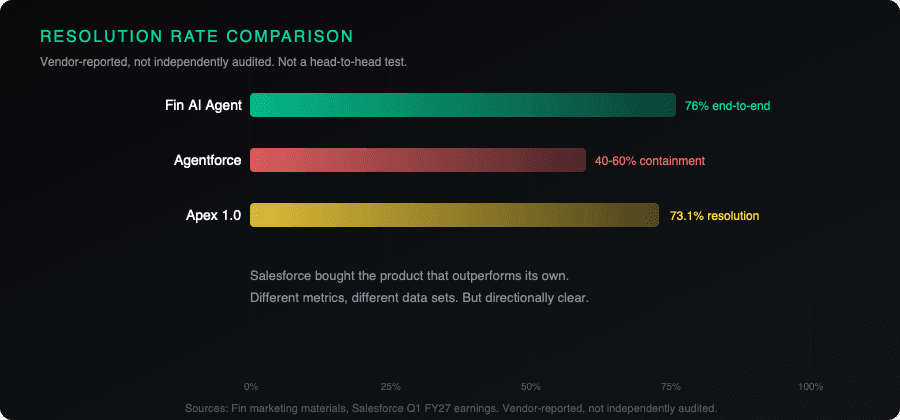
Here is the sharpest way to read this deal. Fin reports 76% end-to-end resolution. Agentforce Contact Center reports 40-60% containment for repeatable requests. Salesforce just bought a model that appears to beat its own.
That framing is rhetorically powerful and partly true, but it needs an honest asterisk. These are not head-to-head numbers. Fin's 76% and Agentforce's 40-60% come from two separate vendor reports using different definitions of "resolution" versus "containment," different ticket mixes, and different escalation rules. Anyone selling against Salesforce will use the clean version. The responsible version keeps the caveat.
Still, the directional signal is clear enough that Salesforce was willing to pay $3.6 billion for it. They did not buy Fin because it was cheap. They bought it because they could not close the gap internally fast enough.
The workforce math behind the deal
Marc Benioff has already done to his own company what Fin will now do for 30,000 others. In a September 2025 podcast, he described reducing Salesforce's internal support division from approximately 9,000 employees to around 5,000 after AI agents absorbed half of incoming customer interactions. "I need less heads," he said.
That reduction represents one of the most clearly documented cases of AI-driven customer service workforce displacement by a major enterprise software company. It is not a projection. It already happened.
Forrester Research projects that 49% of current customer service jobs globally will be eliminated by AI by 2030, with high-volume B2C contact centers reaching 80% AI containment within five years. The Bureau of Labor Statistics already projects a 5% decline in US customer service employment from 2024 to 2034. Salesforce's own WARN notice filed in June 2026 listed 86 eliminated positions across Agentforce, MuleSoft, and Marketing Cloud teams.
Salesforce did not publicly connect those cuts to AI automation. The timing speaks for itself.
What this means for buyers right now
If you are evaluating customer support AI tools, the Fin deal changes the landscape in three concrete ways.
Fin is no longer independent. For teams that chose Fin specifically because it integrated with existing helpdesk stacks including Zendesk, the acquisition means your vendor is now owned by Salesforce's largest competitor. Monitor how Salesforce handles those integrations post-close. Fin has not disclosed how its product roadmap will change inside Agentforce's framework.
Agentforce gets a fast-deploy option. Agentforce was built as a deeply customizable enterprise platform. Powerful for organizations with engineering resources, but a slow onboarding experience for mid-market companies that needed something functional in days rather than months. Fin fills that gap because it ships pre-trained and ready to deploy. If you are already on Salesforce, this is good news. If you are evaluating whether to consolidate on Salesforce, this acquisition strengthens the case.
Resolution rate is the new moat. The deal validates that purpose-built models for customer support outperform general-purpose LLMs in production. That has implications beyond Salesforce. Expect every major vendor, from Zendesk to ServiceNow to Sierra, to either build or acquire specialized support models. Every operator evaluating support AI faces the same decision now: pick a platform and verify its resolution rate against your own ticket data before signing anything.
Ignore every vendor's headline resolution rate until you reproduce it in a pilot. "Resolution" and "containment" are not the same metric. The only number worth budgeting against is the one your own tickets produce.
The competitive landscape post-deal
Salesforce is not the only buyer in this space. The company completed at least 10 acquisitions in six months to build out Agentforce, including the $8B Informatica deal in November 2025. In July 2025, NICE acquired Cognigy for about $955 million, the prior comparable agentic-CX deal. Salesforce just paid 3.8 times that amount.
The independents are not standing still. Sierra, co-founded by former Salesforce co-CEO Bret Taylor, raised a $950M Series E in May 2026 and is building AI agents from scratch for the Fortune 500. Zendesk expanded AI agent capabilities to all customers in May and June 2026 and acquired Forethought for autonomous resolution earlier this year. ServiceNow made its MCP Server generally available, opening its platform to external AI agents.
But the field is concentrating. Concentrix committed to a three-year rollout of Agentforce across 80,000 agent seats in March 2026. The large BPOs are picking platforms, not point tools. When the biggest buyers start consolidating, the standalone vendors face a narrowing window.
For mid-market and SMB operators, the practical takeaway is to evaluate agentic CX as a platform decision, not a point-tool procurement. Run a disciplined pilot now, while you still have leverage and choice. The field will be smaller in twelve months.
Sources
- Salesforce Signs Definitive Agreement to Acquire Fin (Salesforce press release, June 15, 2026)
- Salesforce to buy Fin for about $3.6 billion (Reuters)
- Salesforce Acquires Fin for $3.6B: Apex AI Pipeline Resolves Most Tickets Without Humans (TechTimes, June 17, 2026)
- Salesforce Buys Fin for $3.6B: The Agentic CX Land Grab (Digital Applied, June 15, 2026)
- Salesforce to Acquire Fin for $3.6 Billion (CMSWire)
- Salesforce Acquires Fin, Formerly Known as Intercom (MarTech)