Claude Fable 5, JFrog Supply Chain Plugin, Cohere North Mini: 48 Hours That Reshaped AI Dev Tooling
Three major AI dev tooling releases landed in 48 hours: Anthropic Fable 5, JFrog supply chain plugin for Claude Code, and Cohere North Mini Code. Here is what each means for production pipelines.
By Springvanta
Three things landed between Monday and Tuesday that change how teams should think about AI coding agents: Anthropic released its most capable model yet, JFrog shipped supply-chain governance for Claude Code, and Cohere open-sourced a coding agent that runs on a single GPU. None of these happened in isolation.
Claude Fable 5: Mythos-class for everyone
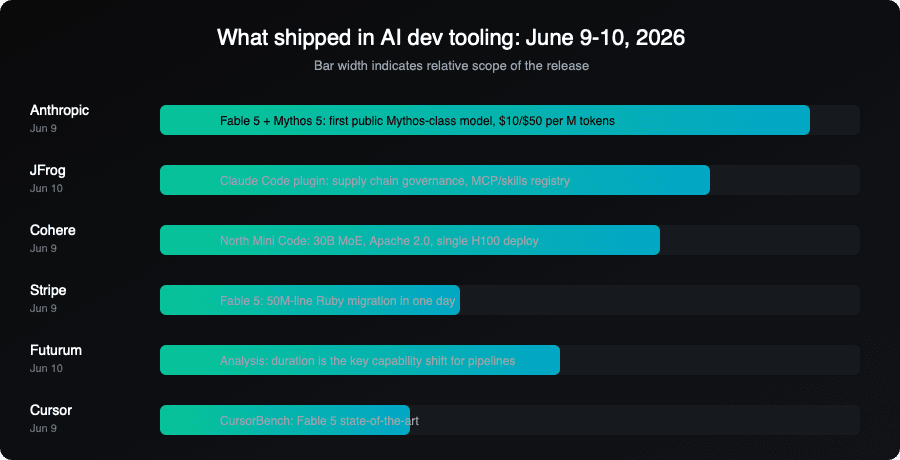
On June 9, Anthropic released Claude Fable 5, the first Mythos-class model available to all developers. Fable 5 sits above Opus in Anthropic's model tier, with pricing at $10 per million input tokens and $50 per million output tokens, less than half what Mythos Preview cost.
The model handles a 1 million token context window and can generate up to 128,000 output tokens in a single request. Stripe reported that Fable 5 completed a codebase-wide migration across a 50-million-line Ruby codebase in a single day, work that would have taken a full team more than two months. Cognition's FrontierCode evaluation ranked Fable 5 highest among frontier models, even at medium effort.
On CursorBench, Michael Truell (Cursor CEO) called it "state of the art," adding that it "opened up a class of long-horizon problems that were out of reach for earlier models." GitHub's CPO Mario Rodriguez said the model took on "complex, long-horizon coding tasks with a level of autonomy and reliability that exceeded previous benchmarks."
The safeguard catch
Fable 5 ships with safety classifiers that route flagged requests, covering cybersecurity, biology, chemistry, and distillation, to Opus 4.8 instead. Anthropic says these classifiers trigger in under 5% of sessions, but the Futurum Group's analysis flagged a real concern: AppSec work, vulnerability analysis, dependency triage, and supply chain review draw on the same reasoning the cybersecurity classifier restricts. Teams running defensive security workflows should measure their refusal rate before trusting Fable 5 inside a security-sensitive pipeline.
There is also a temporary availability constraint. Fable 5 is included on Pro, Max, Team, and seat-based Enterprise plans through June 22. After that, usage credits are required until Anthropic can add enough capacity to restore it as a standard subscription feature.
JFrog plugin: supply chain guardrails inside the agent
On June 10, JFrog released a Claude Code plugin built in collaboration with Anthropic. The plugin gives Claude Code agents governed access to JFrog's software supply chain platform, which currently manages over 18 billion artifacts, a 136% increase from the previous year.
The integration works through three layers. JFrog Platform Skills let agents execute operations like vulnerability scanning, curation checks, and provenance verification using natural language. JFrog MCP Tools provide standardized access to security, compliance, and artifact data regardless of which agent initiates the request. The plugin layer itself integrates natively into Claude Code, with Cursor and VS Code Copilot support planned.
JFrog CTO Yoav Landman put the problem plainly: "AI agents are active participants in the software supply chain, making decisions about dependencies, builds, and deployments, but most of them are doing it blind, without any supply chain context."
This is the first enterprise-grade governance layer for Claude Code. For teams building production pipelines with AI agents, the plugin addresses a gap that has been growing since agents started writing code that ships. Agents pulling in unvetted dependencies, introducing license violations, or installing packages with known vulnerabilities are not hypothetical risks. JFrog's own 2026 supply chain report warned that AI governance is failing as attacks hit record highs.
Cohere North Mini Code: open-source alternative on a single GPU
Also on June 9, Cohere released North Mini Code, a 30 billion parameter mixture-of-experts model with 3 billion parameters active per token, available under Apache 2.0 on Hugging Face.
The model targets agentic software engineering specifically: sub-agent orchestration, architecture mapping, code review, and terminal-based workflows. It supports a 256,000 token context window with 64,000 token maximum generation length. Nick Frosst, Cohere co-founder, demoed it running on a Mac Studio at around 20 GB of RAM.
Cohere trained across three different agent scaffolds (SWE-Agent, Mini-SWE-Agent, and OpenCode) and reports a 10 percentage point gain from the multi-harness approach. Artificial Analysis ranks it 8th of 127 open-weight models on output speed at 210 tokens per second.
There is a catch. The same independent testing found North Mini Code generated 75 million output tokens to complete its Intelligence Index benchmark, against a class median of 25 million. In high-volume agentic pipelines, that verbosity turns into real inference cost and latency. The model also benchmarks below Fable 5 on raw coding capability, which is the tradeoff you accept for local deployment, data residency, and no per-token billing.
Frosst framed it as an ideological choice: "small, cost effective, apache 2.0, and locally deployable" versus "large, expensive, proprietary and hegemonic." For teams that need sovereignty over their coding pipeline, or that run enough volume to make per-token pricing painful, it is a legitimate option. For teams that want the strongest model available and do not mind paying for it, Fable 5 remains ahead on benchmarks.
Why this 48-hour window matters
These three releases are not competing for the same customer. They are building different layers of the same stack.
Fable 5 raises the ceiling on what a coding agent can sustain unattended. The unit of work shifts from a single prompt to a bounded work block the agent owns end-to-end. But multi-hour autonomous runs create new problems: model provenance (a single run can produce artifacts from Fable 5 and Opus 4.8 if refusals trigger), pipeline observability (teams need to know which model generated which artifact), and security boundary management (the refusal rate on defensive security work is still unmeasured at scale).
JFrog's plugin addresses the governance gap that appears the moment agents start making real decisions about dependencies and builds. Supply chain security was already a problem before AI agents entered the pipeline. Agents that can pull packages without human review make it worse unless the governance travels with them.
North Mini Code gives teams a path to run their own coding agent infrastructure without sending code to a managed API. For regulated industries, defense contractors, and companies with strict data residency requirements, that matters more than benchmark rankings.
If you are building or evaluating AI coding pipelines right now, the practical takeaway is this: the model is no longer the bottleneck. Pipeline design, governance, and observability are. Fable 5 can run for hours, but someone needs to watch what it does. JFrog can enforce supply chain policy, but someone needs to configure it. North Mini Code can run locally, but someone needs to provision the GPU and handle the verbosity overhead. The tools arrived this week. The engineering work is just starting.
Sources
- Anthropic: Claude Fable 5 and Claude Mythos 5 (primary source, June 9, 2026)
- JFrog and Anthropic: Enterprise Supply Chain Governance for Claude Code (primary source, June 10, 2026)
- Cohere open-sources North Mini Code (VentureBeat, June 9, 2026)
- Claude Fable 5 Is Most Consequential Where Software Is Built (Futurum Group analysis, June 10, 2026)