Google Ships AI Visibility Reports, Microsoft Builds Search for Agents
Google's new Search Console AI reports and Microsoft's Web IQ grounding API both treat AI discovery as a separate problem from traditional SEO. Here is what changed and what to do about it.
By Springvanta
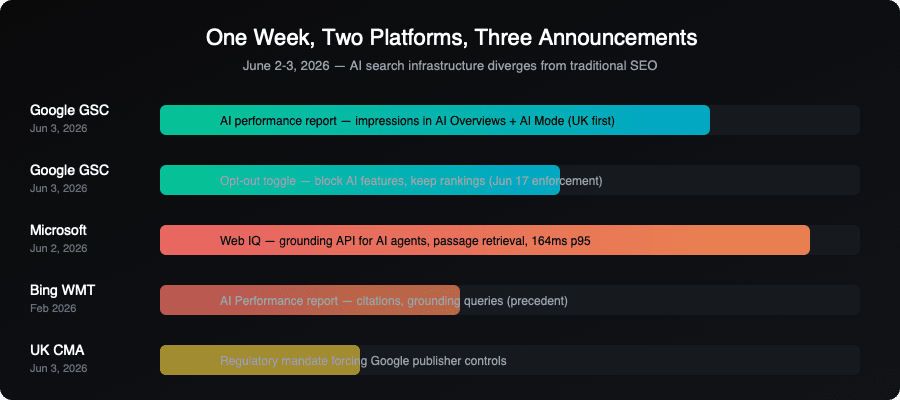
On June 2 and 3, two of the biggest search companies made moves that treat AI discovery as its own problem, separate from traditional SEO. Google shipped dedicated AI visibility reports inside Search Console. Microsoft launched Web IQ, a grounding API it calls "a search engine for AI systems." And Google added an opt-out toggle that lets you pull your content from AI Overviews without touching your regular rankings.
Taken together, the message is clear: being found by an AI agent and being found by a person scrolling search results are becoming different jobs requiring different infrastructure.
What Google shipped on June 3
Google announced two additions to Search Console. The first is a dedicated Search Generative AI performance report showing how often your pages appear inside AI Overviews, AI Mode, and AI Overviews in Discover. For the first time, you can see your AI visibility as its own metric, separate from standard organic search.
The report shows impressions, which pages appeared, countries, devices, and date ranges back to May 18, 2026. What it does not show is clicks. Barry Schwartz at Search Engine Roundtable pressed Google on this and got a familiar answer: they are "continuing to work with website owners to understand what insights will be most helpful."
The second addition is an opt-out toggle. Site owners can now choose to exclude their content from AI Overviews, AI Mode, and AI Overviews in Discover. Google confirmed the setting will not affect regular search rankings. The toggle takes effect on June 17, 2026. Opt out and you lose AI impressions and traffic from those features, but your organic positions stay put.
Both features are rolling out to a subset of UK site owners first. The UK-first timing is not a coincidence. The UK's Competition and Markets Authority imposed legally binding requirements on Google on June 3, compelling publisher controls. Google has nine months to extend full coverage across the UK, with global expansion after that.
What Microsoft shipped on June 2
One day earlier, Microsoft launched Web IQ at its Build conference. The framing is blunt: "a search engine for AI systems." Where Bing was built for humans typing queries and clicking results, Web IQ is built for AI agents that retrieve information repeatedly, reason over it, and operate inside tight latency budgets.
The technical details are worth understanding. Web IQ does not return documents. It returns passages and structured evidence objects. Microsoft's argument: models do not need web pages, they need information, and web pages are a "poor proxy" for that. Operating at the passage level concentrates useful signal while cutting token waste.
The performance claims are specific: 164ms p95 latency (nearly 2.5x faster than alternatives, tested across five data centers), higher grounding satisfaction scores on 3,000 production queries, and fewer tokens per call at equivalent quality. Web IQ already powers grounding for Microsoft Copilot and ChatGPT. It is now available in limited access to Azure customers.
Microsoft's Distinguished Engineer for Search and AI, Knut Risvik, described the project as a "major ground-up re-architecture" of the Bing stack. The indexing, retrieval, ranking, and passage selection layers were all redesigned for agents that search 5-10 times per query chain.
The opt-out decision most businesses will get wrong
The opt-out toggle will generate the most noise and the most mistakes. An early Search Engine Roundtable poll showed 33% of SEO respondents would block Google from using their content in AI features. A separate poll from Digital Applied had 41.9% staying in versus 33.2% opting out.
The problem is what the toggle does not cover. It only controls Google's AI features. It does nothing for ChatGPT, Perplexity, Gemini as a standalone app, or any other AI platform where your customers might be asking about you. Lee (2026a) found that cross-platform URL overlap is only 1.4%. Thirty-five to forty percent of queries produce zero shared cited domains across ChatGPT, Perplexity, and Gemini. Opting out of Google AI Overviews does not make you invisible to AI search. It makes you invisible to one AI search platform, while the rest keep citing you (or your competitors) however they want.
For SMBs whose customers search on Google, removing yourself from AI Overviews means removing yourself from the place where 2.5 billion monthly users are now getting answers. The toggle is built for publishers playing an attribution game, not for businesses trying to be findable.
What to actually do
Check whether you have access to the GSC AI report. UK properties are first in line. If you have UK properties, you can start measuring your AI Overviews impressions against your standard search impressions now. The data starts May 18. Compare which pages show up in AI features versus which ones drive organic clicks. The gap between those two sets tells you something about how AI search values your content.
Do not sleep on Bing. Microsoft has been building toward this for months. Bing Webmaster Tools added AI citation data in February, grounding query mapping in March, and Citation Share previews at SEO Week. Web IQ is the retrieval side of that same stack. If your customers use Copilot or ChatGPT, your visibility there depends on how well your content serves passage-level retrieval, not traditional ranking signals.
Start thinking about content as passages, not pages. Both Google's AI features and Microsoft's Web IQ extract and surface passages. A well-structured page with clear, self-contained sections that each answer a specific question will outperform a long-form article where the useful bits are buried in paragraphs of context. This is not about writing differently for AI. It is about making your content modular enough that a retrieval system can extract a useful passage without needing the surrounding context.
Google gave you a dashboard. Microsoft gave you a new distribution channel. Neither is optional if your business depends on being found.
Sources
- Google Search Central Blog: Introducing Search Generative AI performance reports in Search Console (June 3, 2026)
- Google Blog: New opportunities, control and insights for website owners (June 3, 2026)
- Search Engine Roundtable: Google Search Console AI Performance Report & AI Blocking Controls (June 3, 2026)
- Bing Search Blog: Announcing Microsoft Web IQ (June 2, 2026)
- Search Engine Journal: Microsoft Web IQ Gives AI Agents Bing Grounding APIs (June 2, 2026)
- Digital Applied: GSC AI Reports: Should You Block Google AI Responses? (June 6, 2026)
- CitedByAI: Google Just Launched AI Visibility Reports in Search Console (June 3, 2026)