Context Awareness Won: Vertical AI's Week of Proof
Ambience, iManage, and HouseWhisper proved that reading the full record beats listening to conversations. Three industries, same lesson.
By SpringVanta
Something shifted this week in vertical AI, and it wasn't another chatbot launch.
Ambience Healthcare rolled out a chart-aware inpatient AI suite that resolves 91% of documentation gaps by reading the full patient record. iManage unveiled a "Context Fabric" at ConnectLive that turns decades of legal documents into a governed knowledge layer for AI agents. And HouseWhisper crossed 7,000 agents on a platform that remembers what leads said three months ago and brings it back at the right moment.
Three different industries. Same underlying bet: the AI that wins in vertical workflows is the AI that understands context, not just conversation.
The problem with listening to conversations
Most AI tools built for professional workflows start from the same assumption: listen to what people say, and you'll capture what matters. That assumption works fine for outpatient visits where a patient describes their symptoms. It falls apart fast in more complex settings.
Ambience Healthcare published a number that stopped me. In their inpatient deployments, 70% of clinically important diagnoses had zero mention in the conversation transcript. Patients in hospitals are often sedated, cognitively impaired, or simply unable to give a reliable history. The data that actually drives documentation and care lives in lab results, medication changes, imaging reports, and prior notes. The spoken word is a fraction of the picture.
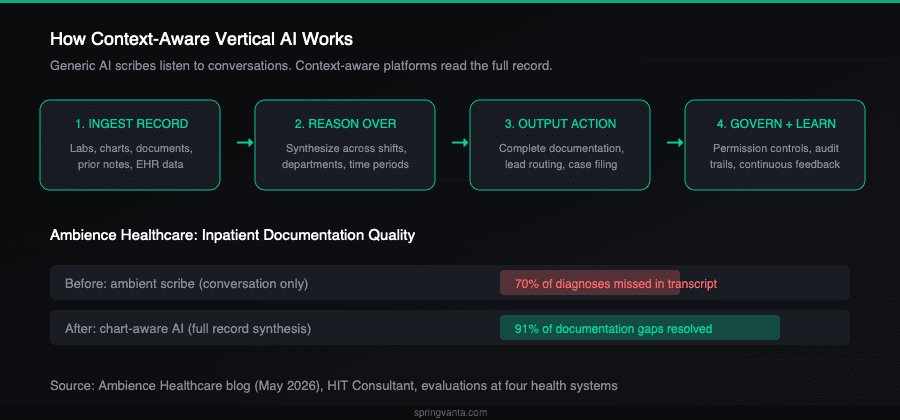
Ambience built around this reality. Their platform reads and reasons over the entire patient record: labs, vitals, medication orders, imaging, prior notes. It synthesizes across shifts and departments, not just single encounters. At four health systems they evaluated, chart-aware discharge summaries filled in 91% of information that had been missing from standard documentation.
At Saint Luke's Health System, utilization across H&P notes, progress notes, and discharge summaries topped 70%. NPS scores rose 31 points. That's more than double the typical adoption rate for ambient scribing tools in hospitals.
The legal industry's knowledge problem
Law firms have a different version of the same problem. Decades of work product, precedent, deal structures, and litigation insights sit in document management systems. Lawyers know it's there. Finding it, and making it usable by AI without creating a compliance nightmare, is the hard part.
iManage's "Context Fabric," announced at ConnectLive 2026, is their answer. It's an architectural layer that transforms accumulated documents and activity into what the company calls a "living, governed foundation" for AI agents. The fabric understands relationships between documents, tracks real-time activity, and keeps existing security and access controls intact.
The Claude integration is telling. Organizations can apply Anthropic's AI assistant to institutional knowledge within iManage's security environment. No bulk exports, no custom integrations. The MCP (Model Context Protocol) Server lets AI agents search and surface permission-aware context from governed knowledge while leaving access controls in place.
The traction numbers are hard to ignore: 83% of the Global 100 law firms use iManage. 79% of the Am Law 100. 90 new customer logos added in 2026 alone. 78% of their customer base has moved to cloud. The market for legal AI isn't experimenting. It's operationalizing.
Real estate leads have memory now
HouseWhisper takes the context idea in a different direction. Founded by Luis Poggi (former Zillow VP) and backed by Zillow co-founder Spencer Rascoff, the platform treats every lead conversation as data that compounds over time.
Their Lead Engine doesn't just capture incoming leads. It remembers conversation details and resurfaces them contextually. A lead who mentioned wanting a three-bedroom in a specific school district six months ago gets a relevant nudge when inventory matches. The Rules Engine routes leads by ZIP, price range, language, and agent availability.
Since launching in February 2025, 250+ teams and 7,000+ agents have joined. That growth rate in a notoriously slow-to-adopt industry says something about the product-market fit.
What connects these three
Here's what I find interesting: none of these platforms are competing on model quality. They're competing on context density.
Ambience wins because it reads the chart, not just the microphone. iManage wins because it turns locked-down document stores into queryable knowledge with governance baked in. HouseWhisper wins because it remembers what leads said months ago and acts on it without being asked.
The pattern is consistent across healthcare, legal, and real estate: the first wave of vertical AI was about automating single tasks (transcribe this, summarize that). The second wave is about understanding the full workflow context and acting on it.
For businesses evaluating AI intake or automation tools, the question to ask isn't "what can this AI do?" It's "what does this AI know about my workflow, and where does that knowledge come from?" If the answer is "we listen to conversations," that might work for simple intake. If the answer is "we read your entire operational record," you're looking at a different category of product.
The vendors that figured out context awareness this week aren't just shipping features. They're building moats.
Sources
- Ambience Healthcare, "Expands Chart-Aware Intelligence to Full Inpatient Workflow," blog post, May 2026
- HIT Consultant, "Ambience Healthcare Launches Chart-Aware Inpatient AI Suite to Resolve 91% of Documentation Gaps," May 29, 2026
- LawSites (Robert Ambrogi), "iManage Touts AI Momentum and a 'Context Fabric' as It Unveils Platform Overhaul at ConnectLive 2026," May 22, 2026
- Real Estate News, "HouseWhisper" coverage, May 2026