The Government Pulled Fable 5. Model Governance Stopped Being Optional.
US export control suspended Claude Fable 5 on June 12. Claude Code shipped model governance the same day. Here's what your agent stack needs now.
By Springvanta
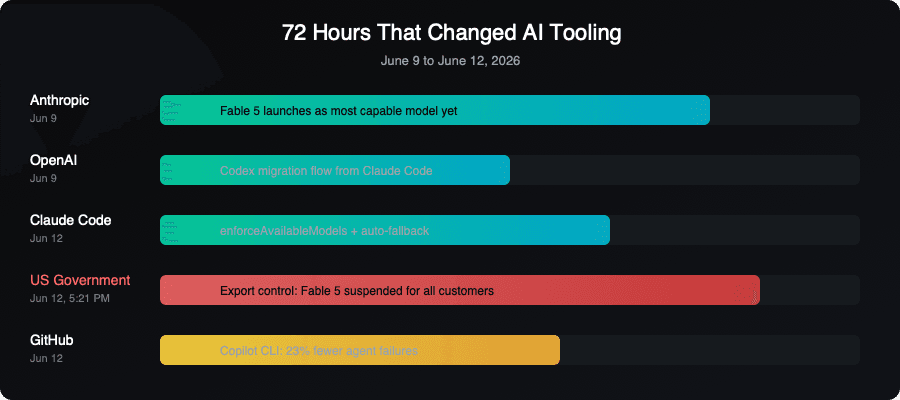
On June 12, at 5:21 PM Eastern Time, Anthropic received a directive from the US government. The directive, citing national security authority, ordered the company to suspend all access to Claude Fable 5 and Mythos 5. Not just for foreign nationals. For everyone. Three days earlier, Fable 5 had launched as the most capable model Anthropic had ever made generally available.
By that evening, it was gone. Every developer who had switched their Claude Code sessions to Fable 5 needed to switch back.
The government's concern, according to Anthropic's own statement, was a method of bypassing Fable 5's safeguards. The bypass consisted of asking the model to read a codebase and identify software flaws. Anthropic pointed out that OpenAI's GPT-5.5 and other publicly available models can do the same thing without any bypass, and that security professionals use this capability every day. They complied with the order anyway.
Anthropic called it a misunderstanding. They said if this standard were applied across the industry, "it would essentially halt all new model deployments for all frontier model providers." They apologized to customers. They said they're working to restore access.
While the Fable 5 suspension dominates the headlines, three other things shipped the same day that matter more for anyone running agents in production.
Claude Code shipped model governance the same day
On June 12, the same day the export control directive arrived, Claude Code released version 2.1.175 and 2.1.176. The timing is hard to ignore.
Version 2.1.175 added enforceAvailableModels, a managed setting that lets organizations define which models their developers can access. User settings and project settings can no longer widen an allowlist set by administrators. If your security team says Opus 4.8 only, that's what your developers get.
Version 2.1.176 fixed auto mode for Fable 5 specifically. When Fable 5 became unavailable, Claude Code would fail for organizations without Opus 4.8 enabled. The fix: automatic fallback to the best available Opus model. Claude Code also fixed a gap where environment variable overrides (ANTHROPIC_DEFAULT_*_MODEL) could bypass the allowlist entirely, and where the /fast command could toggle to blocked models.
And the VSCode extension picked up usage attribution in its /usage dialog. Teams can now see token costs broken down by skill, agent, plugin, and MCP server over 24-hour and 7-day windows. That matters because when you're juggling model availability changes, you need to know where your spend is concentrated.
This is infrastructure for a problem nobody planned for: models that disappear mid-session.
GitHub's agents learned when not to ask for help
Also on June 12, GitHub published details about an improvement to Copilot CLI's agent orchestration. They call it "smarter subagent delegation," and it's now live for 100% of production traffic.
The problem GitHub identified is one every agent platform faces: agents that delegate too eagerly. You ask for a simple change, and instead of handling it, the agent spins up a helper subagent to search the repository, waits for the result, then acts. Three steps where one would do.
The fix wasn't a new configuration option. GitHub changed how the main agent decides between handling a task directly, delegating to a specialist, or running tasks in parallel. The results from their A/B test:
- 23% reduction in tool failures per session
- 27% fewer search tool failures
- 18% fewer edit tool failures
- 5% improvement in P95 wait time
- No quality regression
When you can't guarantee your most capable model will stay online, agent efficiency matters more than raw model power. An agent that wastes calls on unnecessary delegation is burning tokens you might need to ration. GitHub's data shows that smarter orchestration, not bigger models, drove the biggest improvement in agent reliability this week.
OpenAI built a migration path from Claude Code
On June 9, the same day Fable 5 launched, OpenAI's Codex app update (version 26.608) quietly added a "Migrate to Codex" flow. It imports your setup directly from Claude Code and Claude Cowork, including during onboarding. A revamped plugins screen and marketplace came with it.
Could be coincidence. Could be OpenAI reading the room. They built a migration path from Claude Code into their onboarding flow, and when your model can be pulled by government directive with hours of notice, having that path ready is risk management, not vendor hopping.
Codex 26.609, released June 11, added rate-limit banking for Plus and Pro users, developer mode for browser use (Chrome DevTools Protocol access), and Computer Use for Enterprise customers. The rate-limit banking detail is worth noting: Plus and Pro users get one free rate-limit reset at launch, plus a referral program to earn more. OpenAI is making it easier to try Codex without committing to a plan change.
What this means if you're running AI agents in production
The Fable 5 suspension is the first time a major AI model has been pulled from commercial availability by government action.
Model availability is now an operational risk, not a product decision. Your infrastructure needs to assume that any model can become unavailable. Claude Code's enforceAvailableModels setting exists because Anthropic learned this the hard way. If you're building on any single model provider, you need fallback logic, not just preferences.
Cost visibility matters more when models rotate. Claude Code's new usage attribution, broken down by skill, agent, plugin, and MCP server, exists because when Fable 5 went offline and sessions fell back to Opus 4.8, teams needed to understand the cost implications immediately. If you don't know where your tokens are going, you can't budget for a model change.
Agent efficiency compounds under constraint. GitHub's 23% reduction in tool failures came from better orchestration, not a model upgrade. When your best model might disappear, the agents that waste fewer calls survive longer on weaker fallbacks.
Multi-vendor isn't paranoia. OpenAI shipped a Claude Code migration tool the same week Fable 5 launched and got pulled. The tools are ready. The question is whether your team has evaluated the alternatives before you need them.
The companies that handle this well will be the ones that treated model governance as infrastructure from the start, not as an afterthought triggered by a government letter at 5:21 PM on a Thursday.
Sources:
- Anthropic statement on Fable 5/Mythos 5 suspension (June 12, 2026)
- Claude Fable 5 and Mythos 5 launch announcement (June 9, 2026)
- Claude Code releases v2.1.173-177 (June 11-13, 2026)
- How we made GitHub Copilot CLI more selective about delegation (June 12, 2026)
- OpenAI Codex changelog (June 9-11, 2026)