AI Search Went Everywhere, Autonomous, and Wrong in 72 Hours
Apple shipped Siri AI with zero citation analytics. Google's AI Mode agents search without queries. KPMG pulled a report with 89% fabricated citations. Three days that broke AI search measurement.
By SpringVanta
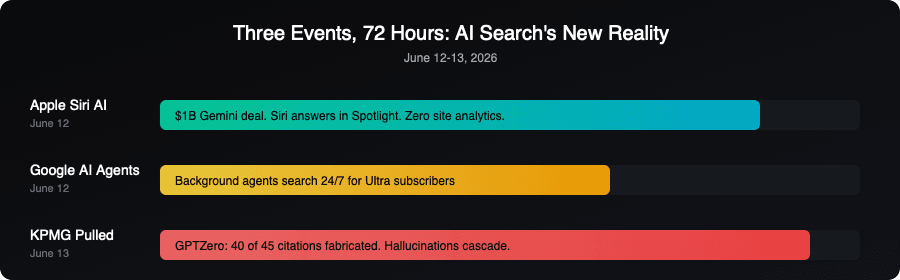
Apple is paying Google roughly $1 billion a year for a custom Gemini model to power the new Siri. WWDC announced the product this week. What Apple didn't announce: any way for website owners to know if Siri cites them.
The Applebot support page says web answers "may include links to sources." That's the entire measurement framework. No impression counts. No click tracking. No citation reports. A site could appear in Siri's answers every day, or never, and see the same data either way.
In the same 72 hours, two other things happened that make the measurement gap worse.
Google started shipping AI Mode information agents to Ultra subscribers. These agents search the web in the background, monitor topics, and push synthesized updates with links to sources. No query needed. The agent searches whether you asked it to or not.
And KPMG pulled a published report after AI-detection firm GPTZero found that 40 of 45 citations were fabricated. Organizations named as case studies (UBS, Swiss Federal Railways, Transport for London) said the claims about their AI usage were invented. GPTZero's CEO warned that false information from authoritative sources can cause "second-hand AI hallucinations" when AI search engines train on or cite the bad data.
Three properties of AI search changed at once. It went to surfaces you can't measure. It started operating without anyone asking. And it proved that what it produces can be overwhelmingly wrong, even from a Big Four firm.
Apple's black box
Siri AI generates conversational answers on "virtually any topic" by pulling current web information. It lives inside Spotlight on iPad and Mac, the search bar people already use to find files and apps. Every Spotlight search box is now a potential AI answer engine.
On iPhone, Siri sits in the Dynamic Island. The Camera app gets a Visual Intelligence mode. Conversations sync across devices through iCloud. Bloomberg reported that Apple is paying roughly $1 billion per year for a custom Gemini model of about 1.2 trillion parameters. Apple hasn't confirmed those figures.
The rollout starts as a user beta later this year, in English first. iOS 27 brings broader features this fall. The EU and China won't get it initially.
For search marketers, the problem is straightforward. Google Search Console tells you when you appear in AI Overviews. Google even added a toggle last week to opt out of generative AI features entirely. Apple gives you nothing. No dashboard. No API. No way to know if Siri ever mentions your brand.
Apple's privacy-first positioning means they may never build one. If they don't, Siri becomes the first major AI search surface where visibility is genuinely unmeasurable.
Google's agents search without you
On June 12, Robby Stein, Google's VP of Product for Search, announced that AI Mode information agents are now live for AI Ultra subscribers. These agents run in the background. You set up a topic, they monitor it across blogs, news, social posts, finance data, and shopping feeds, then deliver synthesized updates with links to sources.
The agents work in all AI Mode languages and markets. Google plans to expand to AI Pro subscribers this summer. Ultra costs $99.99 to $199.99 per month.
This shifts Google from reactive search to proactive search. Instead of waiting for someone to type a query, the agent crawls continuously and decides what's worth surfacing. Your content might be cited in an agent update that the user never explicitly searched for.
Content freshness becomes a ranking factor again. An agent monitoring a topic needs to find current information, not a blog post from 2024. If your site hasn't been updated, the agent moves on to someone who has.
KPMG and the hallucination cascade
GPTZero ran a forensic review of KPMG's October 2025 report "Total Experience: Redefining Excellence in the Age of Agentic AI." The results: 40 of 45 citations were mangled, misleading, partially fabricated, or too vague to verify. Roughly half the report's factual claims were false, unsupported, or attributed to the wrong source.
The report claimed Emirates airline adopted a chatbot named Sara that could change flights. Sara is a physical robot assistant from 2023. It cannot change bookings.
The report also cited UBS, Swiss Federal Railways, and Transport for London as agentic AI case studies. Those organizations said the claims were invented. The report even contradicted KPMG's own research, citing 55 percent of CEOs ranking AI as their top investment priority, when KPMG's own CEO Outlook from the same month said 71 percent.
KPMG pulled the report. A spokesperson told The Register: "KPMG International takes the accuracy and integrity of its published content seriously. The report has been removed and we are reviewing the circumstances surrounding its publication."
GPTZero's CEO warned that error-riddled publications from major firms can "poison the well of information." When AI search engines like ChatGPT, Gemini, or Perplexity encounter a KPMG report, they give it high authority weight. If the report contains fabricated case studies, those fabricated stories can become "facts" that AI surfaces in answers. The hallucination propagates.
This follows a pattern. Last year, Deloitte refunded the Australian government after AI-generated content slipped into a taxpayer-funded report. The consulting industry keeps warning clients about AI hallucinations while demonstrating them in its own work.
What this means for your business
Three changes hit at once:
- Discovery surfaces expanded with no measurement. Siri in Spotlight is a new AI search device on every Mac and iPad. There is no console for it.
- Search went proactive. Google's agents crawl continuously and decide what to surface without a user query. Your content needs to be fresh enough for an agent to pick up at any moment.
- The information layer is degrading. KPMG's 89 percent fabrication rate shows how quickly bad data from authoritative sources can enter the AI knowledge pipeline.
If you run a business, three things are worth doing now. Add Applebot to your robots.txt allowlist and make sure your content is crawlable. You cannot measure Siri citations, but you can ensure Applebot can read your site. Update your most important pages. Google's agents prioritize freshness, and a stale page will not surface in background monitoring. Audit what AI says about your brand across ChatGPT, Gemini, Perplexity, and Claude. If an AI answer engine is citing wrong information about you, that wrong information is now part of the training pipeline for the next round of answers.
Apple may never give you a Siri dashboard. Google's agents operate below the query layer. The information those systems surface might already be wrong. The best strategy is making your content crawlable, keeping it current, and monitoring what AI says about you across the platforms you can actually see.
Sources: Search Engine Journal, The Register, 9to5Google, Search Engine Journal, Financial Times