Google's 72-Hour AI Search Reset: What Wins, Who Clicks, Why You Stay
Google defined what content earns AI citations, GWI revealed who clicks at 50%, and the opt-out toggle went live. Three signals from one 72-hour window.
By SpringVanta
1|Three things happened between June 17 and June 19 that, taken together, tell you exactly how AI search works now. Google told website owners what content earns citations. Research showed who actually clicks through from those citations. And the opt-out toggle that was supposed to give publishers control went live.
2|
3|## What Google said in Milan
4|
5|At Search Central Live Milan on June 18, Google's team got specific about what earns visibility in AI Overviews and AI Mode. The slide that got the most attention from attendees laid it out in three words: Unique, Specific, Authentic.
6|
7|Rewarded content must be unique, meaning unrepifiable viewpoints that AI cannot synthesize on its own. It must be specific, meaning vertical case study analyses rather than broad overviews. And it must be authentic, meaning first-hand field experience. The direct quote from the presentation, as captured by attendees: "Generic guides based on rewrites or macro-rules are losing relevance."
8|
9|Glenn Gabe, an independent SEO consultant who analyzed the slides, connected this to Google's existing quality framework. The Milan guidance reinforces what Google calls "Scaled Content Abuse" penalties: programmatic text lacking proprietary data gets deprioritized. If your page says what ten other pages already say, AI search has no reason to cite it.
10|
11|Google also killed a persistent myth. Forcing paragraph "chunking" for AI optimization is useless. The official line from the Milan stage: "Content organization must follow human readability criteria." Anyone who sold you a chunking strategy was selling you nothing.
12|
13|Google also confirmed at Milan that traffic originating from AI Overview citations "registers a significantly higher dwell time." The user arrives pre-conditioned by the AI summary, already informed about the topic, and spends more time on the page when they do click. Google did not share absolute numbers, but the directional signal matches what every conversion study has shown this year.
14|
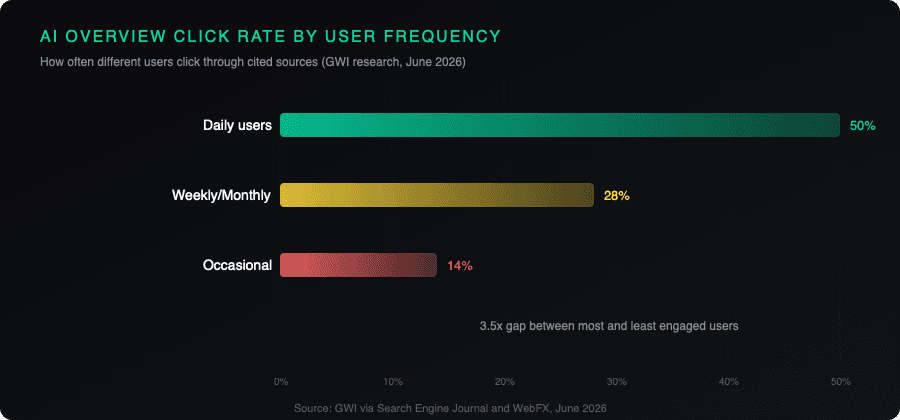
15|## Who actually clicks
16|
17|New research from GWI, a consumer survey firm whose data represents 3 billion individuals globally, breaks AI Overview click behavior into three tiers. The gap between them is wider than most marketers assume.
18|
19|Daily AI Overview users click through to cited sources 50% of the time. Weekly or monthly users click 28% of the time. Occasional users click just 14% of the time. That is a 3.5x spread between the most and least engaged users.
20|
21|GWI Senior Data Analyst Chris Beer framed it this way: younger users are "more actively evaluating AI's role in search, whether positively or negatively, while older users are more likely to remain neutral or unaffected." Daily users treat the Overview as a starting point. They compare sources before deciding where to go. Occasional users accept the summary and move on.
22|
23|The aggregate stat everyone quotes, that AI Overviews reduce organic CTR by 18%, blends three audiences having fundamentally different experiences. The 50% click rate from daily users gets averaged down by the 14% from people who rarely engage with AI features at all.
24|
25|The clicks that do come through are worth more. Ahrefs reported that AI search visitors accounted for just 0.5% of their total traffic but drove 12.1% of signups. That is 23x the conversion rate of traditional organic search. Semrush confirmed the pattern across a broader sample: AI search visitors convert at 4.4x the rate of standard organic visitors on average. WebFX analyzed 2.3 billion sessions and found generative AI-referred visitors converting approximately 1.2x higher than organic search, outperforming every other free channel.
26|
27|The pattern holds across data sources: fewer clicks, higher intent, better conversion. The volume metric that most marketing dashboards track first is the one that tells you the least.
28|
29|
The opt-out trap
30| 31|The third development is the one most publishers are quietly ignoring. On June 17, Google began enforcing the AI opt-out toggle it announced on June 3. Website owners can now block their content from appearing in AI Overviews, AI Mode, and AI Overviews in Discover. Google confirmed this will not affect organic rankings. Traditional search results stay intact. 32| 33|The toggle exists because the UK Competition and Markets Authority required it. The regulator called it a world first. Google framed it as new opportunities for site owners. The response from publishers has been cautious to hostile. 34| 35|Paul Bannister, chief strategy officer at Raptive, called the opt-out nonsensical. His take: "Giving publishers a front-end toggle for AI Overviews or AI Mode is not real control. It is Google offering publishers a light switch while keeping the power plant running." Stuart Forrest, formerly of Bauer Media, pointed out the data asymmetry: "They keep us in by default and don't give us the click data we need to know if AI search is actually hurting our business." 36| 37|One media group reported 800 million fewer Google sessions between Q1 2024 and Q1 2026. That is a real number from a real publisher. But without click-level data for AI features specifically, no one can prove those sessions went to AI summaries versus somewhere else entirely. 38| 39|The practical problem with the toggle is straightforward. Opting out of Google AI features does not opt you out of Perplexity, ChatGPT, or Claude. Those platforms continue citing and summarizing content regardless. When one publisher steps back from Google AI, competitors fill the gap. The Search Engine Land coverage noted that brands like Expedia and NerdWallet already appear in AI answers where traditional publishers once dominated. 40| 41|For an SMB or mid-market operator, the calculation is different from a publisher's. You are not selling ad impressions against pageviews. You are selling a service. If a potential client reads an AI Overview that cites your firm, and that citation brings them to your site 50% of the time because they are a daily user who treats the Overview as a starting point, you want to be in that answer. Opting out removes you from the consideration set of the highest-intent visitors. 42| 43|## What to actually do 44| 45|The Milan guidance, the GWI data, and the opt-out toggle tell a coherent story if you read them together. 46| 47|Google raised the bar on what content earns AI citations. Unique, specific, authentic content wins. Generic guides lose. The clicks that survive the AI filter convert at 2 to 23 times the rate of standard organic traffic depending on whose data you trust. And the opt-out toggle exists but functions as a trap for anyone whose business depends on being found. 48| 49|Three concrete moves for a service business: 50| 51|Audit your top 20 pages by impressions in Search Console. Flag any page with high impressions but CTR below 0.5%. Those are the pages where an AI Overview is likely answering the query before the user clicks. They need original value the Overview cannot replicate: a proprietary data point, a named case study, a step-by-step process from real client work. 52| 53|Set up a GA4 segment for AI referral traffic. Add chatgpt.com, perplexity.ai, gemini.google.com, and bing.com/chat as referral sources. Compare conversion rates against your organic baseline over 60 days. If AI-referred visitors convert at 2x or better, that is your argument for investing in citation visibility. 54| 55|Do not touch the opt-out toggle. The cost of being absent from AI answers is higher than the cost of being present with imperfect attribution. Competitors will take your slot. 56| 57|--- 58| 59|Sources: 60|- Google Search Central Live Milan coverage, Barry Schwartz, Search Engine Roundtable, June 19, 2026 61|- AI Overview Traffic Quality: Fewer Clicks, More Value, Thaakirah Abrahams, WebFX, June 19, 2026 62|- Google's AI Opt-Out Gives Publishers a Lever They Fear to Pull, Emma Rogers, WebProNews, June 18, 2026 63|- Search Generative AI performance reports announcement, Google Search Central Blog, June 3, 2026 64|- AI search traffic conversions, Patrick Stox, Ahrefs 65|