$112M Split Voice AI Into Three Layers in 72 Hours
Bland, Respond.io, and Konecta each raised or launched in the same 72-hour window. Each is betting that depth in one layer of CX AI beats the one-platform approach.
By SpringVanta
$112 million and three companies walked into the same week. They're solving the same problem from angles that don't overlap.
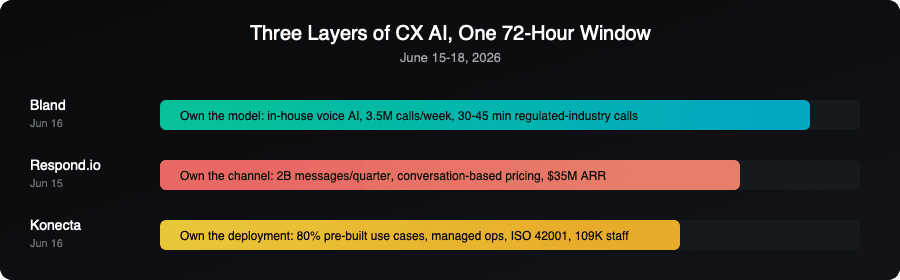
Bland raised $50 million Series C on June 16 to handle the phone calls nobody else can touch: 30-to-45-minute conversations in healthcare and financial services where a wrong answer has consequences. Respond.io raised $62.5 million Series B on June 15 to own the channels where B2C customers actually live (WhatsApp, Instagram, TikTok, not email or phone trees). And Konecta, a EUR 2 billion CX operator with 109,000 employees, launched Kolibri on June 16 to solve the gap that kills most CX AI projects before they see production.
All three think the "one platform does everything" approach has failed. Each is betting that depth in a single layer beats shallow coverage across all of them.
Bland: own the model, own the call
Most voice AI startups wrap an API around someone else's foundation model and call it a platform. Bland builds its own models in-house and refuses to let customers swap in third-party alternatives. "We are one of one in that sense," CEO Isaiah Granet told Fortune. The pitch to customers is blunt: this is what you use, and we own the result.
That model ownership matters because of the calls Bland targets. A typical interaction runs 30 to 45 minutes. In healthcare, that might mean walking an elderly patient through using a blood pressure cuff, interpreting the reading, and deciding whether to escalate to emergency services. The conversation shifts constantly and never follows a script.
"They're not linear," Granet said of the calls. "They're meandering. They require judgment. That's where the real work is."
Because the models are proprietary, Bland can tune directly for voice constraints: latency, interruption handling, ambiguity, context continuity across a long call. These are treated as core system requirements, not edge cases bolted on after deployment.
The scale is real. Bland handles more than 3.5 million calls per week and processed over 175 million AI calls last year. It has 250-plus enterprise customers including Samsara, Kin Insurance, and CNO Financial Group. The $50 million round was led by Dell Technologies Capital, with participation from HubSpot Ventures. Angels include Affirm's Max Levchin, Twilio founder Jeff Lawson, and ElevenLabs CTO Piotr Dabkowski.
180 investors passed on Bland during its Y Combinator days, most convinced phone calls were on the way out. That bet looks wrong. Voice carried 20 billion minutes of traffic daily on Jio alone (announced the same week), and the calls Bland handles are the ones that cannot move to chat or email.
Respond.io: own the channel, own the conversation
If Bland bets on voice depth, Respond.io bets on channel breadth. The Kuala Lumpur-based company processes 2 billion messages per quarter across WhatsApp, Instagram, TikTok, Messenger, Line, Telegram, WeChat, voice calls, and web chat. It just closed a $62.5 million Series B at $35 million ARR, growing 169 percent year-over-year, with a 30 percent profit margin.
CEO Gerardo Salandra describes the target customer as "high-consideration" businesses where people need to talk to someone before buying: healthcare, automotive, retail, education, travel. "You don't go to a website, put your credit card, and buy a car; you chat with someone, you ask a lot of questions," he told TechCrunch.
The structural advantage Respond.io claims is pricing. Enterprise CX platforms typically charge per seat, which means they lose revenue when AI handles conversations instead of humans. Respond.io charges by conversation volume, so whether a human or an AI answers is irrelevant to the bill. "When fewer humans use your product, they make less money," Salandra said. "But we don't charge like that."
Salandra also points to what incumbents missed. "The platforms that exist, they bolted on messaging as a second thought. They're very email focused, they're very call focused, but when it comes to messaging, it's an afterthought." That gap gave Respond.io nine years to build a data flywheel: more messages produce better AI, which attracts more customers, who generate more messages.
The company plans to use the funding for acquisitions in North America and Europe, where it currently generates just 20 percent of revenue but sees its fastest growth. Salandra's stated end goal: "Ringing the bell at Nasdaq."
Konecta: own the deployment, own the outcome
Bland owns the model. Respond.io owns the channel. Konecta owns the operational layer that sits between AI tools and production-ready customer operations.
Konecta is not a startup. It employs 109,000 people across 28 countries, reports EUR 2 billion in annual revenue, and resolves more than 1 million customer interactions daily. On June 16 it launched Kolibri, an agentic AI orchestration platform designed to move CX projects out of what CEO Nourdine Bihmane calls "pilot purgatory."
"We have watched hundreds of AI projects fail, not in the demo, but on the way to production," Bihmane said. "The gap is never the technology. It is the absence of operational knowledge: what regulated industries actually require, how real customer interactions actually behave, where the edge cases live."
Kolibri ships with use-case libraries that are 80 percent pre-built: billing management, claims handling, appointment booking, collections, returns, order tracking, email triage. The remaining 20 percent gets tailored to each client's systems and workflows. The platform can orchestrate tools from Google Cloud, ElevenLabs, Uniphore, CrewAI, NICE, and Salesforce, with an open architecture that lets clients switch models or providers without rebuilding.
The deployment model is what sets it apart from pure software vendors. Konecta runs the platform alongside the client rather than selling a license and walking away. "We have skin in the game in a way that a pure technology vendor never does," Bihmane said. Each decision is logged and auditable in real time. The platform sits within an ISO 42001-certified AI management framework, which matters for banks, telcos, and insurers that need compliance documentation.
Pricing follows the same logic: per business use case, not per agent or per token. Built-in FinOps dashboards show token consumption and compute costs in real time, letting organizations route routine workloads to cheaper models.
Why the split matters
The three-layer split maps to a real buying problem. If you operate in healthcare or financial services and your hardest calls last 30-plus minutes, you need model-level control over latency, interruption, and compliance. Bland's in-house approach gives you that; an API wrapper does not.
If your customers live on WhatsApp and Instagram DMs, you need a platform built messaging-first, not a phone-and-email tool with chat bolted on. Respond.io's conversation-based pricing means you are not penalized for automating more.
If you are a regulated enterprise with 109,000-person operational complexity, you need someone who has already seen the edge cases and will run the system with you. Konecta's 25 years of CX operations, ISO 42001 certification, and per-use-case pricing reflect that.
The companies raising money in this space are no longer trying to be everything. They are picking a layer and going deep. That is a healthier signal for buyers than another "AI-powered customer experience platform" press release, because it means you can evaluate vendors by what layer they actually own rather than what their demo looks like.
Sources: Bland Series C announcement, SiliconANGLE, The Next Web, TechCrunch on Respond.io, SecurityBrief on Konecta Kolibri, Konecta press release