Google's AI Search Overhaul Is Two Weeks Old and Already Fracturing Its User Base
Four developments in 72 hours reveal the cracks in Google's AI-first search strategy: spelling failures, mid-search popups, a 30% DuckDuckGo spike, and Pichai admitting r
By Springvanta
Two weeks after Google's I/O 2026 keynote, where Sundar Pichai called the search box overhaul "the biggest change in 25 years," the backlash has its own momentum. Four separate developments landed in the same 72-hour window, each one amplifying the others.
Google's AI Overviews started misspelling its own company name. A mid-search popup began interrupting standard results to push users into AI Mode. DuckDuckGo saw a 30% install spike from users looking for an AI opt-out. And Pichai himself, sitting across from Nilay Patel on the Decoder podcast, looked at a search result on his phone and said it was "probably more opinionated than it should be."
Any one of these is a speed bump. Together they tell a story about what happens when you move faster than your users want.
AI Overviews can't spell "Google"
After the I/O overhaul went live, AI Overviews started confidently telling users there are two P's in "Google," that "journalism" has an extra 'd' (j-o-u-r-n-a-d-i-s-m), and that the US president's surname is "t-r-p-u-m." The screenshots went viral within hours.
Google told TechCrunch it's "aware of the issue and working on a fix." But researchers say this isn't patchable in the usual sense. The problem is tokenization: transformer models break text into numerical chunks, not letter sequences. A model might encode "Google" as a single token representing the brand concept without knowing it's spelled G-o-o-g-l-e. Ask it to count letters, and it reconstructs an answer from statistical probability.
Matthew Guzdial, an AI researcher at the University of Alberta, put it plainly: "LLMs are based on this transformer architecture, which notably is not actually reading text. When it sees the word 'the,' it has this one encoding of what 'the' means, but it does not know about 'T,' 'H,' 'E.'"
Sheridan Feucht, a PhD student at Northeastern studying LLM interpretability, told TechCrunch there's probably "no such thing as a perfect tokenizer." The errors feel random because they are random in a sense: the model is guessing at letter-level information it was never designed to retain.
A misspelled brand name is funny. An incorrect dosage or legal citation delivered with the same confidence is less funny. Google's previous AI Overview stumbles included suggesting users add glue to pizza and eat one small rock per day, sourced from satirical Reddit posts. Same structural problem, higher stakes.
Google is now interrupting your search to sell you AI Mode
Separately from the spelling issues, Google has started showing a popup inside standard search results that interrupts the page mid-session and asks users to switch to AI Mode. The dialog reads "Learn complex concepts with AI Mode," with two buttons: "Not interested" and "Continue."
DigitBin tested it across 11 queries on both Android and desktop Chrome. The trigger is specific: multi-step comparisons, technical schema questions, and research topics where Google was already serving an AI Overview alongside standard results. Simple lookups and news queries didn't trigger it at all.
The popup appears two to three seconds after results load, overlaying them. Clicking "Continue" replaces your standard results with a Gemini-generated response in the same tab. Clicking "Not interested" dismisses it for that session, but it reappears on similarly structured queries later. There's no documented permanent opt-out.
Google hasn't published official documentation for this popup or its rollout. It wasn't announced at I/O. It appears to be a quiet nudge coinciding with the Gemini 3.5 Flash upgrade, pushing users who haven't adopted AI Mode into the conversational interface.
For businesses tracking how users discover them through search, this matters. If your pages rank well in standard results but your audience keeps getting interrupted by a popup that replaces those results with an AI-generated summary, your organic visibility depends on what the AI decides to cite, not where you rank.
DuckDuckGo installs jumped 30% in a week
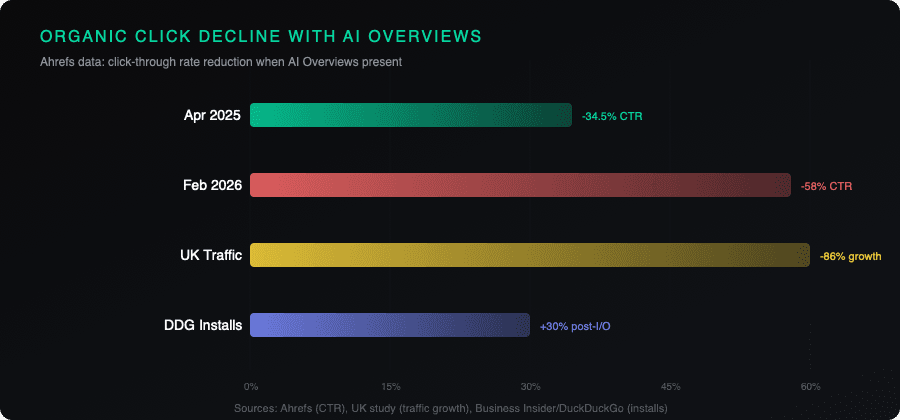
The timing of these issues, landing right after the I/O overhaul, drove measurable user flight. DuckDuckGo told Business Insider that US installs of its app were up 20% overall in the week after Google's announcement, and up 33% for iOS users. Visits to its noai.duckduckgo.com page, where AI is disabled by default, were up more than 20%.
DuckDuckGo CEO Gabriel Weinberg issued a statement: "Google is force-feeding AI with no way to opt out. We want to be the place that puts users in charge and allows them to decide how much or how little AI they want."
Google's position is that you can filter AI results out by going to "More" at the top of the page and selecting "Web." That option exists on desktop. On mobile, it's sometimes available but buried. Most users don't know it's there. A Google representative pointed TechCrunch to the option after the backlash, but it's a few levels deep in an interface that billions of people use without ever changing settings.
For what it's worth, DuckDuckGo's surge is a blip in absolute terms. Google still handles roughly 90% of search traffic worldwide. But the signal direction matters: this is the first measurable post-I/O data point showing users actively leaving rather than passively accepting.
Pichai concedes the point
On the Decoder podcast, recorded May 26, Nilay Patel showed Pichai a search result for "best Chromebook" that he'd been tracking for years. The result opened with an AI Overview giving a confident recommendation, followed by sponsored boxes, then an organic Reddit result with a different answer, then a news publication with a third.
Pichai looked at it and said the result was "probably more opinionated than it should be."
That admission is worth pausing on. The CEO of the company that just bet its flagship product on AI-generated answers is publicly conceding that those answers carry editorial weight they shouldn't. He suggested the result might have been personalized for Patel's browsing patterns, which Patel pushed back on: infinitely personalized results producing inconsistent experiences at scale is the same problem framed differently.
Pichai also didn't dispute the broader traffic trend. When Patel brought up Conde Nast CEO Roger Lynch's instruction to his teams to plan as though search traffic doesn't exist, Pichai said publishers understand their own businesses better than he does. He committed to reflecting high-quality content but didn't argue with the direction of the numbers. That's notable because the numbers are harsh: Ahrefs research found AI Overviews correlate with a 58% reduction in click-through rates as of February 2026, nearly double what they measured in April 2025. A UK study of 800 companies found an 86% collapse in organic traffic growth after AI Overviews and AI Mode deployed.
What this means for businesses that depend on search visibility
These four stories converge on one practical question: if Google is pushing AI-generated answers to 2.5 billion monthly users, and those answers are sometimes wrong, sometimes unwanted, and always displacing the organic results your business depends on, what do you do?
First, understand that the AI Mode popup is a traffic reallocation mechanism. Every time a user clicks "Continue," their standard results vanish and are replaced by a Gemini response. If your page ranked first, you're now visible only if the AI chooses to cite you. Your SEO position doesn't disappear, but its value depends on an intermediate layer you don't control.
Second, the tokenization failures are a reminder that AI answers carry the same confidence whether they're right or wrong. There's no confidence meter, no uncertainty flag. If you're in a regulated industry (healthcare intake, legal services, financial advisory), your AI search strategy needs to account for the possibility that the AI will cite you incorrectly with total assurance.
Third, the DuckDuckGo spike is small but directionally important. A non-trivial number of users are seeking alternatives, and the alternatives are positioning themselves as AI-free zones. If your audience includes the kind of people who install alternative search engines, your visibility strategy should include those surfaces too.
Fourth, Pichai's admission that results can be "too opinionated" is the strongest signal yet that Google knows the current balance isn't right. The company will iterate. But the iteration cycle runs on engagement metrics, not publisher health. Your traffic will be corrected after Google's data tells it to correct, not before.
The businesses that treat AI search visibility as a budgeted discipline in 2026, with the same rigor they apply to paid search and email, will compound an advantage the rest will pay to catch up to. That means structured content, clean schema, direct answers to the questions your customers actually ask, and monitoring what AI Mode actually cites when it answers queries in your category.
Sources
- Google's AI Search Can't Spell Google - RelveHQ, May 30, 2026
- Google's AI Mode Popup Appears for Some Searches — We Tested It - DigitBin, May 31, 2026
- Google's AI-First Overhaul Annoys Users So Much They Are Actually Switching Search Engines - Inc., May 30, 2026
- Pichai on Google Zero, AGI timeline, and a Search he admits is too opinionated - PPC Land, May 31, 2026
- A new era for AI Search - Google Blog, May 19, 2026