Google killed Gemini CLI. Cursor answered with a $0.07 agent.
Google killed free Gemini CLI after 6,000 community PRs. The same week, Cursor hit frontier benchmarks at $0.07/task. The coding agent market is splitting in two.
By Springvanta
On May 19, Google announced it is shutting down free access to Gemini CLI. The open-source AI coding agent, released under Apache 2.0 last June, accumulated over 100,000 GitHub stars and more than 6,000 merged pull requests from external contributors. On June 18, it stops working for everyone who isn't an enterprise customer.
The replacement is Antigravity CLI, a closed-source tool whose GitHub repository contains a changelog, a readme, and a demo GIF. No source code. Google's own announcement admits "there won't be 1:1 feature parity right out of the gate." Usage quotas are tighter. The binary wasn't even available on npm or Homebrew two days after launch.
Enterprise customers keep Gemini CLI alongside Antigravity access. The consolidation Google frames as a "technical imperative" for free users is optional if you pay.
What contributors actually built
Hundreds of developers contributed substantial code to Gemini CLI over eleven months. Andrea Alberti had a 27-commit pull request merged the same day Google announced the shutdown. In the GitHub discussion thread, Alberti asked the obvious question: were contributors "essentially working for free on a code base that will only be used in enterprises?"
Christine Hall, writing at FOSS Force, called it "a new twist on a game that's become increasingly common." The Apache 2.0 license remains intact. The repository stays public. But a license governs code, not infrastructure. Without Google's backend serving requests, the codebase is a museum piece. Running a functional fork requires independent access to a compatible large language model. That is not a weekend project.
Developers have a name for this pattern: open-source release to attract labor, community builds the product, enterprise captures the value, community gets a closed replacement with tighter quotas.
The same week, the opposite signal
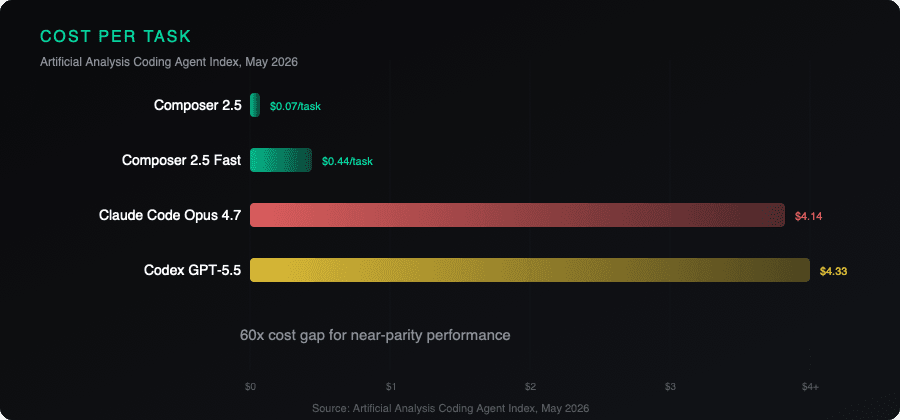
Cursor released Composer 2.5 the same week. It placed third on the Artificial Analysis Coding Agent Index with a score of 63, behind Claude Code with Opus 4.7 at 67 and Codex with GPT-5.5 at 65. The cost difference is where it gets interesting: Composer 2.5 standard runs $0.07 per task. Claude Code Opus 4.7 Max costs $4.14. Codex GPT-5.5 XHigh costs $4.33. That is 10x to 60x cheaper for near-parity performance.
Composer 2.5 is built on Moonshot AI's open-weight Kimi K2.5, with Cursor reporting that 85% of compute went to its own post-training and reinforcement learning. It scores 79.8% on SWE-Bench Multilingual, within a point of Opus 4.7 at 80.5%. On Cursor's own CursorBench v3.1, it edges past Opus 4.7 at default settings.
Also this week, Gartner published its first Magic Quadrant for Enterprise AI Coding Agents. OpenAI and GitHub both landed in the Leaders quadrant. GitHub placed highest in ability to execute. OpenAI highlighted that Cisco used Codex to build most of its AI Defense security platform, compressing delivery from several quarters to weeks. The enterprise tier of coding agents is consolidating fast.
Two markets forming
These three stories, all landing in the same week, tell you where coding agents are headed. The market is splitting.
On one side: enterprise platforms with frontier models, governance controls, audit trails, and per-task costs from $4 to $11. GitHub Copilot serves 140,000 organizations. Codex has 4 million weekly users. This is where Gartner issues reports and procurement teams evaluate vendors.
On the other: independent tools built on cheap or open models, running at a fraction of the cost, with fewer enterprise controls but pricing that makes long agent sessions viable. Cursor sits at the Pareto frontier here. So does Claude Code paired with Sonnet instead of Opus, or open-source agents on locally hosted models.
The Google episode is a warning about what happens when a vendor straddles both sides and decides you belong in the expensive one. The license said open source. The infrastructure said otherwise.
What to do before June 18
If your team uses Gemini CLI on a non-enterprise tier, you have four weeks. Migration options: Antigravity CLI (closed-source, tighter quotas), Claude Code, GitHub Copilot CLI, or self-hosted alternatives.
If you are evaluating coding agents for the first time, the decision is clearer than it was a month ago. Regulated environments where governance and audit trails matter should look at GitHub Copilot and Codex. Teams that prioritize cost and are comfortable managing their own risk should look at Cursor or Claude Code with Sonnet. The trade-off is straightforward: compliance checkboxes versus per-task economics.
What does not work is assuming an open-source license protects you from vendor lock-in. Google just showed that when the tool depends on a cloud backend, the license is decorative. The question that matters is who controls the infrastructure that makes the tool run.
Sources: