Plan for zero search traffic: what Ahrefs, Condé Nast, and Google agree on
Ahrefs proved schema doesn't cause AI citations. Google killed FAQ rich results. Condé Nast is planning for zero search traffic. Here's what SMBs should do about it.
By Springvanta
Three things happened this week. None got much attention on its own. Taken together, they tell you where search is headed.
Ahrefs proved schema doesn't cause AI citations
Ahrefs ran a proper study. They tracked 1,885 pages that added JSON-LD schema between August 2025 and March 2026 and matched them against 4,000 control pages. Zero statistically significant uplift in AI citations on any platform. Google AI Overviews actually showed a 4.6% decline for pages that added schema versus controls.
The correlation is real. Schema markup appears on 53% of AI-cited pages. But Ahrefs attributes that to site quality, not the markup. Better-maintained sites publish stronger content, build more links, and happen to use structured data. The schema didn't cause the citations. The quality did.
This is worth pausing on. "Add schema for AI visibility" has been the most repeated GEO advice of the past year. Ahrefs just showed it doesn't work.
Google killed FAQ rich results
On May 7, Google deprecated FAQ rich results. Those expandable Q&A dropdowns that used to double your SERP real estate are gone. Search Console reporting disappears in June. The API follows in August.
This had been dying since 2023, when Google restricted FAQ rich results to government and health sites. FAQ visibility dropped from 53.94% of eligible pages to 17.04%. More than 82% of pages carrying FAQ schema lost the feature entirely. The May 2026 update just finished the job.
Google didn't remove FAQPage as a schema type. The markup is still valid. But the visibility incentive that drove millions of websites to bolt FAQ sections onto every page is gone.
The SEO industry's reaction was what you'd expect: frantic posts about whether to delete the markup. The better question is whether your FAQ content was ever written for a person.
Condé Nast told its brands to plan for zero search traffic
Condé Nast CEO Roger Lynch said the thing nobody in media wanted to say out loud. After three straight years of internal forecasts underestimating actual search traffic declines, he told his teams to plan as if search traffic is zero.
This is the company behind Vogue, The New Yorker, Wired, GQ, and Vanity Fair. Domains with domain authority scores most businesses will never reach. If a media conglomerate with that kind of authority can't count on Google, the rest of us should pay attention.
Lynch described a barbell effect in his portfolio. Large authoritative brands and small niche publications are holding ground. The ones getting squeezed sit in the middle: big enough to need traffic, not authoritative enough to earn it without trying.
A Reuters Institute survey of 280 senior media leaders across 51 countries backs this up. Publishers expect search traffic to fall more than 40% over the next three years.
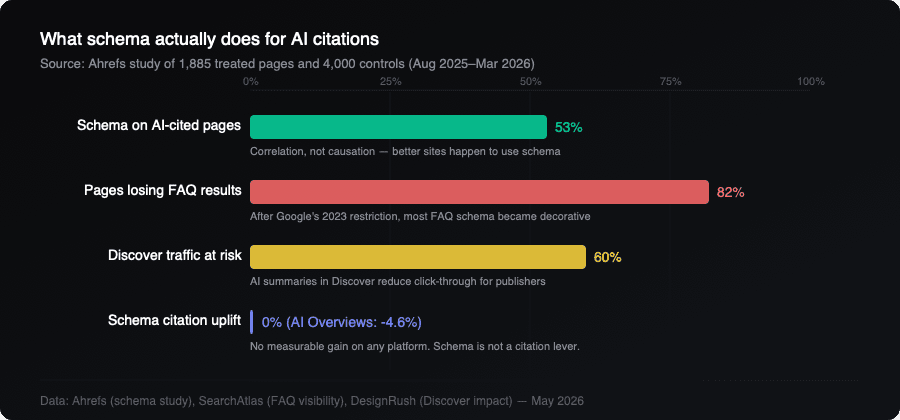
The Ahrefs study found no measurable AI citation uplift from schema markup. AI Overviews showed a 4.6% decline relative to controls. Schema appears on 53% of cited pages, but Ahrefs attributes this to site quality, not the markup itself.
What connects these stories
The Ahrefs study says: the technical lever you were told to pull doesn't work.
The FAQ deprecation says: Google is removing the last publisher-controlled SERP features.
The Condé Nast directive says: even the biggest brands shouldn't assume search traffic exists.
The thread connecting them is that visibility in AI-era search is no longer about optimizing pages. It's about being an entity that AI systems recognize, parse, and trust.
Donna Rougeau, writing in Search Engine Land this week, audited 19 businesses in Prince Edward Island. She found the same problem in every single one: deep expertise buried in content that AI systems couldn't interpret. Technical specs locked in PDFs. Venue details hidden behind forms. Supply chain information written as marketing copy instead of structured data points.
Her line that stuck with me: "If you're optimizing for LLM responses, you're already too late. Appearing in an LLM's output is a symptom of authority, not the source of it."
What to do this month
Cyrus Shepard analyzed 54 experiments and studies on AI citation factors. His takeaway: "Win SEO, win AI citations (most of the time, with extra steps)." The top signals still align with traditional SEO fundamentals. The difference is that the baseline has moved.
Three things worth doing right now:
Export your FAQ performance data from Search Console before June. The report disappears then. You'll want the historical data.
Audit your five most important pages for machine-readability. Open each one and ask: could an AI system extract the key facts without guessing? If your pricing, capabilities, or service area are buried in paragraphs of marketing copy, they're invisible to citation engines.
Invest in content authority, not content volume. The Ahrefs data is clear: the pages that get cited have strong editorial signals. Not the most schema. Original reporting, proprietary data, and expert analysis are what AI systems surface.
The Condé Nast directive sounds extreme. Plan for zero search. But that framing is useful for any business, not just publishers. Not because search is disappearing tomorrow, but because search is becoming a byproduct of authority rather than a faucet you can optimize open. The companies investing in making their expertise parseable and citable now are the ones AI systems will reference when the referral landscape finishes shifting.
Sources:
- Ahrefs schema and AI citations study
- Google FAQ structured data deprecation notice
- DesignRush SEO roundup: FAQ deprecation, schema study
- Search Engine Land: What makes a brand machine-readable
- Cyrus Shepard: AI citation ranking factors
- Reuters Institute: Journalism, media, and technology trends 2026
- SearchAtlas: FAQ rich results analysis