Google Rewrites Search: The I/O 2026 Overhaul That Changes Visibility Forever
Google I/O 2026 brought an AI search box, 24/7 agents, and generative UI to Search. What the biggest change in 25 years means for your website visibility.
By Springvanta
At Google I/O 2026, the company announced what VP of Search Liz Reid called the biggest change to its search box in over 25 years. The update is not cosmetic. It repositions Google Search from a directory of links into an AI-powered assistant that synthesizes answers, monitors the web around the clock, and builds interactive applications on demand.
For businesses that depend on organic search traffic, the implications are structural. Here is what changed and what it means for your visibility strategy.
The Intelligent Search Box
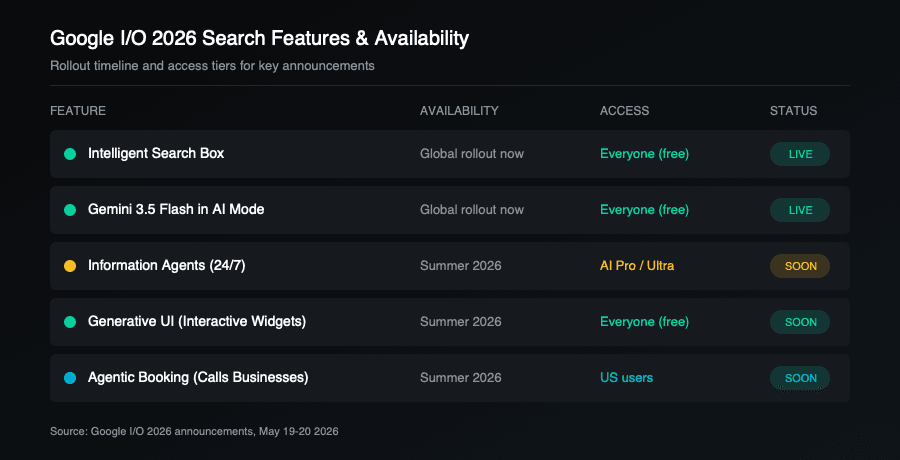
The redesigned search box expands dynamically as you type longer, more conversational queries. It accepts text, images, files, videos, and open Chrome tabs as input. AI-powered suggestions appear as you type, going beyond traditional autocomplete to guess your intent using context from your Google account.
The key shift: asking a follow-up question from an AI Overview now routes you directly into AI Mode, Google's chatbot-like search experience. VP of Product Robby Stein told The Verge that users will "reliably" see AI Overviews for natural-language questions. The traditional list of blue links is not gone, but you have to actively select the "Web" tab to see it.
Gemini 3.5 Flash Powers Everything
AI Mode now runs on Gemini 3.5 Flash globally. Google says the model delivers "sustained frontier performance for agents and coding" and is four times faster than comparable frontier models. This upgrade enables the new generative features, including real-time interactive visualizations that appear directly in search results.
The model also powers a new conversational flow. You can move from an AI Overview into a full AI Mode conversation without losing context, making the boundary between search results and chatbot nearly invisible.
Information Agents: Google Searches for You
Starting this summer, Google AI Pro and Ultra subscribers can set up "information agents" that operate in the background 24/7. These agents scan blogs, news sites, social posts, and real-time data sources like finance and sports, alerting you when conditions you defined are met.
Google's examples range from apartment hunting to tracking sneaker drops. For businesses, this means a new layer of discovery: your content could surface inside an agent's synthesized update without the user ever running a manual search or visiting your site.
Generative UI and Mini-Apps
Search can now build interactive widgets and custom applications on the fly. Ask about black holes and you might get a live simulation with sliders. Ask Search to plan a family outing and it can create a dashboard with event suggestions, map embeds, and calendar integration.
The generative UI capability will be free for everyone this summer. Custom mini-apps built with Google Antigravity will launch first for AI Pro and Ultra subscribers in the US.
Agentic Booking Expands
Google is expanding its AI-powered booking feature to include local experiences and services. In categories like home repair, beauty, and pet care, Google will call the business on your behalf to schedule an appointment. This rolls out to all US users this summer.
What This Means for Your Visibility
The data points framing this shift are striking. According to Semrush, 93% of AI Mode sessions end without a click to any external website. AI Overviews now reach 2.5 billion users. AI Mode has surpassed 1 billion monthly users, doubling every quarter.
The old contract between Google and content publishers was straightforward: create useful content, earn a ranking, receive a click. That contract is being rewritten. Visibility inside AI-generated answers is replacing the click-through as the primary value proposition. As Ars Technica reported, organic results are increasingly positioned as "footnotes" rather than the core of the search experience.
For businesses evaluating AI automation, this creates a clear imperative: your content strategy needs to account for citation inside AI answers, not just traditional ranking. Structured, fact-based content that demonstrates expertise is more likely to be synthesized into an AI Overview than generic pages optimized solely for keywords.
What to Do Now
Three practical steps for the current :
-
Audit your AI visibility. Search for your key terms in Google AI Mode, ChatGPT, and Perplexity. Note whether your content appears as a cited source or is synthesized without attribution.
-
Structure content for citation. AI systems favor content that clearly states facts, answers specific questions, and signals authority through expertise markers. Listicles, comparison tables, and step-by-step guides are disproportionately represented in AI citations.
-
Monitor the agent layer. Information agents create a new discovery surface. Content that addresses ongoing needs, like monitoring market conditions or tracking product availability, is more likely to surface inside agent notifications.
The search box that billions of people use daily is becoming an AI interface. The businesses that adapt to citation-centric visibility, rather than click-centric metrics, will be the ones that remain discoverable.
Sources: