Marketing Automation Is Now an Agent Operating Layer
Marketing automation returns $5.44 per dollar spent, 28% of mid-market teams are switching for AI agents, and $300M+ has flooded into AI-native CRM platforms. The cate...
By Springvanta
The marketing automation platform you bought three years ago is not the tool you are using today. It is becoming something else entirely: an operating layer where AI agents compose, monitor, and optimize campaigns on your behalf.
The data is unambiguous. According to the Digital Applied marketing automation statistics collection, which consolidates 130+ verified data points from HubSpot State of Marketing 2026, Marketo benchmarks, Forrester Wave, and G2 grid surveys, marketing automation in 2026 delivers an average $5.44 return per dollar spent, with top-quartile programs exceeding $8.70. Mid-market adoption has reached 78 percent. The category has crossed from a productivity tool into a near-default operating layer for B2B revenue teams.
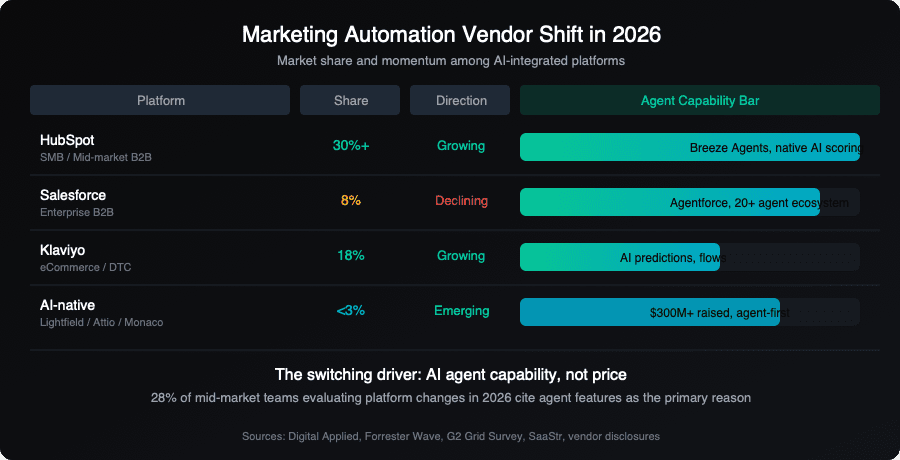
The Switching Signal: Agent Capability, Not Price
The most telling statistic in the entire collection is this: 28 percent of mid-market teams report evaluating a platform change in 2026, the highest figure since 2019. The primary driver is not cost. It is AI agent capability.
This lines up with what SaaStr founder Jason Lemkin described in his CRM analysis: SaaStr now runs 20+ AI agents connected to Salesforce as the central data hub. The agents handle outbound campaigns (Artisan, Monaco), inbound qualification (Qualified, with 71% of closed-won deals coming from AI-qualified leads in one month), call transcription (Momentum, Attention), and warm lead win-backs (Agentforce, with a 72% open rate on contacts previously considered dead). SaaStr now pays more for its AI agents than for Salesforce itself.
The CRM that becomes the hub for AI agents wins. The one that does not becomes a database you are overpaying for.
Where the Platform Shift Is Heading
HubSpot leads the broader marketing automation market at 30%+ share, with Breeze Agents now natively embedded for AI scoring and campaign optimization. Salesforce Account Engagement (formerly Pardot) holds 8% and is declining as enterprise buyers migrate toward integrated revenue platforms. Klaviyo commands 18% of the eCommerce vertical. Adobe Marketo Engage sits at 12%, flat.
But the real story is the new entrants. AI-native CRM platforms that did not exist two years ago have collectively raised hundreds of millions of dollars:
- Lightfield has 2,500 companies signed up in three months, 100+ YC startups, $81M raised at a $300M valuation. You connect your inbox and five minutes later you have a populated pipeline.
- Attio has become the CRM of choice for AI-native companies like Lovable, Granola, Modal, and Replicate. $141M raised, 5,000 customers, 4x ARR growth.
- Monaco combines AI-native CRM with a prospect database and human-supervised AI salespeople. $35M raised.
- Reevo has $80M from Khosla and Kleiner Perkins, founded by ex-DoorDash engineering leadership, spanning marketing, sales, and customer success in one platform.
The common thread: none of them were built on the assumption that humans enter data. They all assume AI agents do the work.
What This Means for Lead Qualification and Intake
For teams running inbound intake and lead qualification, the shift from workflow builder to agent layer is especially consequential.
Traditional lead scoring uses static rules applied after a form submission. The form collects what the prospect types. The score reflects what the rule engine can match. Everything else, including the context a skilled salesperson would catch in a two-minute conversation, is lost.
AI-native platforms flip this sequence. The agent reads behavioral signals, enrichment data, and CRM history in real time. It qualifies against your ICP the way a senior rep would, weighing firmographics, intent signals, and engagement patterns simultaneously. Qualified leads get routed to the right rep with a research brief and recommended talking points. Unqualified leads enter nurture sequences automatically.
The Salesforce State of Sales Report (Seventh Edition, 2026), surveying 4,000+ sales professionals, found that reps spend 60% of their time on non-selling tasks. Gartner found that sellers who effectively partner with AI tools are 3.7 times more likely to meet quota. The gap is not about trying harder. It is about whether your automation stack acts as a campaign tool or as an autonomous operating layer.
The Practical Playbook
If you are evaluating your marketing automation stack in 2026, the data points to three priorities:
-
Audit integration quality before evaluating platforms. Programs that connect automation to CRM, product analytics, and revenue attribution consistently outperform standalone email platforms. The ROI gap is structural, not incremental.
-
Treat agent capability as a primary selection criterion. Every agent you deploy deepens your commitment to the platform it runs on. At 2-3 agents, switching CRMs is annoying. At 10, it is expensive. At 20, it is functionally impossible.
-
Invest in the data contracts that make agents possible. Agents are only as good as the data they can read. If your CRM fields are incomplete, your enrichment sources are disconnected, or your lead scoring thresholds are calibrated to 2023 volumes, no amount of agent capability will compensate.
The companies that treat automation as an operating layer rather than a campaign tool are the ones compounding gains right now. The ones still running batch-and-blast email with manual lead handoff are losing qualified pipeline share to automated competitors at a measurable rate: an average gap of 14% in opportunity creation velocity.
Sources
- Digital Applied, Marketing Automation Statistics 2026: 130+ Key Metrics
- SaaStr, Which CRM Should You Use in 2026/2027? Follow the Agents
- Futurum Research, Can Agentforce Sales Redefine AI Sales?
- Salesforce, State of Sales Report, Seventh Edition, 2026
- Gartner Sales Survey, 1,026 B2B Sellers, January-March 2024
- The Smarketers, 5 Ways AI Agents Are Changing B2B Marketing in 2026
- Keyrus, AI-Driven Marketing: What Needs to Change in 2026