The May 2026 Core Update Is Done. Google's AI Mode Popup Is Just Getting Started.
Three developments in 72 hours: a core update finishes with record volatility, Google starts intercepting search sessions with an AI Mode popup, and Microsoft confirms AI reduces clicks. Here is what it means for your traffic.
By Springvanta
The May 2026 Core Update Is Done. Google's AI Mode Popup Is Just Getting Started.
On June 2, Google's May 2026 core update finished rolling out after 12 days of ranking volatility that tracking tools ranked among the biggest in recent months. That same day, a separate story was unfolding: Google has started showing a mid-search popup that interrupts your regular results page and asks you to switch to AI Mode.
Two events, 72 hours apart. One reshuffles which sites rank. The other changes whether anyone clicks through at all.
The core update: three waves of volatility
Google announced the May 2026 core update on May 21. By the following weekend, tracking tools from Semrush, Sistrix, and Mozcast were already showing elevated volatility. A second wave hit over the weekend of May 30-31. Then on June 2, the morning the update was officially declared complete, Barry Schwartz at Search Engine Roundtable reported a third spike, the biggest one yet.
Forum posts on WebmasterWorld tell the story in raw terms. One site owner reported a 90% traffic drop in December that got another 50% worse with this update. Another said May was "extraordinarily strong conversion-wise" despite the turbulence. The volatility cut in different directions depending on the site, which is how core updates work. They do not penalize. They re-rank based on updated relevance signals.
Google's official description called it "a regular update designed to better surface relevant, satisfying content." That is the same language they use for every core update. What makes this one notable is the intensity. Multiple tracking tools showed volatility higher than the March 2026 core update, and the three-wave pattern is unusual.
The AI Mode popup: Google interrupts its own results
While the core update was reshuffling rankings, Google was quietly testing something that could matter more. DigitBin published testing data on May 31 showing a new popup that appears inside standard Search results, mid-session, asking users to switch to AI Mode.
The popup reads "Learn complex concepts with AI Mode" with a subline about verifiable explanations. Two buttons: "Not interested" and "Continue." It appears two to three seconds after the results page loads, overlaying the standard blue links.
DigitBin tested 11 queries across Android and desktop Chrome. The popup triggered consistently on multi-step comparisons, technical schema questions, and research topics where an AI Overview was already showing. Simple lookups, news queries, and single-fact searches did not trigger it.
Tapping "Continue" replaces your standard results with a full AI Mode response in the same tab. It does not open a new page. It takes over the one you are on.
"Not interested" dismisses the popup for that session but is not a permanent opt-out. It reappeared in subsequent sessions on similarly structured queries. Google has not published documentation on this popup, its rollout timeline, or how dismissal works.
Microsoft says the quiet part out loud
Also on June 2, Microsoft stated publicly that AI summarization in search is reducing clicks and website visits. It is rare for a major search company to say this directly. Google has been more careful, pointing to overall query growth and AI Mode's 1 billion monthly users.
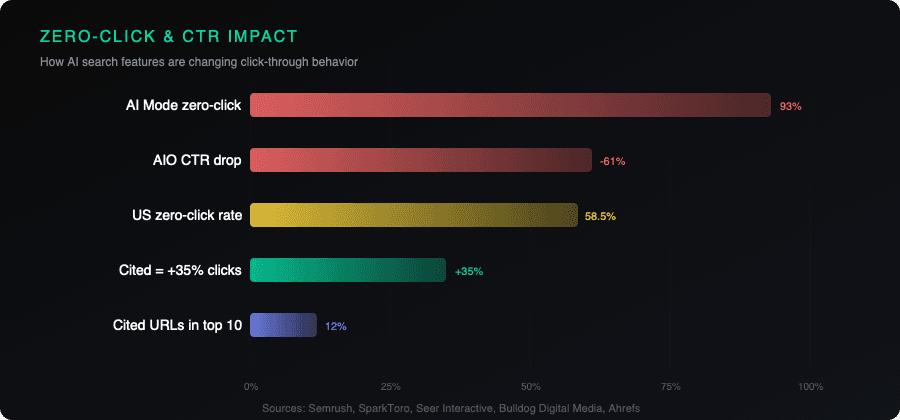
The data from third parties backs Microsoft up. SparkToro's 2024 research put zero-click searches at 58.5% in the US. Semrush data from September 2025 showed 93% of AI Mode searches end without a click. Seer Interactive found AI Overviews cut organic click-through rates by 61% on informational queries. Sistrix calculated 265 million clicks lost per month in Germany alone from AI Overviews.
Multiple outlets are reporting traffic declines of 20-40% across affected categories. The Gartner prediction of a 25% decrease in traditional search traffic by 2026 is playing out roughly on schedule.
Why the convergence matters
Three things happened in the same 72-hour window:
- A core update finished its biggest wave of ranking volatility, reshuffling which sites appear in traditional results.
- A new popup began intercepting users mid-search and redirecting them to AI Mode, where 93% of queries generate no external clicks.
- Microsoft confirmed that AI summarization is reducing website visits.
The first changes who ranks. The second changes whether ranking matters. The third makes clear this is not reversing.
You can recover from a core update. You cannot recover from users being redirected away from your result before they see it.
What to do right now
If your traffic dropped with the core update, Google's standard advice applies: audit your content against their quality guidelines, focus on original reporting and first-hand experience, and avoid scaled or commodity content. Marie Haynes noted that Google published new guidance on ranking in AI features on May 21, recommending unique perspectives, non-commodity content, and high-quality images and video.
But the AI Mode popup raises a different question. If Google is going to intercept complex queries and redirect users to AI Mode, your content needs to be what AI Mode cites, not just what ranks in traditional results.
Get cited, not just ranked. Bulldog Digital Media found that only 12% of URLs cited by AI platforms rank in Google's traditional top 10 for the same queries. Citation and ranking are becoming separate systems. Structure your content with clear answers, specific data points, and quotable claims.
Register as a preferred source. Google's Preferred Sources feature, which rolled out to AI Overviews and AI Mode on May 28, lets users designate trusted publishers. Google says people are twice as likely to click through to a preferred source. Add the deep link to your site (https://google.com/preferences/source?q=yourdomain.com) so visitors can add you in one click.
Track AI visibility separately from traditional SEO. Position one CTR has dropped by as much as 58% on queries where AI Overviews appear, according to Ahrefs. But brands cited in AI Overviews earn 35% more organic clicks and 91% more paid clicks than uncited competitors on the same queries.
The core update will settle. The popup will not. Google is building a search experience where it answers the question itself and cites sources as supporting evidence. If your strategy depends on people clicking blue links, you are optimizing for a shrinking surface.
Sources:
- Google May 2026 Core Update Volatility Hits Hard Again June 2nd — Search Engine Roundtable
- Google May 2026 Core Update Has Completed Rolling Out — Search Engine Roundtable
- Google's AI Mode Popup Appears for Some Searches — DigitBin
- Microsoft: AI Summarizes Results, Reducing Clicks & Website Visits — Search Engine Roundtable
- Zero-Click Search Statistics 2026 — Digital Applied
- Click Behavior in Zero-Click Search — ZipTie.dev
- Google AI Mode & AI Overviews Add Preferred Sources & New Carousel — Search Engine Roundtable
- Marie Haynes' Google Algorithm Update List — Marie Haynes