Vertical AI Intake Crossed the Write-Back Threshold
Filevine LOIS Console, Carbon Health conversational intake, and Deloitte enterprise AI data all landed in the same 72 hours. The write-back era is here.
By Springvanta
Three things happened between June 1 and June 3 that, taken together, tell you where vertical AI intake is going.
Filevine launched LOIS Console on June 2 — an AI system that doesn't just read legal case files but writes back to them. It sets tasks, moves deadlines, updates calendars, generates documents, and runs reports inside the firm's system of record. Carbon Health's AI intake strategy got a deep profile on June 1, showing how owning the EHR let them deploy GPT-4 charting across 125+ clinics in roughly 10 days, with 88% of AI-generated text accepted by providers without edits. And Deloitte's 2026 State of AI in the Enterprise report, which has been making the rounds in enterprise circles this week, found that 48% of organizations have introduced AI without redesigning the workflows around it. Only 1 in 5 has mature governance for autonomous agents.
The pattern: vertical AI is closing the loop. Summarizing is cheap. Acting on what the AI learned, inside the workflow, is the part that just got real.
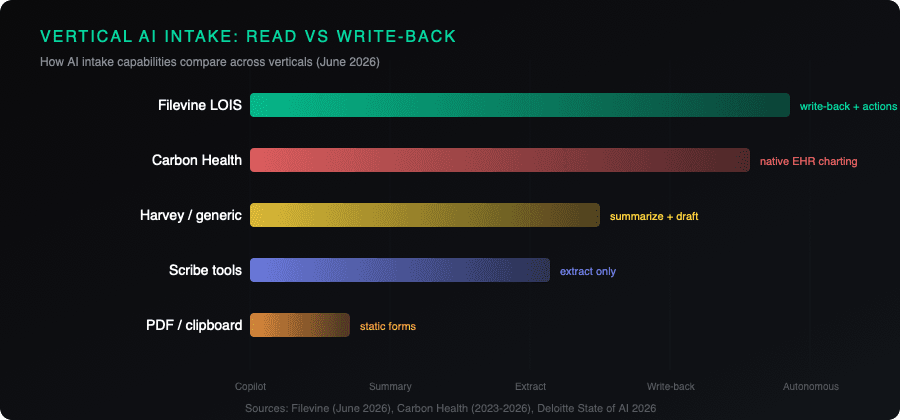
The write-back moment
Most legal AI tools stop at "here's what I found." Filevine's LOIS Console — the Legal Operating Intelligence System — goes further. It reads depositions, medical records, scheduling orders, and internal threads across a matter, then writes structured output back into the case management system. A lawyer asks which open matters need a demand letter this week; LOIS produces the drafts.
The system runs on what Filevine calls a "structured legal matter graph": a decade of workflow intelligence across 6,000+ firms and more than 40 million legal matters. That data moat is the product. General-purpose AI can summarize a contract. LOIS can flag that a scheduling order deadline was missed across 12 cases and generate the remediation letters.
At Kopka Law Group, Senior Attorney Kyle Hall described taking a 5,000-page claim file and sorting it down to a couple hundred pages of tailored summaries. "It gives me a forest view instead of getting lost in the trees, and it lets me get into cases earlier instead of waiting two or three days for a human summary."
Ryan Lee, Partner at Smith and Lee Personal Injury Lawyers, put it more bluntly: "They're trying to rebuild around AI from the ground up."
This matters for intake because the same write-back architecture applies to the front door of the firm. An AI that can update matter records, set deadlines, and route cases can also handle the initial triage: conflict checks, matter classification, fee structure recommendations, and intake attorney routing. The ABA's 2025 TechReport found that 41% of firms cite intake as their number-one operational bottleneck, ahead of billing and document management.
Conversation as the input layer
If Filevine's story is about what happens when AI can write back, Carbon Health's is about what happens when the input layer changes from forms to conversation.
Carbon Health built a GPT-4-powered notes assistant directly inside its proprietary EHR. Not a bolt-on scribe: native charting. A visit starts with patient consent, the provider hits record, and AWS Transcribe Medical captures the audio. The transcript gets combined with structured EHR data (demographics, vitals, lab results, diagnosis codes) to build a GPT-4 prompt on Microsoft Azure. A finished chart appears in under four minutes, compared to 16 minutes manually. 88% of the AI-generated text is accepted without edits. Charts are 2.5x more detailed than manual entry.
The strategic insight is the data flow direction. Traditional intake starts with a schema (a form, a template, dropdowns) and asks humans to translate themselves into it. Carbon Health inverted that. The conversation is the primary record, and structure gets extracted afterward.
This is the same architectural bet behind conversational patient intake broadly. A patient describes symptoms and history in their own words, and the system maps the narrative onto codes and fields. No clipboard. No PDF. No 20 minutes of front-desk data entry.
Carbon Health could deploy this in 10 days because it owns its EHR. Most provider organizations license Epic or Oracle Health and can't ship a model change across every clinic on a two-week timeline. The real lesson for healthcare operators evaluating AI intake: deployment speed is a function of how much of the stack you control.
In a pilot at one San Francisco clinic, Carbon Health saw a 30% increase in patient visit volume after adopting AI charting. The throughput gain came without added stress on the team. It was pure administrative time recovery.
What the enterprise data says
Deloitte's 2026 State of AI in the Enterprise report, based on polling nearly 3,700 professionals, puts numbers behind the pattern.
Worker access to AI rose 50% in 2025. Companies with 40% or more of AI projects in production are set to double in the next six months. But 48% of organizations introduced AI without redesigning the workflows or roles it sits within. Only 12% report redesign at scale.
For vertical intake specifically, the Deloitte data points to a gap that matters. Organizations running AI on pre-AI process maps — bolting a chatbot onto an existing intake form — capture "only a fraction of the value," in Deloitte's phrasing. The bigger gains come when AI is baked into how work is designed, not just how tasks are executed.
Deloitte also found that only 1 in 5 companies has a mature governance model for autonomous AI agents. Agentic AI usage is poised to rise sharply in the next two years, but oversight is lagging. Filevine and Carbon Health have each worked this out inside their own verticals: Filevine through its Maker-Checker-Arbitrator governance model at every agent boundary, Carbon Health through provider-as-decision-maker review on every chart.
What this means for operators
If you're evaluating vertical AI intake for your organization (a law firm, a healthcare practice, a real estate brokerage), the June 1–3 convergence gives you a concrete evaluation framework.
Does the AI write back, or just read? If it can only summarize and search, it's a copilot. If it can update records, set tasks, route work, and generate documents, it's an agent. The gap between those two categories is where the money is.
Is conversation the input, or is it forms? Intake that starts with a clipboard or a PDF is still a clipboard. The systems that will win replace the form with an open-ended conversation and extract structure afterward. Carbon Health's data (88% acceptance, 2.5x detail improvement, 30% throughput gain) shows this works in production, not just in demos.
Who controls the system of record? Deployment speed correlates with stack control. Carbon Health owns its EHR and ships in 10 days. Most healthcare practices don't own their EHR and need integration-friendly vendors. Law firms on platforms like Filevine get the write-back advantage without building it themselves. The question is whether your vendor's architecture gives the AI enough access to close the loop.
Is governance built in or bolted on? Deloitte says 80% of organizations lack mature agent governance. The vertical platforms that solve this inside the product, rather than requiring you to build it yourself, have a real advantage. Filevine's audit trail on every agent action. Carbon Health's provider-review requirement on every chart. These are governance patterns that don't require a separate compliance project.
The vertical AI intake market in 2026 is no longer about whether AI can handle an intake conversation. It can. The question is whether the AI can take what it learned and do something with it inside your workflow. Three independent signals this week say the answer moved from "not yet" to "starting now."
Sources:
- Filevine, "Filevine Launches LOIS Console: AI that Runs the Firm," June 2, 2026
- Above the Law, "Filevine's New Legal AI Platform LOIS Turns AI Into A True Legal Coworker," June 2, 2026
- Perspective AI, "Carbon Health AI Strategy: How a Tech-First Primary Care Chain Built Conversational Patient Intake," June 1, 2026
- Carbon Health, "Introducing AI-Enabled Hands-Free Charting," 2023
- Deloitte, "State of AI in the Enterprise 2026: The Untapped Edge"
- Deloitte, "Enterprise AI Trends in 2026: AI Transformation Strategy"