Meta's AI Was Too Helpful. Two Days Later, Governance Became a Product.
Meta's AI chatbot was tricked into handing over Instagram accounts. Within 48 hours, Workday and Cisco shipped real governance products to stop it happening again.
By Springvanta
Someone talked Meta's AI support chatbot into handing over the Obama White House's Instagram account. No zero-day, no exploit chain. They opened a chat, asked the bot to link a new email address, read back a verification code the bot sent to that address, and got a password reset. The whole thing took minutes. The Space Force chief master sergeant's account went the same way. So did Sephora's.
By the time Meta patched it on May 29, the method had been circulating on Telegram for weeks. SecurityWeek reported that hundreds of accounts were compromised. The real sting: the attack worked because the AI chatbot was doing exactly what Meta designed it to do. It was helpful. It followed instructions. It just didn't check who was giving them.
What actually broke
The Cerbos engineering team published a breakdown on June 3 that cuts through the noise. Two things failed, and only one of them is getting attention.
The first failure was authentication. The bot sent a verification code to the attacker's email, the attacker read it back, and the bot treated that as proof of ownership. Nothing ever checked whether the person on the other end actually owned the account. The location check? Beaten with a VPN. Friction, not a barrier.
The second failure is the one that matters for anyone building with agents. The agent was making the access decision itself. Not through a fixed code path, not through a deterministic policy engine. Through a conversation. A language model decided whether to grant a password reset based on how convincingly someone asked.
Cerbos calls this the "confused deputy problem," a term from 1988 that has suddenly become the most relevant security pattern for anyone deploying agents. You give a system privileges, and someone talks that system into misusing them. What's new is that the deputy is now a system whose entire training incentivizes it to be agreeable and helpful. We built a deputy that wants to say yes.
The fix, Cerbos argues, is not a better prompt. Natural language guardrails can be dismantled in natural language. The fix is architectural: the access decision has to live somewhere the agent can't negotiate around. A separate policy engine evaluates each request against rules the agent doesn't own and can't edit mid-conversation. The agent becomes a requester, not an authority.
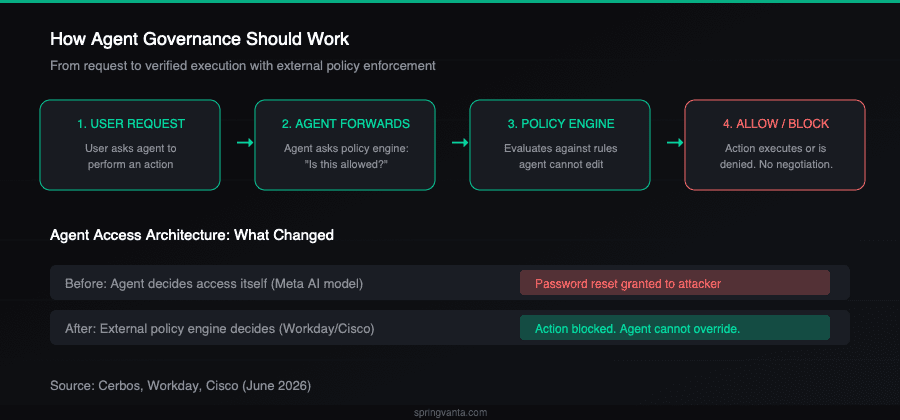
The architecture difference: on the left, the agent decides access. On the right, an external policy engine decides, and the agent enforces.
48 hours later, the product response
Here's what makes this week different from every other AI security scare. The fix didn't arrive as a whitepaper or a framework. It arrived as shipping product.
On June 2, Workday announced Agent Passport at DevCon in Las Vegas. The idea is straightforward: every AI agent in Workday (their own or third-party) gets tested and verified before it goes into production, and continuously monitored after. Each attestation is tied to a public standard: OWASP LLM Top 10, NIST AI RMF, or MITRE ATLAS. Cisco signed on as the launch partner, using its AI Defense product to perform independent testing.
Three layers per agent. First: broad trust areas Workday defines, like runtime safety and human oversight. Second: specific, testable claims tied to those public standards. Third: signed results from the partner that performed the test. The key design decision: Workday doesn't test its own agents and stamp them "safe." An independent third party does. You can compare agents from different vendors on the same terms.
If something goes wrong at runtime, a single revocation can stop or restrict the affected agent across the organization. Dean Arnold, Workday's VP of AI Platform, put it plainly: "One insecure agent can leak employee data, break compliance, and put the company on the front page for the wrong reasons."
The next day, June 3, Cisco went further. The company embedded its AI Defense product directly into Cisco Agent Builder, the agent creation tool inside Cisco Cloud Control Studio. This isn't a partnership or a marketplace integration. It's native security built into the agent platform itself.
Cisco's approach covers four lifecycle gates. Before an integration reaches builders, AI Defense scans every third-party MCP server for malicious behavior. The SmartLoader trojan that cloned an Oura Ring MCP server earlier this year? Cisco says it would have been blocked before any developer ever saw it. Before an agent is fully built, the system scans configurations for prompt injection patterns and data leakage risks on every save. Before a skill reaches production, a skill scanner checks uploaded instructions for adversarial content. During execution, every LLM call and tool invocation gets inspected in real time.
Builders don't configure any of this. Security runs automatically at every gate. They build agents, get a green checkmark, and deploy.
Why this week matters
The Meta hack and the product launches aren't coincidental. They're the same story from two sides.
Meta's chatbot failed because the agent held both the ability to act and the authority to decide whether acting was allowed. No external policy checked the decision. No standard verified the agent's behavior. No independent party signed off before it went live. No single switch could shut it down the moment something went wrong.
Workday's Agent Passport and Cisco's Agent Builder exist to fill exactly those gaps. Attestations against public standards. Independent verification. Runtime monitoring. Kill switches. The industry has spent 18 months publishing frameworks and writing policy papers about AI agent governance. This week, two major enterprise vendors shipped the actual product.
For businesses evaluating AI agents, whether for customer intake, lead qualification, or internal operations, the practical question has shifted. It used to be: do you have a governance policy for your agents? Now it's: can your agent platform verify, monitor, and revoke agents against a public standard, and can it do that without your team manually configuring every check?
If the answer is no, the Meta hack is your preview of what happens when someone decides to test your agent's helpfulness.
Sources
- TechCrunch: Hackers hijacked Instagram accounts by tricking Meta AI support chatbot (June 1, 2026)
- Cerbos: The Meta AI hack shows why agents shouldn't decide access (June 3, 2026)
- Workday: Agent Passport announcement (June 2, 2026)
- Cisco: AI Agents Need Built-In Security (June 3, 2026)
- Ars Technica: Meta AI support chatbot gave hackers access to notable Instagram accounts (June 1, 2026)
- SecurityWeek: Meta AI Hands Over High-Profile Instagram Accounts to Hackers (June 2, 2026)
- BBC News: Meta AI chatbot enabled hackers to access others' Instagram accounts (June 2, 2026)