Four Launches in 48 Hours: Vertical AI Stops Answering Questions, Starts Running Operations
Hippocratic AI, Elation Health, Filevine, and Litera all shipped operational AI in the same 48 hours. The shift from copilot-style Q&A to write-back workflow automation is the story of the week.
By Springvanta
Four products shipped between Monday morning and Tuesday afternoon. Hippocratic AI released an "AI Front Door" and a Nurse Co-Pilot for hospitals. Elation Health bought Aster, a voice AI startup, and folded it into its primary care EHR. Filevine launched LOIS, a console that reads your case files and writes tasks back. Litera put its client intelligence platform inside Microsoft 365.
None of these are chatbots. They run operations: scheduling, intake, document generation, eligibility verification, revenue cycle calls, nurse workflow automation. The AI does the work and writes the results back into the system of record.
That is the shift. For two years, vertical AI meant a copilot that summarized a document or answered a question. This week it means software that handles a workflow end to end without a human initiating each step.
Hippocratic AI: answering calls and running the front door
On June 2, Hippocratic AI launched two products.
The AI Front Door replaces the call center and digital intake stack with a single AI agent that handles scheduling, lab results, billing, and care guidance in one continuous conversation. It remembers previous interactions. It works across phone, text, and web. That last part matters more than it sounds: most healthcare call centers still route patients through multiple departments for different request types. One conversation, one agent.
The Nurse Co-Pilot sits inside the inpatient workflow. It automates patient education, discharge prep, caregiver engagement, and medication adherence support. Nurses trigger AI-assisted interactions from the EHR. Structured summaries get written back automatically. Hippocratic says it returns one to four hours per nurse per shift. Whether that number holds up in production, the product direction is clear: the AI does not advise the nurse, it does the routine work the nurse was doing between patients.
For a practice evaluating AI intake, the Front Door is the relevant product. It handles the full call: scheduling, insurance questions, care navigation. But what to watch is the architecture. Hippocratic built a longitudinal care interface that maintains patient context across interactions and channels. That is a different category than a voice IVR with a language model on top.
Elation Health buys Aster: voice AI meets the EHR
Also June 2. Elation Health announced its acquisition of Aster, a startup that built Atlas, a voice AI agent for healthcare front-office tasks. Aster raised $2.8M from Zeal Capital Partners, Cornerstone Ventures, Octopus Ventures. The team joins Elation.
Elation already embeds Anthropic's Claude into its EHR for clinical summaries. Adding Aster's voice agent gives Elation phone-based intake and scheduling inside the same platform clinicians use for charting. The voice agent connects to the EHR. The EHR is the system of record. No separate intake tool, no sync lag, no data living in two places.
For primary care practices, Elation's core market, this means the front-desk phone call and the clinical note start in the same system. That integration density is what makes AI intake practical at scale.
Filevine's LOIS: AI that reads and writes the law firm
On June 2, Filevine launched the Legal Operating Intelligence System. LOIS.
It is not a chatbot that summarizes a case. It is a console that reads the firm's matter data, identifies what needs to happen, writes tasks back to the system of record, generates documents, updates calendars, and runs reports.
Ryan Anderson, Filevine's CEO: "Tools do not run firms and tools do not win cases." LOIS is built on Filevine's structured legal matter graph, which draws on data from 6,000+ firms and 40 million legal matters. The pre-processing pipeline lets LOIS read millions of documents in a single analysis. Where competitors stop at summarization, LOIS tracks completeness. What is missing, not just what is there.
For intake: a lawyer can ask LOIS which open matters need a demand letter this week and have drafts waiting for review within minutes. The intake-to-action loop closes inside the platform. No export to Word, no manual calendar update.
Kyle Hall, a senior attorney at Kopka Law Group, described taking a 5,000-page claim file and sorting it down to a couple hundred pages of tailored summaries. "It gives me a forest view instead of getting lost in the trees, and it lets me get into cases earlier instead of waiting two or three days for a human summary."
Litera's Foundation 365: client intelligence where lawyers already work
On June 3, Litera launched Foundation 365, its AI-powered CRM for law firms, now running across Microsoft 365. Built on Microsoft Dynamics 365, it surfaces client and relationship data inside Outlook, Teams, and Copilot.
The product targets a specific problem: lawyers do not open a separate CRM. Foundation 365 brings the intelligence to the email client and chat tool. It identifies which client relationships need attention, who the best contact is, and what opportunities are developing, all inside the tools lawyers already use all day.
Litera serves more than 4,000 firms worldwide, including five of the Global Top 10. The Microsoft integration is the differentiator. Most legal CRM platforms are standalone tools that require context-switching. Foundation 365 removes that friction.
Why four launches in 48 hours
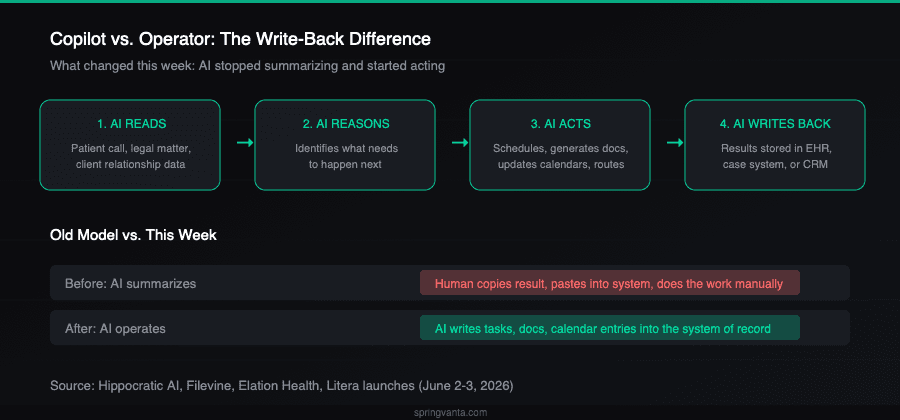
Three things connect these products.
Write-back is the new standard. All four systems write results back into the system of record. LOIS writes tasks, calendar entries, and documents into Filevine. The Nurse Co-Pilot writes structured summaries into the EHR. Aster's voice agent writes intake data into Elation's EHR. Foundation 365 writes relationship signals into Microsoft 365. If the AI only reads and summarizes, it is a copilot. If it writes back, it is an operator. The line between those two things matters for what you pay and what you get.
Vertical-specific infrastructure is pulling ahead. Hippocratic's safety architecture was validated across millions of patient interactions. LOIS runs on a legal matter graph with 40 million matters. Elation bought a healthcare-specific voice agent. Litera integrated with Dynamics specifically for law firm CRM. The moat is domain data and domain-specific integrations, not the underlying model.
The integration surface is the product. Elation did not build voice AI. It bought a startup whose agents already connected to healthcare phone systems and EHRs. Litera did not build a new interface. It embedded inside Microsoft 365. Filevine did not add a chat window. It built a console that reads and writes its existing matter graph. The AI goes where the work already happens. This pattern showed up in May too, when Hyro integrated with Five9 and Supio connected to Thomson Reuters Westlaw. The standalone AI tool is giving way to the embedded AI function.
What to ask if you are evaluating vertical AI
If you run intake or operations at a healthcare practice, law firm, or real estate brokerage, the products that launched this week change the evaluation questions.
Ask whether the AI writes back to your system of record. If it only summarizes or answers questions, it adds a step, not removes one. Ask whether it maintains context across interactions and channels. If it treats every call as a blank slate, you are running a fancier IVR. Ask whether it handles the full workflow or just the first five minutes. Hippocratic's Front Door does scheduling, billing, and care navigation in one call. LOIS handles demand letters, calendar updates, and document generation.
The gap between "answering the phone" and "closing the loop" is where the value is.
Sources:
- Hippocratic AI Front Door and Nurse Co-Pilot launch (MedTech Spectrum, June 2, 2026)
- Elation Health acquires Aster (MobiHealthNews, June 2, 2026)
- Filevine launches LOIS Console (Filevine, June 2, 2026)
- Litera Foundation 365 in Microsoft 365 (Litera, June 3, 2026)
- QurHealth and Caring One AI voice solution (Web3Wire, May 31, 2026)
- Tanner Health goes live with Hyro AI assistant Clara (National Law Review, May 29, 2026)