One Agent, Every Channel: Voice + Chat Merge This Week
Fin, HubSpot, Quiq, and Chatbase all shipped unified voice+chat agents in the same week. The two-system support stack is collapsing.
By SpringVanta
Four platforms shipped the same feature in the same week: one AI agent that works across chat, phone, and email without splitting context, knowledge, or escalation paths. That is not a coincidence. It marks the point where the two-system support stack , one for chat, one for voice , starts to collapse.
The week in brief
Fin (formerly Intercom) renamed the entire company around its AI agent on May 12, then launched Fin Operator two days later , an AI agent whose sole job is managing the customer-facing agent. Fin crossed $100M ARR, growing at 3.5x. The parent company's $400M total revenue means the agent is roughly a quarter of the business and nearly all the growth.
HubSpot reported in its Q1 2026 earnings call that Customer Agent now resolves 70% of support conversations autonomously, up from 20% a year ago. The product passed 9,000 customers and accounts for 53% of all AI credits consumed on the platform. CEO Yamini Rangan cited two dominant use cases: after-hours augmentation and tier-one ticket deflection.
Quiq launched Voice AI on May 11, extending its enterprise CX platform with real-time voice that shares context across messaging and human agents under a single governance layer. One global retailer runs a single agent supporting four brands, seven countries, and four channels simultaneously.
Chatbase shipped Voice on May 8, extending the same chat agent to handle inbound phone calls in 95+ languages through Twilio integration , no separate workflows or escalation systems.
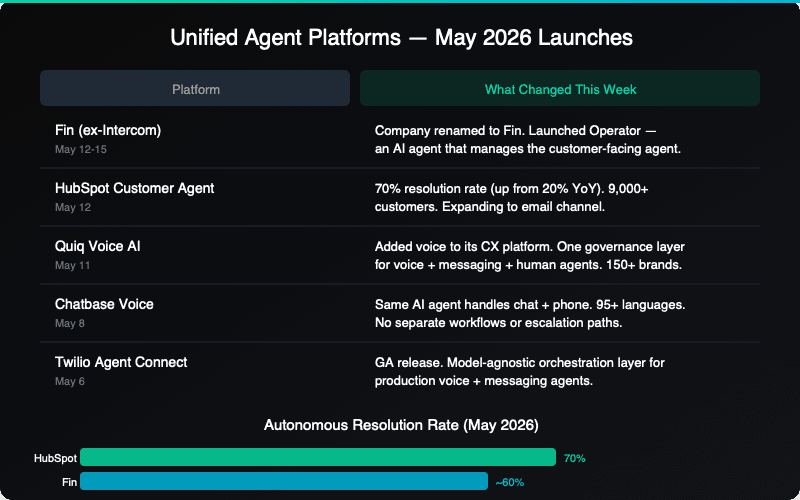
What actually changed
These launches share one structural trait: the voice agent is not a separate product bolted onto an existing chat system. It inherits the same knowledge base, action library, escalation rules, and conversation history. A customer who starts on chat, calls by phone, then follows up by email interacts with one agent that remembers the full thread.
This matters because the old architecture , separate vendors for phone and chat, separate escalation trees, separate analytics , produces what support ops teams describe as a maintenance burden that grows faster than the support volume itself. The average contact center currently manages 3.2 disconnected support tools. Only 7% deliver uninterrupted transitions between channels, per CMSWire's reporting.
The resolution rate is real
HubSpot's jump from 20% to 70% autonomous resolution in twelve months is the sharpest published curve in the customer service agent market. CTO Dharmesh Shah's framing during the earnings call was direct: as frontier models improve, the agent moves from tier-one to higher-level support. The 70% figure is a checkpoint, not a ceiling.
One customer burned through 5,000 included credits within days of turning Customer Agent on and is now scaling toward 100,000 to 300,000 credits per month. Another, Synergent, already resolves 85% of conversations without human intervention.
The new operational problem
More resolution creates a new problem: who manages the agent?
Fin Operator is the first commercial answer. It acts as a data analyst, knowledge manager, and debugger for the customer-facing Fin agent. Paste in a conversation where Fin failed, and Operator traces the reasoning chain, identifies the root cause, proposes a fix, back-tests it, and suggests a monitor. Nothing ships without a human clicking "Apply."
Brian Donohue, Fin's VP of Product, described the shift: "Software engineers' primary job is now managing agents who write code. Support ops, your job is to manage an agent who's managing the agent for your customers."
Constantina Samara, VP of Customer Support at Synthesia, said Operator changed her team's workflow: "Previously, improving how Fin handles a conversation often meant reviewing everything yourself. With Operator, you just ask."
Why this matters for businesses evaluating AI intake
If you run intake , customer inquiries, lead qualification, scheduling, support , the one-agent-per-channel model is about to look as dated as IVR trees. The platforms consolidating voice, chat, and email into a single agent configuration reduce operational surface area. Fewer vendors, fewer escalation paths, fewer places where context gets dropped.
For businesses considering AI voice or chat intake, the practical question has shifted. It is no longer "should we deploy a voice bot or a chatbot?" The platforms shipping this month are converging on: deploy one agent, then choose which channels it speaks through.
Sources
- VentureBeat: Intercom, now called Fin, launches an AI agent whose only job is managing another AI agent (May 15, 2026)
- CX Today: HubSpot's Customer Agent Hits 70% Resolution Rate (May 12, 2026)
- CMSWire: Quiq Launches Voice AI to Unify Enterprise CX (May 11, 2026)
- CXM Today: Chatbase Launches Voice AI Agents for Customer Support (May 11, 2026)
- Twilio Blog: Agent Connect GA (May 6, 2026)