KPMG Declares GEO Enterprise Infrastructure
KPMG's GEO mandate signals that generative engine optimization is now enterprise strategy, not an SEO side project. What it means for service businesses.
By Springvanta
When KPMG , one of the Big Four consultancies , publishes a feature-length article declaring that "the page-one race is over," it is not a prediction. It is a signal that generative engine optimization has moved from SEO-adjacent experimentation into enterprise infrastructure territory.
Their May 2026 article, GEO Mandate: Optimizing Content for AI-Generated Results, frames GEO as a cross-functional discipline touching marketing, sales, customer support, knowledge management, and decision intelligence. Not a side project for the SEO team. A core capability for the entire organization.
This is not incremental advice. KPMG reports running its own GEO program internally , what they call "Client Zero" , and claims it has driven more qualified engagement and stronger leads despite declining B2B web traffic overall.
The data behind the shift
Three recent data points explain why Big Four consultancies are now treating GEO as strategy work, not tactical SEO.
Google AI Overviews now reach 1.5 billion monthly users, appearing on over 25% of searches , up from 13% in March 2025, according to Google's May 6 announcement. AI Mode sessions show a 93% zero-click rate based on Semrush clickstream data, meaning citation inside the AI response has become the primary visibility opportunity.
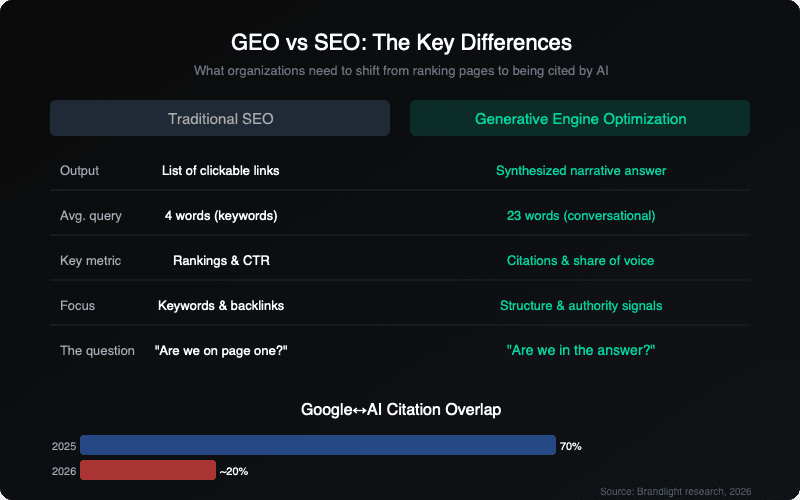
The overlap between top Google results and AI-cited sources has collapsed from roughly 70% to below 20%, per research from GEO firm Brandlight, cited in the LLMrefs 2026 GEO guide. This divergence is widening as AI systems develop independent preferences for which sources to trust and cite. Page-one Google rankings no longer guarantee AI visibility , and AI visibility no longer requires page-one rankings.
Content freshness has become a direct ranking factor in AI citation. LLMrefs reports that AI citations drop off sharply for content older than three months, creating what they describe as a "citation cliff." Quarterly content refreshes are no longer optional for organizations that depend on being found.
What KPMG gets right about GEO
KPMG's framework stands out because it does not treat GEO as an SEO add-on. Their article identifies seven business areas where AI-generated discovery changes how organizations operate:
- Commerce and product discovery. AI now decides what gets compared and recommended before a human visits any product page. Structured product data, consistent brand signals, and authoritative third-party references determine whether AI systems cite or ignore your offerings.
- Content and marketing. Authority, structure, and credibility matter more than keywords. Machine-readable schema markup and content knowledge graphs provide the semantic context AI needs to distinguish genuine expertise from surface-level content.
- Customer experience. Customers increasingly encounter your brand through AI answers, not your website. GEO ensures AI represents your brand accurately across chat, voice, email, and social platforms.
- Knowledge management. Internal search is becoming conversational and synthesized. GEO principles apply inside the enterprise, shaping how employees find and use organizational knowledge.
Their five-step action plan , audit current AI visibility, refresh content for conversational queries, invest in knowledge graphs, integrate marketing and sales data, and establish governance , maps directly to the capabilities that service businesses need to build.
What this means for service businesses
For organizations running client intake, lead qualification, or appointment booking , the workflows SpringVanta supports , the GEO shift has concrete implications.
Your intake forms and service pages are now AI sources. When someone asks ChatGPT or Google AI Mode "What is the best way to get legal help for a small business dispute?", the AI pulls from multiple web sources to synthesize an answer. If your practice or agency is not structured for AI extraction , clear heading hierarchy, direct answers, schema markup, verifiable claims , you will not appear in that response, regardless of how good your organic rankings are.
AI-driven referral traffic converts differently. Early data shows that users arriving from AI citations are further along in their decision-making. They have already received a recommendation. The conversion rates are higher, even though the volume is lower. This aligns with what we have observed in AI-era lead qualification: fewer, better-informed leads that close faster.
Community presence is now a ranking factor. Google's May 2026 update explicitly integrates Reddit discussions and community content into AI responses. Reddit already appears in over 46% of tracked AI search prompts. Brands without community representation face competition from user-generated content inside the same AI response.
The operational gap
KPMG's article highlights a gap most organizations have not addressed: GEO requires cross-functional coordination. It is not something the marketing team can handle alone. Product data needs to be structured for machine consumption. Customer support knowledge bases need to be AI-readable. Sales enablement content needs schema markup and expert attribution.
This is the same pattern we see in AI intake automation. The technology works, but the organizational alignment , clean data, consistent processes, clear governance , determines whether it delivers value. GEO follows the same logic. The brands that treat it as infrastructure, not campaign work, will be the ones AI systems learn to trust.
Sources
- KPMG, "GEO Mandate: Optimizing Content for AI-Generated Results," May 2026
- Google, "Explore the web with generative AI in Search," May 6, 2026
- LLMrefs, "Generative Engine Optimization (GEO): The 2026 Guide," May 2026
- Impressive Digital, "Google AI Search Updates May 2026," May 12, 2026
- Brandlight research on citation overlap, cited via LLMrefs