Opus 4.8 Runs 1,000 Agents. MCP Goes Stateless. What It Means.
Claude Code ships 1000-agent dynamic workflows with Opus 4.8 while MCP drops sessions entirely. AI dev tooling graduated from autocomplete to agent operating system.
By SpringVanta
Two things landed in the same ten-day window that, taken together, change what "AI coding tool" means.
On May 28, Anthropic shipped Claude Code v2.1.154 with Opus 4.8 and dynamic workflows: a single Claude Code session can now spin up to 1,000 subagents in parallel, each working on an independent slice of a problem. Three days earlier, the MCP working group locked the release candidate for the 2026-07-28 specification, the largest protocol revision since MCP launched. The headline change: sessions are gone. Every MCP request is now self-contained, so servers can sit behind a plain load balancer without sticky sessions.
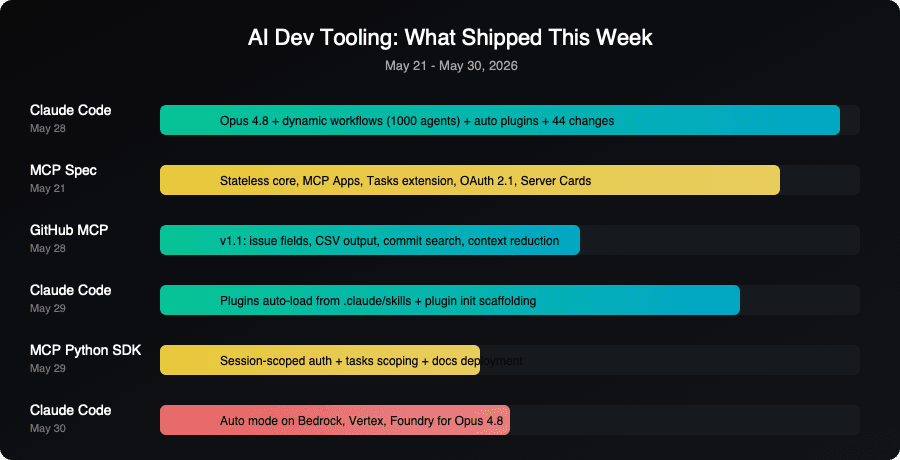
Neither of these is small on its own. Together, they say something specific: the infrastructure for running AI agents at scale is hardening fast, and it is happening in the tools developers already use daily.
What Opus 4.8 actually changes
The benchmark numbers are real but not the main story. SWE-bench Pro went from 64.3% on Opus 4.7 to 69.2%. Terminal-Bench 2.1 jumped from 66.1% to 74.6%. USAMO 2026 math went from 69.3% to 96.7%. Those are large single-cycle gains, and they come at the same price: $5 per million input tokens, $25 per million output.
The thing I keep thinking about is the honesty improvement. Anthropic says Opus 4.8 is roughly four times less likely to let code flaws pass unremarked compared to Opus 4.7, and 17 times less likely to produce what they call "dishonest agentic summaries." Bridgewater Associates, which tested it early, specifically called out that the model proactively flags issues with its own inputs and outputs. When a hedge fund that manages $100+ billion says the most valuable feature is that the model tells you when it does not know something, that is worth paying attention to.
For teams using Claude Code, there is a new effort dial. Opus 4.8 defaults to "high" effort. You can push it to "xhigh" for hard tasks. And there is a new "ultracode" tier that combines xhigh reasoning with automatic dynamic workflow orchestration. Claude decides when to spin up subagents. You do not manage the coordination.
Dynamic workflows: the part that changes how you work
Here is the architecture. You give Claude a task. Instead of reasoning through it in a single agent loop, Claude writes a JavaScript orchestration script on the fly. A separate runtime executes that script, spinning up parallel subagents. Up to 16 run concurrently. A hard cap of 1,000 agents total per run. Each subagent works on an independent slice of the problem, and intermediate results live in script variables rather than eating into Claude's context window.
Jarred Sumner, the creator of Bun, used dynamic workflows to port the Bun runtime from Zig to Rust. Roughly 750,000 lines of Rust produced. 99.8% of the existing test suite passing. Eleven days from first commit to merge. That is not a benchmark. That is a real project with real stakes.
Three ways to trigger it: include "workflow" in your prompt, enable the ultracode setting, or use the bundled /deep-research command. It is available on Max, Team, and Enterprise plans as a research preview. Token consumption can be substantial, so Anthropic recommends starting with scoped tasks to calibrate cost.
Plugins load themselves now
A quieter change in v2.1.155 that matters more than it sounds: plugins in .claude/skills directories now load automatically. No marketplace step, no manual install. Drop a plugin directory in your project's .claude/skills/ folder and Claude picks it up. There is also a new claude plugin init command to scaffold one.
For teams building internal tooling around Claude Code, this removes a friction point. You can version-control your custom plugins alongside the codebase they support. New team members clone the repo and Claude has the plugins immediately. The /plugin Discover tab also now pins plugins whose relevance signals match the current directory.
Auto mode goes cloud-native
v2.1.158, shipped May 30, extends auto mode to Bedrock, Vertex, and Microsoft Foundry for Opus 4.7 and Opus 4.8. Auto mode replaces permission prompts with background safety checks. It was previously limited to Anthropic's own API. For enterprises running Claude Code on AWS, GCP, or Azure, this means you can now run fully autonomous agent sessions without routing through Anthropic's infrastructure.
This matters if you have data residency requirements or existing cloud commitments. Auto mode + dynamic workflows on Bedrock means a fully autonomous, multi-agent coding environment that never leaves your VPC.
MCP goes stateless
The 2026-07-28 release candidate, locked May 21, is the largest MCP spec revision since the protocol launched in November 2024. The core change: sessions are gone.
In the current spec (2025-11-25), every MCP connection starts with an initialize/initialized handshake. The server returns a Mcp-Session-Id. Every subsequent request from that client must carry that session ID, pinning the client to the server instance that issued it. Put a load balancer in front and you need sticky sessions. Scale horizontally and you need shared session state. Restart a server and every active session dies.
In the new spec, every request carries its own context. Protocol version, client info, and capabilities travel in _meta on each request. Two new headers, Mcp-Method and Mcp-Name, let gateways route traffic without inspecting the body. A remote MCP server can now sit behind a plain round-robin load balancer and scale horizontally like any other HTTP service.
State does not disappear. It becomes explicit. Servers that need context across calls return handles from tool responses. The model passes those handles back as ordinary arguments. The dependency is visible, auditable, and any server instance can pick up where another left off.
The RC also ships three new extensions: MCP Apps (server-rendered HTML interfaces rendered in sandboxed iframes), Tasks (a proper lifecycle for long-running work), and Server Cards (structured metadata via .well-known URLs so registries can discover server capabilities without connecting). OAuth alignment moves to mandatory OAuth 2.1 with PKCE.
The final spec publishes July 28. If you run production MCP servers, that is your migration deadline.
GitHub's MCP server grew up too
GitHub shipped MCP Server v1.1.0 on May 28. The highlights: issue field support, CSV output for list tools (cutting token usage on large result sets), a new search_commits tool, and significantly reduced context in project item responses. The context reduction alone is meaningful for anyone running GitHub's MCP server inside an agent loop. Less context per response means longer sessions before you hit token limits.
Why this week matters for people who are not developers
If you run a business that is evaluating AI automation, these changes affect you in specific ways.
First, the agent infrastructure your automation runs on is getting cheaper and more reliable. Dynamic workflows mean a single AI session can handle tasks that previously required human orchestration: migrating data, auditing configurations, running compliance checks across thousands of records. MCP going stateless means that infrastructure scales without the operational headaches of session management.
Second, the "honesty" improvement in Opus 4.8 addresses a real problem with AI agents in business contexts. Agents that confidently produce wrong results are worse than agents that tell you they are unsure. If you are deploying AI for intake processing, lead qualification, or document analysis, the model telling you when it does not know something is a safety feature, not a limitation.
Third, auto mode on Bedrock/Vertex/Foundry means you can run fully autonomous AI agents inside your own cloud environment. For healthcare, legal, or financial services businesses with data residency requirements, this removes a barrier that existed a week ago.
Sources
- Claude Code v2.1.154 release notes (GitHub, May 28)
- Claude Code v2.1.155 release notes (GitHub, May 29)
- Claude Code v2.1.158 release notes (GitHub, May 30)
- MCP 2026-07-28 Release Candidate (MCP Blog, May 21)
- GitHub MCP Server v1.1.0 (GitHub, May 28)
- Introducing Claude Opus 4.8 (Anthropic, May 28)
- MCP Is Growing Up (Agentic AI Foundation, May 27)
- MCP Python SDK v1.27.2 (GitHub, May 29)
- Claude Opus 4.8 Is an Agent Honesty Release (Developers Digest, May 29)