Page One ≠ AI Citation
Conductor's analysis of 3.3 billion search sessions reveals ranking on page one no longer guarantees AI citation. Here is what changes for content strategy.
By SpringVanta
For over two decades, the goal of SEO was straightforward: get to page one. The higher you rank, the more traffic you get. That equation still holds for traditional blue-link results — but a new layer of search has opened on top of it, and it plays by different rules. Conductor's 2026 AEO/GEO Benchmarks Report, released this week, puts hard numbers behind what many SEO professionals have sensed anecdotally. Analyzing 3.3 billion search sessions across 13,770 domains and 10 industries, the report documents the growing gap between ranking and being cited by AI-generated search results. The headline finding: AI referral traffic currently accounts for just 1.08% of total organic sessions. That number is small, but it is growing fast , and it is distributed unevenly in ways that should reshape how businesses think about content strategy.
What the data actually shows
The report breaks AI search behavior into two related but distinct phenomena: AI Overviews (Google's generated summaries that appear above traditional results) and AI referrals (clicks that originate from ChatGPT, Perplexity, Gemini, and other AI assistants).
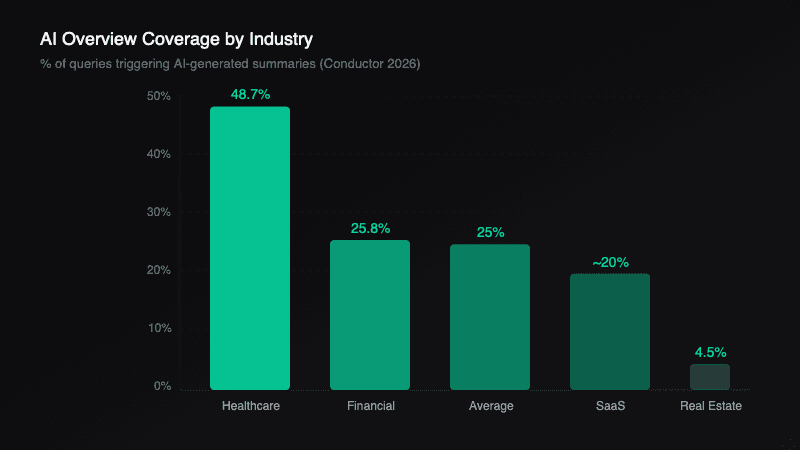
For AI Overviews, coverage varies dramatically by vertical:
The zero-click problem intensifies
Google's AI Mode , the expanded AI search experience the company rolled out more broadly this month, has a striking behavioral signature. According to Conductor's data, 93% of AI Mode sessions end without a single external click. Users get their answer from the AI summary and move on. This is the zero-click problem on steroids. Traditional SEO has always dealt with some percentage of searches that never result in a click (featured snippets, knowledge panels, local packs). AI Mode amplifies this dramatically because the summaries are longer, more detailed, and frequently cite multiple sources inline. For businesses that rely on search traffic to drive awareness and leads, this creates a fundamental tension. Your content might be selected as a source for AI-generated answers , you just might never see the click.
Reddit's outsize influence
One of the more surprising findings: Reddit content is cited in 46% of AI search prompts and responses across the study. Forum and community content : Reddit, Quora, Stack Overflow, carries disproportionate weight in AI citation patterns compared to its share of traditional organic results. This aligns with Google's visible emphasis on "first-hand experience" and forum content in recent algorithm updates. AI systems appear to favor content that demonstrates authentic, specific, experiential knowledge over polished corporate marketing pages.
What this means for your content strategy
The report suggests several practical adjustments: Audit your AI visibility separately from rankings. Track whether your content appears in AI Overviews and whether it gets cited by ChatGPT. These are distinct from your position on page one. Tools are emerging for this : Conductor's own platform now includes AEO metrics, but even manual testing with targeted queries provides a starting point. Prioritize specificity over ness. AI summaries tend to cite sources that provide a clear, specific answer to a defined question, not sources that try to cover everything. Content that answers "how much does [specific service] cost in [specific location]" is more likely to be cited than a general guide. Invest in community-aligned content. The Reddit signal is strong enough that businesses should consider how their expertise shows up in community discussions. This does not mean seeding Reddit with promotional content : AI models can distinguish authentic participation from marketing. It means creating genuinely useful resources that community members would reference naturally. Track the right metrics. If 93% of AI Mode sessions end without a click, measuring AI search success requires looking beyond referral traffic. Brand mentions in AI outputs, citation frequency, and downstream assisted conversions become more relevant than raw click counts.
The broader shift
Google reported that AI Overviews now reach 1.5 billion monthly users. The company also added "Further Exploration" sections in AI Mode , expandable follow-up links that keep users in the AI experience longer. Inline citation links, moved from grouped footnotes to direct in-text references, give the appearance of sourced authority while keeping users on-Google. For businesses building intake forms, lead qualification workflows, and customer acquisition funnels, this shift means rethinking the top of the funnel. If potential customers are getting their first exposure to your category through an AI summary rather than your website, the content that feeds those summaries is your new front door. The businesses that adapt fastest will not necessarily be the ones with the best traditional SEO. They will be the ones that understand the citation graph , which sources AI models select, how they summarize, and what triggers a user to actually click through.
Sources: Conductor 2026 AEO/GEO Benchmarks Report (BusinessWire, Webbiquity); Google I/O 2026 search announcements (Impressive); Conductor platform data, 3.3B sessions, 13,770 domains, 10 industries.