The CRM Is Dead. Long Live the AI Agent Hub.
Zendesk, HubSpot, and Salesforce are racing to become AI agent hubs, not just CRMs. Here is what it means for your automation strategy.
By SpringVanta
The tools you use to track customer relationships are in the middle of an identity crisis. They are not becoming smarter databases. They are becoming something else entirely: operating systems for AI agents. In the span of six weeks, three of the largest customer-facing platforms on earth — Zendesk, HubSpot, and Salesforce, have each made decisive bets that the future of CRM is not about better data entry. It is about autonomous agents that do the work for you. If you run intake forms, qualify leads, or manage a support queue, this shift is coming for your workflow next.
Zendesk: AI Agents for Everyone
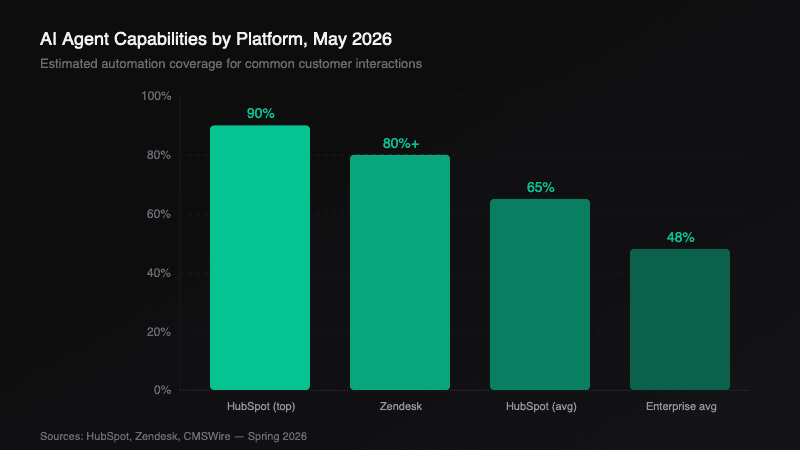
On May 11, 2026, Zendesk began rolling out its most advanced agentic AI capabilities to all customers across every plan. Previously, these capabilities were locked behind premium tiers. Now, any Zendesk customer gets access to AI agents that can reason through multi-step conversations, pull from knowledge bases and CRM data, and resolve complex issues without human intervention. The timing is telling. Zendesk also introduced an automation potential report that analyzes your last 90 days of support tickets and surfaces exactly which conversation topics are ripe for AI automation. It identifies knowledge gaps. It shows sample tickets and how an AI agent would have responded. You can jump directly from the report to creating or enhancing an AI agent. This is a strategic move: instead of asking customers to guess where AI might help, Zendesk is handing them a diagnostic. The guesswork is gone. The onboarding friction is reduced. And the path from "we should probably automate something" to "our AI agent is live" got dramatically shorter. By August 31, 2026, Zendesk will stop development on its older Essential AI agents and bot builder. By December 10, they go end-of-life. The message is clear: agentic AI is not a feature tier. It is the platform.
HubSpot: From CRM to "System of Action"
HubSpot's Spring 2026 Spotlight event, announced April 14, was not a routine feature release. It was a repositioning of the entire platform. The headline product is HubSpot AEO (Answer Engine Optimization), which tracks how your brand shows up in ChatGPT, Gemini, and Perplexity , and recommends actions to improve visibility. This is HubSpot acknowledging that the traditional SEO funnel it helped build is eroding. Organic traffic for its customers fell 27% year over year, while AI referral traffic surged. LLM visitors convert 4.4x better than organic search visitors. But the deeper story is the AI agents.
- Customer Agent now handles email (the highest-traffic support channel) and resolves 65% of conversations on average, with top teams hitting 90%.
- Prospecting Agent identifies buying signals, maps buying committees, and drafts outreach , early users see response rates at 2x the industry benchmark.
- Smart Deal Progression analyzes call transcripts and full deal history to suggest CRM field updates, draft follow-ups, and surface action items.
- Breeze Assistant now has role-aware responses, brand alignment, and access to website analytics and campaign playbooks.
HubSpot is calling this the shift from a "system of record" to a "system of action." The CRM is no longer where you store information about what happened. It is where AI agents coordinate what happens next.
Salesforce: The Agent Hub Nobody Expected
Perhaps the most vivid illustration of this shift comes from outside the official product roadmap. SaaStr founder Jason Lemkin recently documented how Salesforce went from "shelfware" , still paid for, barely used, to the center of a 20+ AI agent operation. The agents handle prospecting, pipeline management, email campaigns, event coordination, and sponsor management. All connected to Salesforce as the data layer. SaaStr now pays more for its AI agents than for Salesforce itself. Lemkin's takeaway: "The CRM that becomes the hub for AI agents wins. The one that doesn't becomes a database you're overpaying for." Salesforce has been buying its way into this position , acquiring Qualified and Momentum, two core AI agent companies, and building Agentforce with 2,000 engineers. The thesis is clear, and it is the same thesis driving HubSpot and Zendesk: the CRM's value is no longer in storing data. It is in orchestrating autonomous work.
What This Means for Your Operations
Three signals from this wave of announcements are directly relevant if you are evaluating AI automation for your business: 1. The diagnostic layer is arriving. Zendesk's automation potential report is the most explicit example, but HubSpot's AEO tool serves a similar function for marketing: analyze what is happening, surface where AI can intervene, and reduce the distance between insight and action. Expect every major platform to add something like this within 12 months. 2. Pay-per-result pricing is the new normal. HubSpot's Customer Agent costs $0.50 per resolution. The Prospecting Agent costs $1 per recommended lead. This is a fundamental shift from seat-based SaaS pricing. You pay for outcomes, not access. For businesses evaluating AI automation, this dramatically lowers the risk of experimentation. 3. The vendor lock-in is real , and accelerating. As Lemkin noted, at 2-3 AI agents, switching CRM platforms is annoying. At 10, it is expensive. At 20, it is functionally impossible. The CRM decision you make today is no longer just a CRM decision. It is an AI infrastructure decision that compounds over time.
The Bottom Line
The platforms are not waiting for you to be ready. Zendesk is putting agentic AI in every plan. HubSpot is redesigning its CRM as an agent orchestration layer. Salesforce is acquiring agent companies and wiring them into its core. The question is not whether AI agents will handle your intake, support, and lead qualification workflows. It is which platform's agents will do it , and how quickly you can move from diagnosis to deployment. If you are mapping out your automation roadmap for the second half of 2026, start by auditing which platform already holds the data your agents will need. The answer to "where do we start with AI automation?" is increasingly "where your data already lives."
Sources: Zendesk AI agent expansion announcement, Zendesk automation potential report, HubSpot Spring 2026 Spotlight via CMSWire, SaaStr: Which CRM Should You Use in 2026/2027? Follow the Agents, Zendesk AI agent reporting updates