Patient Access Stopped Being Convenience. It's Revenue Now.
Three healthcare AI launches in 72 hours converged on one thesis: patient access is where revenue leaks. Sensi.AI, Innovaccer, and Bridge each built around that number.
By Springvanta
Every patient interaction that goes unanswered costs $294 in lost revenue over the next year. That number comes from a report Innovaccer released this week, based on surveys of hospital executives managing $84 billion in combined net patient revenue. A typical 400-bed health system loses $6.2 million annually from avoidable referral leakage. Patients who called, waited, and gave up.
Three healthcare vendors launched products in the same 72-hour window, and they all converged on the same thesis. The intake layer, where patients first interact with the healthcare system, is where revenue gets captured or lost. Not the diagnosis. Not the treatment plan. The scheduling call and the intake form.
Sensi.AI built an operating system for home care
Sensi.AI launched its Agentic Operating System on June 11, built for home care agencies. The platform combines three agents (Care, Ops, and Growth) into one system running on audio AI data from hundreds of thousands of senior homes.
The Growth Agent is the piece worth paying attention to. It functions as an inside sales rep for home care agencies, following up with every prospect automatically and managing leads through a built-in CRM. Susan Kahlau, owner of a Visiting Angels franchise with 200+ clients, reported a 2.5x increase in conversion to assessments after deploying it.
The Ops Agent handles daily chaos: caregiver no-shows, call-out coverage, schedule coordination. Colby Bechtold of Hummingbird Care Services in Florida said caregiver no-shows "plummeted." He described the change as eliminating night workers who were only doing "traffic control which makes no fiscal sense."
Sensi supports over 80% of the largest home care networks in North America. Agencies using the platform report 22% fewer hospitalizations and doubled client service duration. The new Ops and Growth agents turn what was a monitoring tool into something that actively runs the business side of a care agency.
Innovaccer put a number on the problem
The Innovaccer report, covered by TechTarget on June 10, quantifies what patient access failures actually cost. Beyond the $6.2 million headline, the breakdown shows where money leaks:
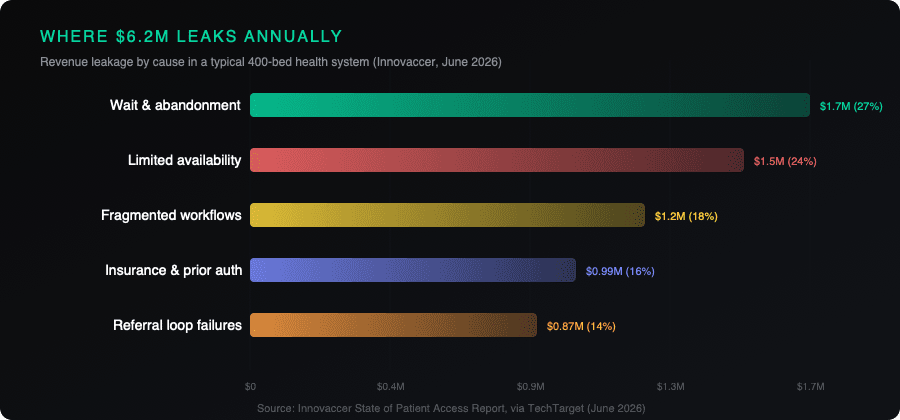
- Wait and abandonment: $1.7 million (27%)
- Limited appointment availability: $1.5 million (24%)
- Fragmented workflows: $1.2 million (18%)
- Insurance and prior authorization: $0.99 million (16%)
- Referral loop failures: $0.87 million (14%)
Staff at these health systems use three to seven different systems for patient access. Average handle time: 8.7 minutes per interaction.
AI-enabled access centers change the math fast. The report calculated $8.1 million in net benefit on a $2.5 million investment, achievable in just over three months. Cost per scheduled appointment drops from $77 to $52. Referral-to-appointment conversion jumps from 58.2% to 82.7%. Speed to answer drops from 82 seconds to 12 seconds.
"Every hold time, every broken referral loop, every abandoned call is a precise, measurable financial event," said Abhinav Shashank, CEO and cofounder of Innovaccer.
Bridge went after login walls and manual data entry
Bridge launched its Patient Access and Revenue Suite on June 11, targeting what CEO John Deutsch calls the "technology soup" of disconnected intake, reminders, scheduling, and billing vendors.
The headline feature is loginless access. Patients complete registration forms via a secure mobile link without creating an account, remembering a password, or downloading an app. Bridge also enhanced its discrete EHR data write-back, which pushes patient-submitted information directly into EHR fields without manual transcription.
The company says the suite consolidates vendor license fees by up to 65% and serves as the entry point to its broader digital front door platform.
What the convergence tells you
These are three different companies with three different architectures targeting the same bottleneck. Sensi.AI built a vertical operating system that treats lead intake and caregiver scheduling as revenue functions. Innovaccer measured the cost of getting it wrong. Bridge removed the friction points (login walls, manual data entry, disconnected vendors) that cause patients to abandon the process.
Vonage also entered this space this week with healthcare-specific AI agents through its Avaamo partnership, handling appointment scheduling, care navigation, and billing support over voice. The Vonage angle is more CX infrastructure than intake-native, but it targets the same failure point: generic chatbots cannot complete healthcare-specific tasks like scheduling within clinical escalation boundaries.
The shared bet across all four launches is that vertical AI in healthcare has moved past answering questions and started completing tasks. The agents that succeed are the ones that understand referral workflows, know when to escalate to a human, and can write data back to the EHR without creating new cleanup work for clinical staff.
Three questions for operators
If you run intake, scheduling, or patient access operations, these questions are worth asking this week:
-
How many systems does your team touch to complete one patient interaction? If the answer is more than two, you are likely in the fragmented-workflow category that costs $1.2 million annually.
-
What is your speed to answer? Health systems that respond to scheduling inquiries within 5 minutes convert 2 out of 3 patients. Systems that respond after 24 hours convert fewer than 1 in 10. The gap is $294 per lost interaction.
-
Does your intake tool write back to the EHR? If staff are re-entering patient-submitted data manually, the intake layer is creating work instead of eliminating it.
The organizations already using AI in their access centers are pulling ahead of those that are not, and the gap is widening by about 8% per year, according to Innovaccer's data. Patient access stopped being a cost to minimize. It is where the money is.