Voice AI Stops Waiting, Starts Calling First
Three platforms launched outbound and proactive voice AI in the same week. Delight AI, Kraken+Sierra, and DROS.ai are betting that voice agents should call first, not just answer.
By Springvanta
For a year, voice AI companies competed on who could answer the phone better. Faster response times, higher resolution rates, more natural conversation.
Last week, three companies stopped waiting for customers to call and started having their agents call first.
Delight AI shipped outbound calling and proactive outreach for e-commerce support. Kraken and Sierra went live with autonomous utility agents covering 1.3 million accounts. DROS.ai launched compliance-guardrailed voice agents for one of the most heavily regulated contact center functions in existence: debt collection.
Three industries, three regulatory environments, the same bet. The phone now rings before the customer knows they need help.
Delight AI: reactive support goes proactive
On June 5, Delight AI released Voice 2.0. The headline feature isn't a better voice model. It's outbound calling.
Even the best voice AI agents have been reactive until now. They waited. The customer had to recognize a problem, decide to call, and sit through hold music before the AI said a word. Delight's Outbound Voice flips that: the AI initiates calls to confirm flagged orders, follow up on stale tickets, or remind customers about subscription renewals.
The more interesting half is Proactive Voice. It's not just scheduling calls. It's a monitoring layer that watches signals across your customer data (order status, ticket age, payment failures) and triggers outbound calls when conditions are met. Delight framed it simply: "The best customer service call is one the customer never had to make."
Underpinning both features are 2,000+ quality improvements across the voice stack, covering six failure modes that Delight identified from production data. Dr. Cool Services, an HVAC company in Las Vegas, is already using the platform for proactive maintenance scheduling alongside inbound booking.
The math for e-commerce and SaaS support teams is straightforward. Every call the AI makes proactively is one inbound call that never arrives. Support volume for predictable issue types drops. Agents spend less time delivering bad news.
Kraken and Sierra: 1.3 million accounts, four weeks
June 11 brought the biggest deployment number of the week. Kraken, the utility operating system behind 90+ million energy accounts worldwide, launched Autonomous Agents built with Sierra, Bret Taylor's AI customer experience company.
The first agent went live at a major energy utility within four weeks. It now covers 1.3 million customer accounts.
What separates this from generic voice AI is the data layer. Kraken's agents access real-time account information, usage data, pricing details, and operational workflows through a governed AI access layer. Energy market logic, regulations, and operational rules are codified into the agent's action layer and continuously updated. The agents don't just talk. They understand meter readings, tariff structures, and outage protocols.
Bret Taylor: "Agent OS sets the standard for adaptability and transparency, enabling even regulated companies to go live in weeks with high CSAT and resolution rates. Any team can build an agent, deploying it everywhere across every channel, including voice."
Assaf Biderman, Kraken's chief AI officer, was more direct: "Energy is too important, too complex, and too urgent for generic AI."
Utilities have specific data models, compliance requirements, and customer journeys. A generic voice AI can't handle a billing dispute that involves time-of-use tariffs and net metering credits. Kraken's agents can, because they're built on a unified utility data model. Axios covered the partnership and noted that Sierra, which has focused on retail, financial services, and healthcare, is now extending into utilities through this model.
DROS.ai: outbound voice, FDCPA-compliant
Also on June 11, DROS.ai launched AI voice agents for debt collection. This is one of the most compliance-sensitive outbound calling environments in any industry.
Debt collection calls are governed by the Fair Debt Collection Practices Act and similar regulations. AI agents operating without context and safeguards create real legal exposure. DROS built its agents to load the full account picture (history, compliance rules, next-step logic) before a single word is spoken.
Anshul Shrivastava, CEO of Vodex (which builds DROS): "Most AI voice tools in collections are essentially cold-dialers with a script. We built DROS differently. Every call starts with the full account picture, the compliance rules, and the history of every prior interaction."
The platform supports inbound and outbound agents with built-in guardrails for scripting and regulatory compliance. It also handles 15-second live user verification and parallel voice and SMS automation.
The pattern here matters for any regulated industry: the value isn't in the voice model. It's in the compliance layer on top of it. A general-purpose voice AI can't legally make a debt collection call. DROS can because it built the regulatory scaffolding first and added the AI second.
What changed
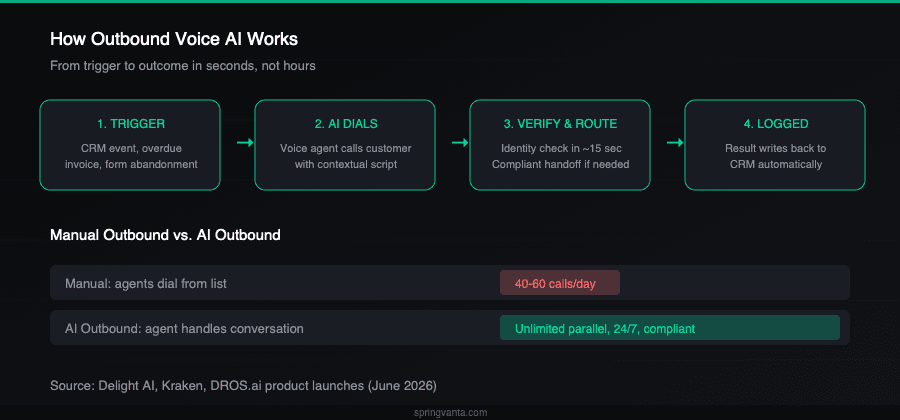
The voice AI product category shifted this week from "answer calls" to "decide when to call." If you're evaluating voice AI vendors, the question to ask now is whether they support outbound and proactive triggers, not just inbound resolution.
The three launches share something else: none of them work without an industry-specific data layer underneath. Kraken had the utility model. Delight had the workflow engine. DROS had the regulatory logic. Generic voice AI gets you natural-sounding calls. Industry-specific voice AI gets you calls that actually resolve something.
For healthcare, legal, and financial services teams watching from regulated industries: compliance guardrails are now part of the product, not a blocker. DROS proves this. If your objection to voice AI has been regulatory risk, the product category just caught up with your concern.
Sources:
- Delight AI Voice 2.0 announcement (June 5, 2026)
- Kraken Launches Autonomous Agents for Utility Customer Service — Business Wire (June 11, 2026)
- AI startup Sierra partners with utilities company Kraken Technologies — Axios (June 11, 2026)
- Kraken Launches Autonomous Agents for Utilities — Destination CRM (June 11, 2026)
- DROS.ai launches voice agents with compliance guardrails — PR Newswire (June 11, 2026)