86% Less Invoice Time, 20% More Bookings: Real Estate's 72-Hour AI Agent Wave
Five companies shipped role-based AI agents for real estate in 72 hours around NAA Apartmentalize. Yardi led with an 86% invoice time cut and the first MCP connector in the industry.
By SpringVanta
Five product launches, one conference, zero chatbots
Something shifted at NAA Apartmentalize this week. The multifamily industry's biggest annual conference, held June 17-19, became the stage for a wave of AI agent launches that had nothing to do with website chatbots or listing description generators. In the 72-hour window surrounding the event, at least five companies shipped AI agents designed to own specific operational roles in real estate, not assist with them.
Yardi, the largest property management software company in the US, led the charge with role-based AI agents covering leasing, maintenance, accounting, and internal operations. It followed up with the first MCP (Model Context Protocol) connector in real estate, letting operators query live building data through Anthropic's Claude. Inhabit launched a four-product AI suite for property management. Obligo shipped a deposit-specific agent. Ralo emerged from stealth as the first AI-native mortgage broker with $2.9M in seed funding.
And HousingWire published analysis of more than one million AI-powered follow-up calls showing that intent-triggered outreach converts meaningfully better than volume dialing, with natural-sounding voices boosting appointment rates by roughly 20%.
The thesis across all of these: real estate AI has graduated from answering questions to running operations. If you are evaluating AI for property management, leasing, or brokerage operations, the product landscape just changed.
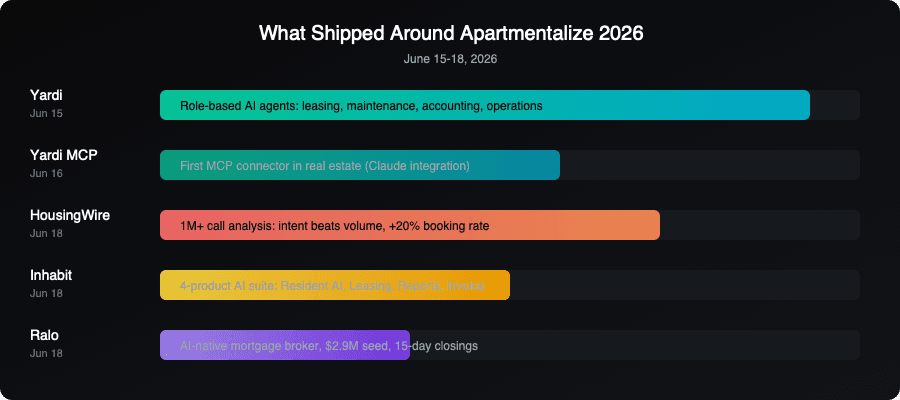
Yardi deployed agents for every role
Yardi's announcement on June 15 covered four distinct agent categories, each replacing manual work in a different part of the multifamily business.
For the renter journey, Chat IQ handles lead nurturing, tour scheduling, application support, payment reminders, and renewal outreach. For internal users, Virtuoso Assistant delivers AI-powered guidance inside the Yardi platform so staff can complete tasks without leaving their workflow. For maintenance, AI inspection agents analyze video walkthroughs of units to identify needed repairs and surface suggested parts from Yardi Marketplace. For accounting, Smart AP uses AI-powered OCR for invoice processing.
The accounting number is where it gets concrete. KETTLER, a multifamily operator, cut invoice processing time by 86% and eliminated 48 hours of manual work using Smart AP. That is not a marginal efficiency gain. It is one full staff week recovered per invoice cycle.
Richard Malpica, VP of multifamily at Yardi, framed the shift directly: "Our agents have transitioned from answering to doing."
That framing matters. A chatbot answers. An agent does. The distinction is whether the AI can take action inside your operational systems, or just deflect questions to a human who can.
The first MCP connector in real estate
The next day, Yardi shipped something arguably more important than the agents themselves: the Virtuoso Connector for Claude, the first MCP connector available on the Anthropic marketplace from any property management software provider.
MCP (Model Context Protocol) is an open standard that lets AI models securely access external data sources. With the Virtuoso Connector, an operator can ask Claude a question like "Which of our properties have the highest delinquency rates this quarter?" and get an answer grounded in live Yardi data, with access automatically following existing user permissions.
Gary Shaw, regional managing director at Colliers, said the connector "fundamentally changes what's possible" and has "transformed how we operate across hundreds of properties."
This is significant for two reasons. First, it signals that the largest incumbents in real estate software are choosing open architecture over vendor lock-in. An operator using Yardi can now use Claude, or eventually other LLMs, to work with their data directly. Second, it sets a precedent. If Yardi opens up, competitors like RealPage, AppFolio, and Buildium face pressure to do the same. The question buyers should ask their vendors is simple: can I access my data through the AI tools I choose, or only through yours?
One million calls say intent beats volume
HousingWire published an analysis on June 18 drawn from more than one million real estate follow-up calls over a three-month period. The findings challenge the default playbook for most real estate teams.
The strongest-performing outreach was not the highest-volume calling. It was outreach triggered by a specific consumer action: a property click, a valuation request, a landing page visit, an email open. A buyer who clicked on a listing yesterday is a fundamentally different conversation than a contact who has been sitting in a CRM for three years. Treating both the same way wastes the first and annoys the second.
One data point stood out. Adding subtle human characteristics to AI voice callers (pauses, tonal variation, slight imperfection) increased appointment booking rates by roughly 20%, moving from a 4% base rate toward 5%. Perfect voices performed worse than natural ones. The lesson: consumers respond to experiences that feel human, not experiences that feel produced.
The broader takeaway for operators: if your AI follow-up strategy is "call more people," you are optimizing the wrong metric. The metric that matters is appointment rate, not call count. And appointment rate depends on what you know about the person before the phone rings.
Inhabit, Obligo, and Ralo: three more pieces
Three additional launches in the same window filled out different layers of the real estate AI stack.
Inhabit launched at Apartmentalize with a four-product suite: Resident AI (a multilingual 24/7 resident assistant), ReportsPro AI (natural language property reporting), Invoice AI (automated accounts payable), and a Leasing Assistant managing inbound chat, voice, and SMS with hybrid AI-to-human handoff. The breadth is the point. Inhabit is betting that property managers want one AI platform, not four bolted-together tools.
Obligo introduced the Deposit Agent, the first autonomous AI agent for security deposit management. It handles the full deposit lifecycle: requirements, charge processing, refunds, compliance, and dispute prevention. Available via MCP and API, it integrates with Yardi, RealPage, AppFolio, and Buildium. This is narrow by design. Obligo is proving that highly specific, single-workflow AI agents can build a business.
Ralo, backed by Y Combinator and Manresa Ventures, launched as the first AI-native mortgage broker with $2.9M in seed funding. Founded by two former Google employees, Ralo claims rates more than half a point below the national average and closings in 15 days versus the industry average of 30-45 days. The entire loan process runs through an AI loan officer with no human loan officer, processor, or underwriter in the loop. That is either the future of mortgage origination or a regulatory disaster waiting to happen. Possibly both.
What the convergence means for operators
If you run property management, brokerage, or mortgage operations, three things just changed.
The consolidation window is open. Yardi's announcement is the clearest signal yet that the major platforms are building AI agents into their core systems rather than leaving it to third-party add-ons. If your property management software does not have role-based AI agents by the end of 2026, you will be paying for a tool that is falling behind.
Open data access is becoming a buying criterion. The MCP connector from Yardi matters because it lets you choose your AI layer independently of your data layer. When evaluating vendors, ask whether they support MCP or equivalent open AI data access. If they do not, ask when. The answer tells you whether they see AI as a feature they control or infrastructure you own.
The data is catching up to the hype. We now have hard numbers: 86% invoice processing time reduction, 20% appointment booking improvement from voice tuning, 50% scheduling error reduction in healthcare (Mayo Clinic's Opmed deployment landed the same week). The pattern across these data points is consistent. AI agents that own a specific operational workflow, grounded in real industry data, produce measurable results. AI bolted onto the side of a CRM produces fewer measurable results and more vendor presentations.
The real estate industry has spent two years asking whether AI is ready. After this week, the better question is which roles you will automate first, and whether your current systems will let you.
Sources:
- Yardi delivers AI agents for every multifamily role and workflow (Yardi, June 15, 2026)
- Yardi adds Virtuoso Connector for Claude to Virtuoso Enterprise (Yardi, June 16, 2026)
- Real estate teams shift AI follow-up to intent signals (Sam Mehrbod, HousingWire, June 18, 2026)
- Inhabit launches new slate of product innovations at Apartmentalize 2026 (PRNewswire, June 18, 2026)
- Obligo introduces the first AI agent for security deposits (PRNewswire, June 15, 2026)
- Ralo launches as first AI-native mortgage broker (GlobeNewswire, June 18, 2026)