Up to Half of Referrals Go Nowhere. Three AI Companies Are Closing the Gap.
Three companies launched systems this week that close the gap between knowing what patients and clients need and actually getting them to act on it.
By SpringVanta
Between 30 and 50 percent of healthcare referrals never become completed visits. That is not a rounding error. At median hospital operating margins near 1 percent, referral leakage costing 10 to 30 percent of potential revenue is the difference between a hospital that can invest in its mission and one that cannot.
Healthcare is not unique in this. Law firms miss 35 percent of inbound calls during business hours and 60 percent after hours. The information needed to serve clients exists somewhere in the practice's systems, but it sits in the wrong place at the wrong time.
Three companies announced products this week that attack the same structural problem from different angles: the gap between knowing what needs to happen and making it happen. None of them are chatbots. None of them answer questions. All of them close loops.
Clarify Health acquires Loyal Health: from intelligence to activation
On June 19, Clarify Health completed its acquisition of Loyal Health, creating what the companies call healthcare's first closed-loop network intelligence and patient activation platform.
The deal connects two things that have always lived in separate systems. Clarify's Meridian platform analyzes where patients need care: which providers deliver the best outcomes, where referral corridors exist, where revenue is leaking. Loyal's platform does the other half. It activates patients into those pathways through outreach, scheduling, and digital engagement, managing more than 80,000 provider profiles and powering millions of real-time scheduling transactions annually for close to 500 hospitals.
Todd Gottula, Clarify's CEO, framed the structural problem directly: "Health systems know that better referral management drives better outcomes. What they haven't had is a single platform that connects the intelligence, where should this patient go, with the activation that gets them there."
The root cause is structural. Intelligence about where patients need care lives in analytics tools. The tools to actually move patients live in patient engagement platforms. Neither one closes the loop. A health system can see its referral leakage in a dashboard and still not have the infrastructure to fix it.
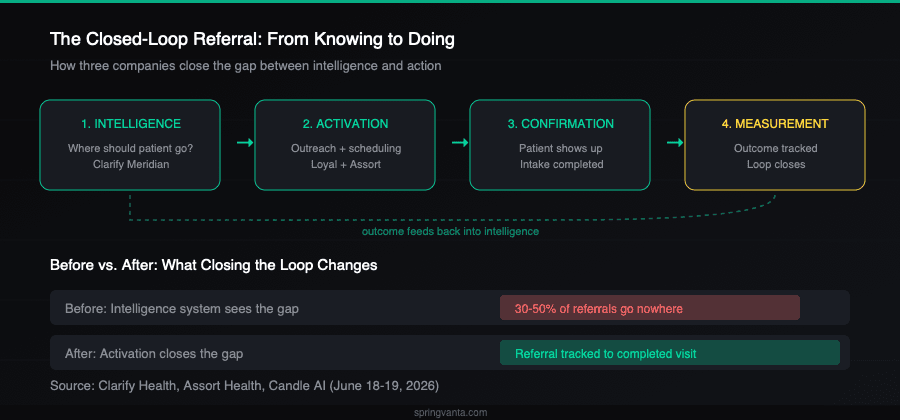
Clarify now combines both. The platform identifies high-value referral corridors, quantifies leakage, activates patients through targeted outreach, and measures whether the patient actually showed up. That last step, measuring the outcome, is what makes it a closed loop instead of another point solution.
Assort Health: patients should not have to tell their story twice
Two days earlier, on June 18, Assort Health announced Continuous Patient Conversations, a platform built around a concept they call Patient Journey Memory.
Every time a patient calls a specialty practice, they start from scratch. They confirm their date of birth, their insurance, their provider, their scheduling preferences, and whatever else the last person they spoke with already wrote down. If they started scheduling through a chatbot earlier in the week and dropped off, the voice agent on the phone has no idea.
Patient Journey Memory builds a longitudinal profile with every interaction. It tracks preferred language, so a patient who speaks Spanish gets greeted in Spanish automatically. It tracks scheduling patterns, so the agent can lead with the time slot the patient has historically chosen. It tracks engagement windows, so outreach happens when the patient is actually responsive. It carries across channels. A chatbot conversation on Monday feeds into a text message on Thursday.
The system draws on 180 million patient interactions and 62,000 care automation protocols. When a patient has an open referral, the AI agent proactively reaches out to schedule it, without a staff member working the referral queue.
This is the same referral gap Clarify and Loyal are addressing, just from the patient side. The referral exists in the EHR. The patient does not know it exists. The staff does not have time to chase every open referral. The loop stays open.
Assort's approach makes every interaction compound. Intake forms arrive pre-populated because the system already knows the patient. Insurance verification happens before the visit. When a patient completes forms for a women's health visit, the system flags that she is due for a mammogram and offers to schedule it in the same interaction.
The compounding effect matters. The longer a practice is on the platform, the more the system knows about each patient. That is structurally different from a chatbot that resets context every session.
Candle AI and Docketwise: context trapped in the wrong system
The referral gap is not a healthcare-only problem. Immigration law firms collect enormous amounts of information during intake. Docketwise, one of the leading immigration case management platforms, uses intelligent questionnaires to gather client details, prepare forms, and manage matters throughout the filing process.
That information is what attorneys need when responding to client emails. But it lives in Docketwise, not in the attorney's inbox. When a client emails with a question about their case, the attorney has to leave Gmail or Outlook, navigate to Docketwise, search for the client, find the relevant matter details, then go back to the email and draft a response.
On June 18, Candle AI announced a partnership with 8am's Docketwise that brings client and matter information directly into Gmail and Outlook. The attorney sees the context alongside the email conversation and can draft a response without switching systems.
Immigration firms using Candle AI are saving up to 1 hour or more per day on email and responding to clients up to 75 percent faster. The partnership was showcased at the AILA Annual Conference in San Diego, where immigration attorneys could see the integration working inside their actual email clients.
This is the same structural problem. The information exists. It was collected at intake. But it is not accessible at the moment of action, when the client is waiting for a response and the attorney is in their inbox. Candle AI closes that loop by moving the context to where the work actually happens.
The pattern: information without activation is overhead
These three announcements share a thesis. The problem is not collecting information. The problem is that collected information sits in the wrong system when someone needs to act on it.
Healthcare has referral intelligence platforms that can see leakage in real time but cannot schedule the patient. It has patient engagement tools that can send reminders but cannot see the referral pattern that caused the gap.
Legal has intake platforms that collect detailed client information and email systems where attorneys spend their day, with no bridge between them.
The vertical AI companies winning right now are not building better chatbots or faster transcription. They are building infrastructure that connects the systems where information lives to the channels where action happens. That is a harder engineering problem than answering phones, and the market is paying for it. Clarify acquired Loyal rather than building patient activation from scratch.
For any business evaluating AI intake or automation tools, the question worth asking is whether the system can close a loop. Can it see a referral, activate the patient, confirm the visit, and measure the outcome? Can it carry context from Monday's chatbot session into Thursday's phone call? Can it surface intake data in the inbox where work actually gets done?
If the answer is no, the system is collecting information. It is not closing gaps.
Sources:
- Clarify Health Acquires Loyal Health — Healthcare IT Today, June 19, 2026
- Assort Health: Continuous Patient Conversations — Assort Health Blog, June 18, 2026
- Candle AI Partners with Docketwise — LawSites/LawNext, June 18, 2026