$800M ARR and 2.4B Work Units: Salesforce, Adobe, and Microsoft Ship Agentic AI in One Week
Salesforce ships multi-agent orchestration at $800M ARR while Adobe and Microsoft ship agentic AI the same week. Three platforms say agents are production-ready.
By SpringVanta
Salesforce launched Agentforce in early 2025. Eighteen months later, it generates $800 million in annual recurring revenue. That number is up 169% year over year. The company has closed 29,000 Agentforce deals and logged 2.4 billion agentic work units across Agentforce and Slack.
On June 15, 2026, Salesforce ships its Summer '26 release, which makes multi-agent orchestration generally available. A service agent can now hand a complex request to a finance agent, which pulls a Tableau dashboard, summarizes it, and returns results inside the same conversation thread. The customer never has to re-explain context or figure out which agent handles what.
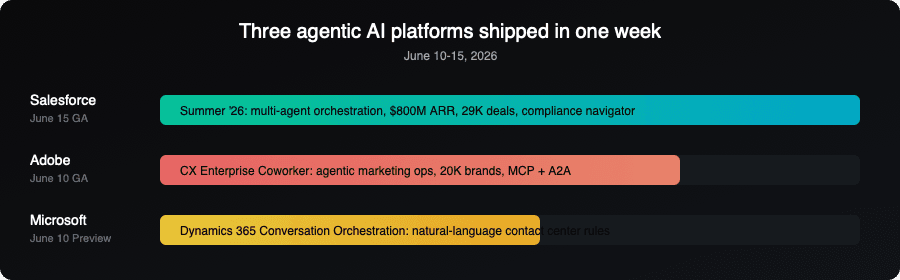
In the same five-day window, Adobe shipped CX Enterprise Coworker to general availability (June 10), and Microsoft released Conversation Orchestration for Dynamics 365 Contact Center (June 10). Three of the largest enterprise software companies put agentic AI into production in the same week. If you are evaluating AI automation for your business, this convergence tells you something about where the market is going.
What Salesforce actually shipped
The headline feature in Summer '26 is multi-agent orchestration. One primary agent receives a user request, routes it to the best-fit specialist using Salesforce's Atlas 3.0 reasoning engine, and returns a coherent answer. Atlas 3.0 supports the Agent-to-Agent (A2A) protocol, the open standard Google and others are pushing for cross-vendor agent handoffs.
For businesses already on Salesforce, this changes the practical math. A Customer Engagement Agent can independently interact with and qualify buyers 24/7 across your website and email, handing warm leads to human sellers. The Agentforce Self-Service Help Agent can be set up in six clicks or less. Momentum captures every customer interaction (calls, emails, meetings) and writes that data back to Salesforce in real time, so agents work from complete deal context instead of whatever the rep happened to log.
The Process Compliance Navigator monitors live workflows and intercepts non-compliant actions before they complete. For finance, legal, and healthcare businesses under regulatory pressure, this is the feature that makes agents deployable without an audit nightmare.
Adobe's CX Enterprise Coworker
Adobe went GA with CX Enterprise Coworker on June 10. It activates a suite of Adobe enterprise applications that 20,000 global brands already use. The Coworker synthesizes insights from Adobe and third-party applications, coordinating AI agents across analytics, content creation, and journey orchestration.
It is built on the same open standards as Salesforce's release: MCP and A2A. That means it can operate across Adobe applications as well as third-party AI platforms from AWS, Anthropic, Google Cloud, Microsoft, and OpenAI. Adobe also built a self-service path for smaller marketing teams: describe your goal in natural language, and the Coworker builds a campaign plan, creates on-brand content, and designs a customer journey flow.
Anjul Bhambhri, SVP of engineering for Customer Experience Orchestration at Adobe, said the product was built because "many organizations are struggling to translate AI adoption into measurable business results."
Microsoft's Conversation Orchestration
Microsoft shipped Conversation Orchestration for Dynamics 365 Contact Center on June 10, available in public preview. The product replaces static routing rules with natural-language playbooks. An admin writes an intention like "If a premium customer is waiting in the queue and no support reps are available, increase their priority over time" and the system handles the rest: reading conversation context, evaluating conditions against CRM data, executing the action.
The first two capabilities target the two most common contact center failures. Dynamic prioritization keeps priority alive throughout a conversation instead of setting it once at queue entry. Overflow management acts the moment a queue has no eligible representatives, instead of waiting for a fixed timer to expire. Different customer segments get different responses: one transfers to a backup team, another receives a callback offer, a third gets a graceful closing message.
Microsoft's framing is simple: "This is the difference between a system that routes and a system that orchestrates."
Why this week matters for buyers
If you are evaluating AI automation for intake, customer support, lead qualification, or marketing operations, three things changed this week:
The bar moved from "can agents do tasks?" to "can agents coordinate across departments?" Salesforce's multi-agent orchestration means a single agent is no longer the end state. The question is how agents share context and hand off work without forcing the customer to repeat themselves.
Compliance became part of the agent layer itself. Both Salesforce (Process Compliance Navigator) and Adobe (inheriting data policies, consent rules, and permissions into agent workflows) built governance directly into how agents operate. If you work in a regulated industry, this removes one of the main blockers that kept agent deployments stuck in pilot.
The revenue numbers are real. $800 million in ARR from Agentforce alone, with 29,000 deals closed. Combined Salesforce AI revenue surpassed $2.9 billion. Enterprises are paying for agents at production scale. The 2.4 billion work units logged means Salesforce has enough usage data to make statistically meaningful claims about what agents actually do, how often they succeed, and where they fail.
No other enterprise AI platform has disclosed a comparable usage volume.
What to ask before you buy
If you are comparing agent platforms after this week's releases, the evaluation criteria shifted. Does the platform support multi-agent orchestration? Single-agent architectures are already behind. Does it use MCP or A2A for interoperability? Any tool that ignores open agent protocols will be painful to connect to the rest of your stack. How do compliance and audit trails work? "The agent did it" is not an acceptable answer to a regulator.
And ask for usage data, not just feature lists. Salesforce's 2.4 billion work units is the first time an enterprise platform has disclosed actual agent task volume at scale. If a vendor cannot tell you how often their agents succeed and where they fail, they are still in pilot, regardless of what their pricing page says.
Sources: Salesforce Summer '26 Release, Enterprise DNA analysis, Adobe CX Enterprise Coworker, Microsoft Dynamics 365 Conversation Orchestration