TCS and DXC Chose Claude for Regulated Industries in 24 Hours
Two IT services giants bet on Claude for healthcare, insurance, and finance in the same 24-hour window. The deployment pattern is what matters.
By SpringVanta
Two of the world's largest IT services companies picked the same AI model for regulated industries on the same day in June. Neither was a product launch.
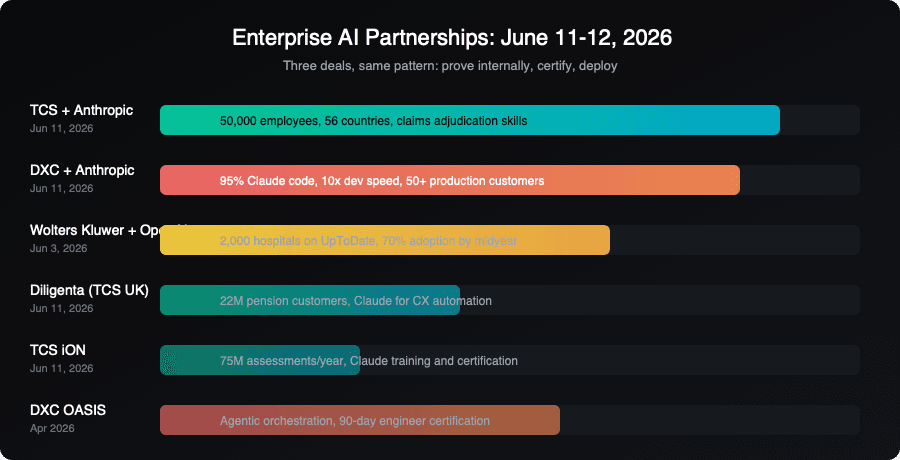
On June 11, Tata Consultancy Services (TCS) and DXC Technology both announced partnerships with Anthropic to deploy Claude across their enterprise operations. TCS is equipping 50,000 employees across 56 countries. DXC is training tens of thousands of Claude-certified engineers. Between them, these companies run the technology infrastructure for banks, airlines, insurers, hospitals, and government agencies worldwide.
What's interesting is the deployment pattern both arrived at independently.
The "customer zero" playbook
Both TCS and DXC followed the same three-step strategy:
-
Prove it internally first. TCS deployed Claude across its own engineering, finance, legal, marketing, and sales teams before offering it to clients. DXC built DXC OASIS, its AI-native managed services platform, using Claude as the primary development tool. More than 95% of OASIS's code was generated by Claude, then reviewed by engineers before shipping.
-
Certify the workforce. DXC runs engineers through a 90-day certification program at the Anthropic Partner Academy. TCS iON, which conducts 75 million assessments annually across 1,500 cities in India, is delivering Claude training and certification at scale.
-
Deploy into production. TCS's Diligenta business serves 22 million pension customers in the UK. DXC OASIS is live with 50+ customers, with Claude as the default foundation model for agentic workflows. These are not sandboxes. They process claims, manage pensions, and run airline operations.
DXC estimates Claude sped up OASIS software delivery by 10x.
Why the model was never the bottleneck
Gartner's Q1 2026 enterprise survey found that 80% of companies now run at least one AI agent in production, up from 33% two years ago. The adoption curve is the steepest since cloud computing in 2010. So what's holding back regulated industries?
TCS CEO K. Krithivasan named it directly: "In regulated industries, most AI initiatives stall at the pilot stage, where the requirements for accuracy, auditability and oversight are far more stringent, and the consequences of error significantly higher."
The gap between what Claude can do in a demo and what it can safely do inside a claims processing system that handles millions of transactions under regulatory scrutiny is where pilots die. The TCS and DXC deals are specifically built to close that gap with governance, certification, and integration expertise.
Anthropic's Chief Commercial Officer Paul Smith: "They proved Claude inside their own operations first, under the same security and compliance requirements their customers face. Now we're bringing Claude inside those environments together, industry by industry."
The specific vertical workflows going live
Both partnerships target concrete, regulated workflows that overlap with what operators evaluate when looking at AI automation:
- Insurance claims adjudication. TCS is building Claude Code skills and plugins for claims processing. DXC is deploying agentic solutions to modernize insurance core systems.
- Financial services. TCS's Diligenta will use Claude for customer experience and agentic process transformation across 22 million policyholders. TCS's banking teams are using Claude Code for software engineering and IT operations.
- Healthcare and life sciences. Both partnerships list healthcare as a target, with TCS focusing on life sciences and medtech workflows.
- Legal and compliance. TCS equips its legal teams with Claude. DXC's certification program includes training for regulated and operationally sensitive environments.
Wolters Kluwer's quiet validation
The same week, Wolters Kluwer expanded its OpenAI partnership for Expert AI. As of April 30, more than half of its US Enterprise Edition customers, roughly 2,000 hospitals, had committed to UpToDate Expert AI. The company expects 70% adoption by midyear.
Wolters Kluwer's approach mirrors the pattern: 75 years of curated clinical and legal content first, AI model second, governance framework throughout. Their FAB platform is model-agnostic. They are not betting on one vendor. They are betting on their ability to govern AI within professional workflows.
The CCH Axcess agentic solutions for tax and accounting professionals are already cutting manual work by 20 to 30 percent.
What this means for your evaluation
If you are looking at AI for intake, claims, or document processing in a regulated industry:
Ask for the customer zero proof. Has the vendor deployed this internally under their own compliance constraints? TCS, DXC, and Wolters Kluwer all did. It is becoming the baseline.
The integration layer is the moat. TCS and DXC are not competing on which model is smarter. They are competing on who can embed AI into legacy systems without breaking compliance. For smaller operators, the question is the same: how well does the AI tool integrate with your existing EHR, CRM, case management, or claims system?
Certification is coming. DXC's 90-day program and TCS iON's training curriculum are early examples. As AI deployment in regulated industries matures, expect industry associations and consulting firms to offer similar programs. Start thinking about who on your team should get certified.
Sources
- TCS and Anthropic: Global Premier Partnership (June 11, 2026)
- Anthropic: TCS partnership (June 12, 2026)
- Anthropic: DXC alliance (June 11, 2026)
- DXC Technology: Multi-year alliance (June 11, 2026)
- TechCrunch: Anthropic taps TCS (June 11, 2026)
- Wolters Kluwer and OpenAI expand collaboration (June 3, 2026)
- Reuters via MarketScreener: India's TCS partners with Anthropic (June 11, 2026)