Build, Execute, Learn: Three CX Agent Tools Shipped in 24 Hours
Cresta, Pipefy, and ChatSee shipped CX agent infrastructure for building, executing, and learning from production agents in one 24-hour window.
By SpringVanta
Three things happened between June 11 and June 12 that, taken together, say something specific about where customer support AI is going.
Cresta launched Conductor, an agent that builds other AI agents for customer experience teams. Pipefy shipped a feature that lets any AI assistant run governed business processes end to end. ChatSee raised $6.5 million to give enterprise agents a memory for their own failures.
None of these are chatbots. None are demos. Each one targets a different phase of the same problem: getting AI agents to work in production without breaking things that cost money.
Build: Cresta Conductor
Cresta's blog post opens with a line that anyone who has deployed CX agents will recognize: "AI agents are easy to demo but hard to get right in production is the 'sky is blue' of truisms about AI deployment."
Conductor is Cresta's answer to that gap. It is a developer-native environment that covers the full agent lifecycle: discovery, blueprinting, build, testing, deployment, and post-launch optimization. Developers describe what they want in natural language, and Conductor produces a reviewable blueprint before any code gets written.
What makes it different from the natural-language agent builders flooding the market is the grounding. Conductor pulls context from Cresta's conversation intelligence platform, which has years of production data from contact centers at United Airlines, Cox Communications, and Marriott. It uses that data to design agents that reflect how customers actually talk, not how an engineer imagines they might.
The build step generates more than prompts. It creates subagent orchestration, configuration files, tool integrations, and the custom code needed for deterministic actions like processing payments or booking reservations. Cresta's CEO Ping Wu framed it plainly: "Building production-ready AI agents is one of the hardest engineering challenges in the enterprise right now."
Internally, Cresta's forward-deployed engineers have used Conductor to cut agent deployment timelines roughly in half. Custom function work that took a full week now takes one to two days.
The testing loop matters too. Conductor generates business-specific test scenarios, runs them against Cresta's Synthetic Customers (personas derived from real conversation data), and when a test fails, it traces the root cause across the blueprint, prompt, tools, and code. The agent hot-reloads so developers can rerun the failed scenario immediately.
Execute: Pipefy Process-as-Tool
Cresta solves the build problem. Pipefy solves the execution problem: what happens when an agent needs to actually do something inside a governed business process.
On June 11, Pipefy launched what it calls "Process-as-Tool." Any AI assistant, whether Claude, Codex, Gemini, or Copilot, can now initiate, execute, and complete entire business processes inside Pipefy using natural language.
The distinction matters. Most MCP (Model Context Protocol) servers give AI access to data. Pipefy's gives AI access to the process itself: approval rules, escalation logic, required fields, audit trails. The AI gives instructions. Pipefy executes them with governance enforced at every step.
CPO Sobhan Daliry put it this way: "While most software vendors are focused on building MCP servers that access data, we built an MCP server that manages the process. You don't just query data, you can run an end-to-end process."
For support and operations teams, this addresses a real gap. An agent that can read a CRM record is useful. An agent that can initiate an approval workflow, route it to the right person, enforce required documentation, and write the result back to the source system is a different category of tool entirely.
Pipefy also shipped both directions of the MCP integration. The MCP Server lets external AI assistants execute Pipefy processes. The MCP Client lets Pipefy's own agents access external tools and systems as part of broader workflow orchestration. Gartner named Pipefy a Representative Provider in Agentic Orchestration Platforms, and the company operates in over 150 countries with 4,000-plus customers.
Learn: ChatSee's failure memory
Cresta builds agents. Pipefy executes processes. ChatSee addresses what happens when agents inevitably fail in production.
ChatSee raised $6.5 million in seed funding on June 12, led by True Ventures, to build what CEO Sekhar Sarukkai calls a "failure intelligence layer" for autonomous AI systems. The premise is straightforward: agents are nondeterministic. You cannot test your way out of every failure. So you need a system that captures what went wrong, preserves the context, and feeds that knowledge back so the same failure does not recur.
ChatSee's taxonomy is built on more than 10,000 grounded examples of enterprise agent failures, classified into 157 categories. These go well beyond hallucination monitoring. They include tool-call failures, scoping errors, reasoning breakdowns, and execution-phase problems.
Sarukkai told SiliconANGLE that these agents are "not classic conversational support kind of agents" but systems "really supporting core business." When an agent misclassifies a merchant code in financial services, or validates a product catalog incorrectly in e-commerce, that error can propagate across every agent in the system before anyone notices.
The fix is a shared failure knowledge base. When one agent fails and a human corrects it, that correction propagates to all other agents referencing the same system. If the correction is critical or becomes a pattern, it gets written to a central authority that agents check before acting.
TAG-infosphere CEO Dr. Eduard Amoroso backed the thesis: "Many of the most significant AI risks emerge at runtime as agents operate autonomously. Because these systems are probabilistic and adaptive, static testing alone is insufficient."
Why this convergence matters
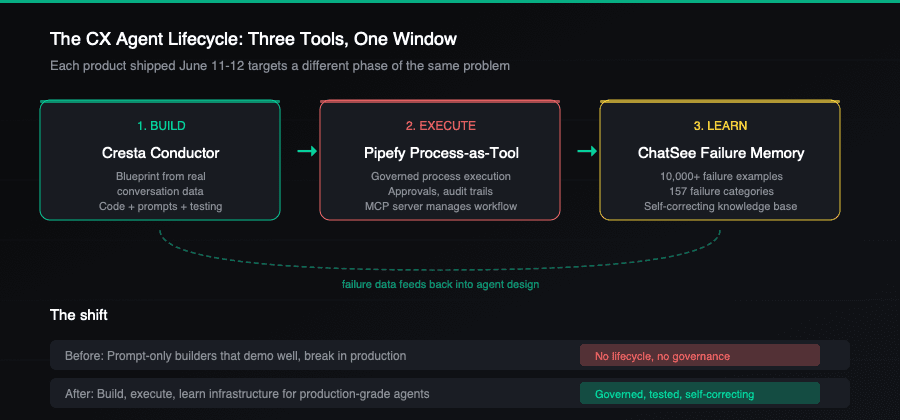
Three companies, three products, one 24-hour window. Each one addresses a different stage of the same lifecycle that every CX agent goes through.
Cresta Conductor targets the build phase: how do you design and ship an agent that reflects how your business actually works, not a generic template? Pipefy targets the execution phase: how do you connect that agent to governed processes with real approval chains and audit trails? ChatSee targets the learning phase: how do you capture what breaks in production and make sure it does not break again?
For operators evaluating AI automation, the signal here is clear. The "build an agent in five minutes with a prompt" era has crested. What replaced it is harder to sell and more useful: tools that design agents from real conversation data, connect them to governed processes, and give them a memory for their own mistakes.
If you are building or buying CX agents, the questions worth asking have shifted. Can the agent builder produce code, not just prompts? Can the agent execute governed processes, not just query data? Can the system learn from production failures, not just log them? Three companies think they have answers. The next six months will show whether operators agree.
Sources: Cresta blog, Cresta press release via PR Newswire, Pipefy via GlobeNewswire, ChatSee via SiliconANGLE, Citybiz on Pipefy, Dealroom on Cresta