Three Platforms, 48 Hours, One Shift: AI Agents Move Into the CRM
Close, Salesforce, and Microsoft all shipped AI agents that execute inside the CRM in the same 48-hour window. Here is what the convergence means for sales and customer operations.
By Springvanta
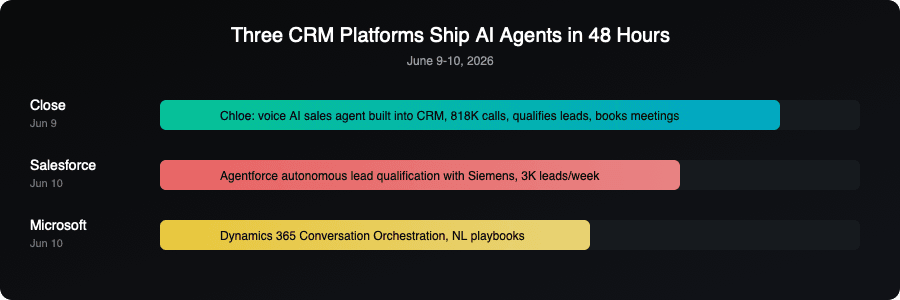
Three things happened between June 9 and June 10 that tell you where CRM and customer operations are headed. Close launched Chloe, an AI sales agent that lives inside its CRM and has already made 818,000 calls. Salesforce published a detailed case study on how Siemens uses Agentforce to qualify 3,000 leads per week with no human SDR in the loop. And Microsoft shipped Conversation Orchestration for Dynamics 365 Contact Center, replacing the rule trees that have governed contact center routing for decades with natural-language playbooks.
None of these are chatbots. None of them sit on top of existing workflows. All three are agents that execute work inside the systems where customer data already lives.
Close: the CRM that calls your leads
Close has been building CRM software for small and scaling businesses since 2013. Their pitch was always straightforward: built-in calling, email, SMS, and pipeline management without the enterprise complexity. On June 9, they made their CRM do something no other CRM at this price point does. They gave it a voice.
Chloe is an AI sales agent built directly into Close. During beta, 306 businesses used Chloe to make 818,000 calls, reach 111,000 prospects, and complete over 6,400 hours of conversations. That is 268 days of nonstop calling, handled by an agent that lives inside the CRM.
Chloe does not just dial numbers. She qualifies inbound leads, re-engages old opportunities, recovers missed calls, answers questions, and schedules meetings. Every interaction enriches the CRM record automatically. Ben Pace, founder of ClientMatchmaking.com, said their first week with Chloe booked 30 meetings, a 50 percent increase in total meetings booked.
Steli Efti, Close's founder and CEO, framed it plainly: "For most of the last twenty years, if you wanted faster lead response, more follow-up, or more sales activity, you hired more people. AI changes that equation."
This is a small business play. Close serves 11,500 businesses, not Fortune 500 accounts. Chloe is available on all Close plans for U.S. customers, with no separate integration or setup required. Your first agent can be calling leads within minutes of signup.
Salesforce: Siemens qualifies 3,000 leads a week with Agentforce
On the enterprise side, Salesforce published a deep technical case study on June 10 showing how Siemens uses Agentforce for autonomous lead qualification.
The Salesforce Engineering team built a multi-agent system that does something most lead qualification tools cannot. It does not wait for a prospect to initiate contact. Instead, Agentforce agents proactively drive the conversation through a structured qualification sequence, asking the right questions, constraining the conversation to the relevant topic, and assessing fit against Siemens' criteria.
This is a different operating model from reactive chatbots. The agent has to manage a conversation flow: progress through specific inquiry steps, read customer responses, adapt when the prospect goes off-script, and determine whether the lead meets qualification thresholds. Siemens runs 3,000 leads per week through this system.
The Salesforce blog post walks through the architecture in detail: how the team defined the agent's domain, built the qualification logic, integrated with CRM data, and set up guardrails to protect the customer relationship while pushing the sales pipeline forward.
Microsoft: natural language replaces rule trees in the contact center
Also on June 10, Microsoft shipped Conversation Orchestration for Dynamics 365 Contact Center. This one targets a different problem: the contact center queue.
Most contact centers route conversations through rule trees that take weeks to build, require IT to modify, and break silently until a customer complains. Microsoft replaced that model with playbooks written in natural language.
An admin writes an instruction like "If a premium customer is waiting in the queue and no support reps are available, increase their priority over time." Conversation Orchestration reads the instruction, monitors the queue in real time, evaluates conditions against CRM data, and executes the action. No rule tree. No change management ticket.
The first two capabilities ship in public preview. Dynamic Prioritization keeps priority scoring alive throughout the conversation instead of freezing it at queue entry. Overflow Based on CSR Availability fires the moment a conversation enters a queue with no eligible agents, routing to backup teams, offering callbacks, or closing gracefully depending on the customer segment.
What the convergence means
These three launches share a pattern that matters for anyone evaluating AI automation.
The AI agents are not bolt-ons. Close built Chloe into the CRM. Salesforce's Agentforce agents operate within the Salesforce org, using the same object model as human users. Microsoft's Conversation Orchestration reads CRM data directly to evaluate conditions. In all three cases, the agent has access to full customer context because it runs inside the system where that context lives.
The work is real work. Chloe made 818,000 qualifying calls. Siemens processes 3,000 leads per week. Microsoft is replacing configuration that takes weeks with natural-language instructions that take minutes. These are not pilot programs or demo features.
The target customer spans from solo founders to Fortune 100. Close serves businesses with small sales teams. Siemens is a global industrial company. Microsoft sells to enterprise contact centers. The same architectural pattern, agents that execute inside the CRM, works at every scale.
For SpringVanta's audience, the practical takeaway is this: if you are evaluating AI for sales, intake, or customer operations, the question is no longer whether to add an AI agent. It is whether your agent has access to the right data and can execute the full workflow. Agents that sit outside the CRM, that only answer questions or escalate to humans, are already behind.