Three Industries, One Week: AI Intake Agents Ship for Real
TD Bank cut mortgage processing from 15 hours to 3 minutes. Spero Health deployed AI intake across 60 clinics. Fello's Felix set 60 real estate appointments. Same week, s
By Springvanta
Same week. Three different industries. Same problem solved.
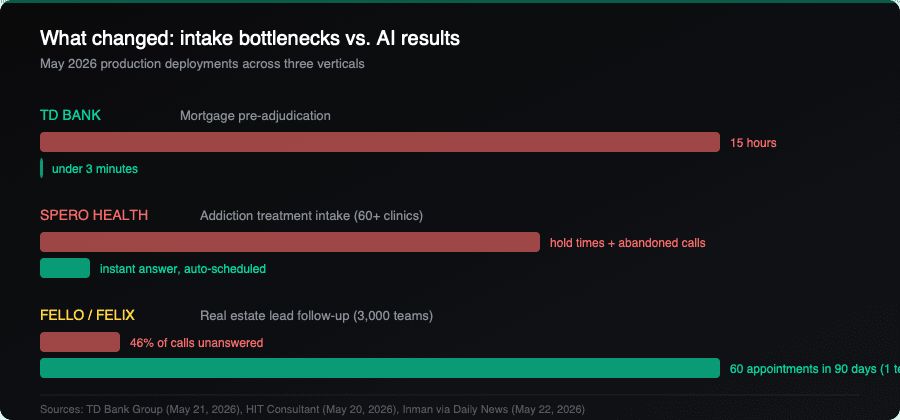
TD Bank cut its mortgage pre-adjudication process from 15 hours to under three minutes. Spero Health deployed AI intake agents across 60 addiction treatment clinics. A real estate platform called Fello launched an AI agent named Felix that set 60 listing appointments in 90 days of beta testing, and prospects on the phone kept mistaking it for a human.
These are not pilots. These are not demos. TD built the model in-house through Layer 6, its AI lab. Spero Health is rolling PatientOps out nationally. Fello has 3,000 real estate teams on its platform and Felix is entering public beta. What changed in the last two weeks is that vertical AI intake stopped being a pitch deck slide and started being an operational fact.
TD Bank: 15 hours to 3 minutes on mortgage applications
On May 21, TD Bank Group announced its first agentic AI model, developed by Layer 6, its in-house AI research center. The model handles pre-adjudication for mortgages and HELOCs. That means classifying client documents, extracting key information, calculating income, validating figures against policy requirements, running consent checks, flagging discrepancies, and generating a summary memo for the underwriter.
The whole thing averages under three minutes. The previous manual process averaged 15 hours.
TD's chief analytics and AI officer Luke Gee called it "a hybrid future where our colleagues and AI work together to help our clients get to a yes faster." The bank has mapped every step of its real estate secured lending and plans to introduce agentic AI at each stage, from document submission to funding release. TD is targeting $1 billion in annual value from AI.
What makes this different from basic automation: the AI agent doesn't just extract data. It reasons across multiple steps, evaluates its own output, and flags discrepancies before a human ever sees the file. The underwriter reviews the summary memo, but the document triage work that consumed the bulk of those 15 hours is gone.
Spero Health: answering every call in addiction treatment
The first call to an addiction treatment provider is a clinical milestone. If someone with substance use disorder reaches out and hits voicemail or a phone tree, there is a good chance they don't call back. Ever.
On May 20, Spero Health announced a partnership with Nashville-based UnityAI to deploy the PatientOps platform across its network of more than 60 outpatient clinics. The platform replaces static phone trees with autonomous AI agents that answer inbound calls, identify patient needs, schedule appointments, and route callers to localized services. No human in the loop for the initial contact.
Edmund Jackson, UnityAI's CEO, said the system was built so that "reaching out leads directly to care connection." Chris DeGeorge, division VP at Spero Health, said UnityAI stood out because it was "built from the ground up to understand healthcare operations."
The context matters. More than 48 million Americans live with substance use disorder. Provider and intake staff shortages in the addiction treatment sector are severe. Administrative tasks consume an estimated 25 percent of total US healthcare spending. Spero Health isn't replacing clinicians. It's removing the bottleneck that prevented patients from reaching them.
Fello's Felix: the AI agent real estate prospects can't distinguish from a human
Ryan Young leads one of Ohio's top-ranked real estate teams. He's also the CEO and co-founder of Fello, a proptech platform used by about 3,000 real estate teams nationally. His problem was familiar to every real estate broker: teams spend thousands on marketing, generate high-intent leads, and then nobody follows up.
Felix is Fello's answer. It's an AI agent that calls, texts, and emails leads autonomously. It ingests property ownership history, equity positions, mortgage type, AVM estimates, and MLS activity, then builds an outreach strategy for each contact. When a contact's status changes, the strategy updates.
During a 90-day beta with Young's team, Felix set roughly 60 listing appointments. On a single Monday during the beta, Young's team received 30 handoffs.
The handoff design is worth noting. Most AI calling tools put the prospect on hold and try to transfer to a human agent, which produces roughly 70 percent drop-off. Felix keeps the prospect in a live conversation while briefing the agent on a separate line, then bridges both parties when the human confirms they're ready.
During demo calls played for Inman, two separate prospects told Felix mid-conversation that they thought they were talking to a real person. One said: "If you had told me you were an actual person, I would have believed you." The other said: "This is one of the most sophisticated AIs I've ever talked to."
Fello layers what co-founder Tom Schrader calls "disfluency engineering" on top of ElevenLabs voice synthesis: deliberate pauses, hesitations, and inflection cues that make the speech pattern feel human rather than synthetic. Some calls lasted 15 to 20 minutes.
Young's assessment: "I can't imagine going back to the old way."
What the convergence tells us
These three deployments share a pattern that's worth paying attention to if you're evaluating AI for your own operations.
First, they all attack the intake bottleneck. The moment a customer, patient, or lead first contacts your business. That's where the highest drop-off rates live and where the operational cost of manual processing is most concentrated.
Second, none of them are general-purpose AI. TD's model was trained on mortgage and HELOC documents. UnityAI's PatientOps was built for clinical workflows. Fello's Felix was trained on real estate data. Vertical specificity is what makes the results possible. A generic chatbot can't classify mortgage documents or run conflict checks against a law firm's case management system.
Third, they all keep humans in the loop at the decision point. TD's underwriter still reviews the summary memo. Spero Health's clinicians still deliver care. Fello's human agents still close the listing appointment. The AI handles the intake work that was eating time and dropping leads. The humans do the work that requires judgment.
If you're running intake operations in any of these verticals, legal, healthcare, real estate, financial services, the question isn't whether vertical AI intake agents work. It's whether your competitors have already deployed them.
Sources
- TD Bank Launches Agentic AI to Transform Real Estate Secured Lending (TD Stories, May 21, 2026)
- TD's AI Just Made Mortgage Waiting Obsolete (PYMNTS, May 21, 2026)
- Spero Health Partners with UnityAI to Deploy PatientOps Platform (HIT Consultant, May 20, 2026)
- UnityAI Partners with Spero Health (UnityAI Blog, May 19, 2026)
- Meet Felix, The AI Agent That Real Estate Prospects Mistake For a Human (Inman via Daily News, May 22, 2026)