AI Agent Pricing Flipped: Pay for Results, Not Activity
Zendesk, HubSpot, and Kustomer all moved to outcome-based AI agent pricing within six weeks. What changed, what the fine print says, and what to ask your vendor.
By Springvanta
Something shifted in AI customer service pricing between April and May 2026, and it happened fast enough that most buyers haven't caught on yet.
Three vendors, Zendesk, HubSpot, and Kustomer, each independently moved to outcome-based pricing for their AI agents within a six-week window. Not "outcome-aligned" or "outcome-influenced." Actual per-resolution billing. You pay when the AI resolves the customer's issue. You don't pay when it doesn't.
That is a different deal structure than what SaaS buyers are used to. And the specifics matter, because what counts as "resolved" varies a lot between vendors.
What actually changed
HubSpot moved first. On April 14, Breeze Customer Agent switched from $1.00 per conversation (whether resolved or not) to $0.50 per resolved conversation. Breeze Prospecting Agent also shifted, from $1.00 per monitored contact per month to $1.00 per recommended lead. You only pay when the agent surfaces a lead it actually recommends for outreach.
HubSpot's Chief Customer Officer Jon Dick was blunt about the reasoning: "You pay when it works, full stop."
There is a catch. HubSpot defines a conversation as "resolved" when the AI shares content or performs an action, and the customer doesn't escalate to a human within 72 hours. If a customer comes back after that window, the conversation reopens and you can get charged again. A single email thread with three issues spaced 72+ hours apart could cost $1.50 under the new model versus $1.00 under the old one. For teams handling lots of long-running email threads, the savings might be smaller than the headline 50% cut suggests.
Zendesk has been running outcome-based pricing since August 2024. They were first. At their Relate conference on May 19, they doubled down with "Verified Resolutions," a system trained on 20 billion tickets that checks whether a resolution actually stuck. Their rate runs about $1.50 per automated resolution, roughly 3x HubSpot's price, but with a more rigorous definition of what "resolved" means.
Kustomer entered the frame on May 21 with Architect, a goals-driven AI system where you define the outcome you want (retain this customer, resolve this issue) and the platform works backwards to orchestrate the right mix of AI, workflows, and human collaboration. It is less about the billing model and more about the operating model. Architect is built around the idea that CX operators, not engineers, should configure how AI behaves. It also speaks MCP, meaning it can connect to any external system that exposes an MCP server.
The bigger pattern
This is not three companies copying each other. It is a response to the same market pressure from three different angles.
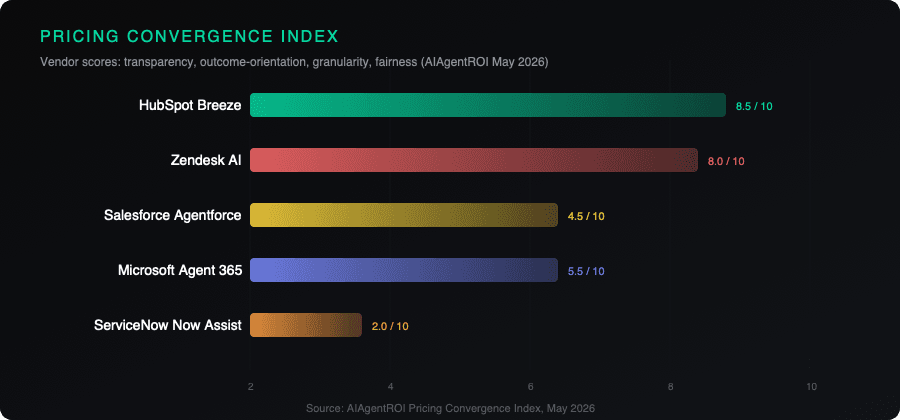
AIAgentROI, a research firm that tracked pricing across eight major AI agent platforms weekly from March through May 2026, published their findings on May 5. Their data: outcome-based pricing went from 1 vendor (Zendesk) to 3 of 8 tracked vendors by April 2026. Including Salesforce's hybrid Flex Credits model, it is 4 of 8, half the market.
The raw economics explain why. Model API costs dropped roughly 80% between early 2025 and early 2026. A customer-service interaction that costs about $0.003 in raw model tokens (GPT-4.1 mini rates) is being billed at $0.50 to $1.50 by platforms. That is a 178x to 535x markup. The markups cover real things: integration, orchestration, security, SLAs. But they are getting harder to justify when the underlying compute cost is collapsing.
AIAgentROI scored each vendor on pricing transparency, outcome-orientation, granularity, and fairness to small buyers. HubSpot came out on top at 8.5 out of 10. Zendesk scored 8.0. The laggards, ServiceNow at 2.0 and UiPath at 2.5, still operate on opaque, sales-negotiated annual contracts with no published outcome billing.
Why this matters if you are buying
The risk is shifting to the vendor. Under per-conversation or per-seat pricing, you pay whether the AI does anything useful or not. Under outcome pricing, the vendor eats the cost of agent failures. If HubSpot's agent resolves 40% of conversations, HubSpot only gets paid for 40% of the volume. That is a strong incentive to make the agent better. It also means your bill scales with actual value, not activity.
Read the resolution definition carefully. HubSpot's 72-hour window and Zendesk's "verified" standard are measuring different things. A "resolution" in HubSpot's world can mean the customer simply stopped responding. A "verified resolution" in Zendesk's world means the system confirmed the issue stayed resolved. The price per unit matters less than what the unit measures.
The best time to negotiate outcome terms is now. AIAgentROI's data shows 5 of 8 vendors still bill by seat, action, or robot. That is not because they cannot do outcome billing. It is because buyers have not demanded it. If your vendor does not offer outcome pricing, ask. The framing writes itself: "If your agent works as well as you say it does, outcome billing costs you nothing extra. If it doesn't, why am I paying for failures?"
What I would watch next
Salesforce is the obvious domino. Agentforce already has a hybrid model with Flex Credits, and SaaStr called their pricing "unnecessarily convoluted" in February. Salesforce has the technical plumbing for outcome billing via Headless 360, announced at TDX 2026 in April. The question is whether they simplify before competitors force them to.
Microsoft is the harder read. Agent 365 went GA on May 1 at $15/user/month, a per-seat model that looks increasingly out of step with where the market is heading. But Microsoft sells in bundles, not individual features, so they may resist outcome billing longer than pure-play CX vendors.
Kustomer's Architect is the most interesting long-term bet. Rather than just changing the billing trigger, they are changing the operating model. You tell the platform what outcome you want, and it figures out how to get there. If that works at scale, it makes the pricing question almost secondary. You are not buying "resolutions" anymore. You are buying "retained customers" or "protected revenue."
That is a different conversation entirely.
Sources:
- HubSpot Breeze pricing change announcement (April 2, 2026): hubspot.com
- Resolve247 analysis of HubSpot's new pricing model (May 19, 2026): resolve247.ai
- Kustomer Architect announcement (May 21, 2026): kustomer.com
- AIAgentROI 2026 Q2 Pricing Convergence Index (May 5, 2026): aiagentroi.io
- Zendesk Relate 2026 announcements (May 19, 2026): zendesk.com
- SaaStr analysis of Salesforce Agentforce pricing (February 2026): saastr.com