Three Vertical AI Deals in 72 Hours, Zero Pilots Among Them
Vonage embedded AI agents in its contact center, Elation acquired Aster's voice intake startup, and Fullspan launched Healthline AI for 63 million users. All in the same week.
By Springvanta
Three deals in 72 hours
Between June 3 and June 5, three things happened that, taken together, say something specific about where vertical AI intake is headed.
Vonage, the Ericsson-owned communications platform, launched industry-specific AI agents inside its contact center product. Elation Health, which serves 50,000 clinicians and 24 million patients, acquired Aster, a women's health startup built around agentic voice AI for patient intake. And Fullspan Health, the company behind Healthline and Medical News Today, rolled out a conversational AI companion for its 63 million monthly users.
None of these are pilot programs. None are "AI-enhanced" features bolted onto existing workflows. They are vertical AI intake either embedded in enterprise infrastructure, acquired into a primary care platform, or deployed at consumer scale.
Vonage bakes vertical AI into the contact center
On June 3, Vonage announced partnerships with two agentic AI vendors: Avaamo for healthcare and Syndeo for financial services and retail. The integration puts vertical-trained AI agents directly inside Vonage Contact Center (VCC), which already connects to Salesforce, HubSpot, Microsoft, Zendesk, and others.
For healthcare practices using VCC, the Avaamo integration means AI agents that can handle appointment scheduling, care navigation, billing inquiries, and test result access over the phone. Live agents step in only when clinical judgment or complex support is needed. Avaamo's VP of Global Partnerships, Rathnavel Kandaswamy, was blunt about what this replaces: "Healthcare organizations need AI that moves beyond chatbots to being able to actually complete routine tasks that drive operational outcomes."
On the financial services side, Syndeo brings a platform that blends deterministic logic with generative AI and flow-guided guardrails. The point is to handle customer calls in regulated industries where wrong answers carry legal risk, not just brand embarrassment.
Jim Lundy, CEO of Aragon Research, framed it as addressing real demand: enterprises want control of their AI strategy with the ability to ensure compliance and customer trust. The integration approach is what matters here. Embedding vertical AI inside the existing contact center rather than requiring a separate tool removes the "one more vendor" objection that has slowed adoption in healthcare and financial services.
Elation Health acquires Aster's voice intake agent
On June 5, Elation Health announced its acquisition of Aster, a startup founded in 2023 by two sisters: Dr. Lailah Kara-Newton, an OB-GYN, and Fifi Kara, a former health product design manager at Meta. The origin story is specific. Kara-Newton experienced undiagnosed preeclampsia during her first pregnancy, underwent an emergency C-section, and her son spent time in a NICU. She and her sister built the tools they wished had existed.
Aster's product includes an AI-native EHR for women's health, practice management tools, and an agentic AI voice agent called Atlas. According to the company, it has processed more than 9,500 automated intake forms and cut charting time by 50%.
Elation Health, which describes itself as building "the first agentic operating system for primary care," now has Aster's voice intake technology and the team that built it. The Aster founders and CTO Nacho Vazquez are joining Elation. Terms were not disclosed. This is Elation's second acquisition.
The acquisition pattern is worth watching. Primary care platforms are buying vertical intake startups rather than building the capability from scratch. If you run an AI intake startup in another vertical (legal, real estate, insurance), this is your market signal.
Fullspan Health puts conversational AI in front of 63 million people
Also on June 5, Fullspan Health launched Healthline AI, a conversational agent that answers health questions using only medically reviewed content from Healthline, Healthgrades, Medical News Today, and Psych Central.
The consumer demand numbers are worth sitting with. According to OpenAI, one in four ChatGPT users submits a healthcare prompt every week. That is 200 million people asking a general-purpose AI health questions on a regular basis. A March 2026 Rock Health survey found that 32% of respondents now use chatbots for health information, up from 16% in 2024.
Fullspan's own consumer research found 90% of respondents were interested in a conversational health experience, and nearly 70% said they would trust it more than ChatGPT. The product launches with Type 2 diabetes content and is set to scale across Fullspan's entire audience.
The architecture choice matters. Healthline AI only draws from Fullspan's own medically reviewed properties. It does not browse the open web or generate answers from training data. That is a deliberate tradeoff: giving up breadth for verifiable sourcing. Consumer health AI is going toward walled gardens with editorial control, not general-purpose chatbots.
What the convergence tells us
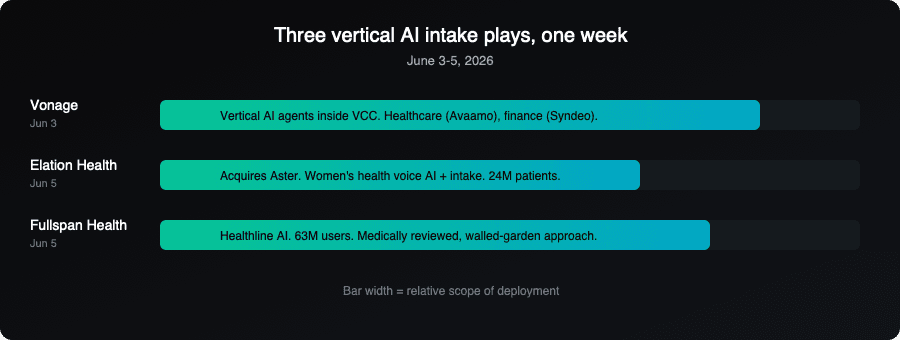
Three stories from the same window, three different entry points into vertical AI intake.
Vonage is the infrastructure play. Embedding vertical AI agents inside an existing contact center platform that already connects to Salesforce, HubSpot, and Zendesk. The target buyer is a healthcare or financial services IT director who does not want another vendor to manage.
Elation is the acquisition play. Buying Aster for its voice intake agent and women's health EHR rather than building one. The calculation: building was slower than buying.
Fullspan is the consumer play. Putting conversational AI in front of 63 million users with medically reviewed content guardrails. The target buyer is a health system or pharma company that wants AI engagement without hallucination liability.
Each approach assumes something different about adoption. Vonage assumes enterprises will adopt AI if it lives inside tools they already pay for. Elation assumes vertical-specific intake agents are valuable enough to acquire. Fullspan assumes consumers will trust AI health tools if the sources are verifiable.
All three assumptions are being tested right now, in production, at scale.
What this means if you are evaluating AI intake
If you are a healthcare practice, legal firm, or real estate team looking at AI intake tools, a few things stand out from this week.
Integration matters more than feature lists. Vonage's play works because the AI agent lives inside VCC, not in a separate dashboard. When evaluating vendors, ask whether the AI integrates with your existing CRM, EHR, or contact center, or whether it requires its own interface.
Vertical-specific is now table stakes. Avaamo handles healthcare tasks, not generic customer service. Aster was built for women's health, not generalized intake. Syndeo has financial services guardrails baked in. General-purpose AI agents are losing ground to vertical-trained ones.
Acquisition activity is a signal. When established platforms start buying intake startups rather than partnering with them, the technology has moved from "interesting" to "strategic." Expect more acquisitions in legal and real estate AI intake over the next 12 months.
Sources:
- Vonage Launches Industry-Specific AI Agents for Healthcare, Financial Services and Retail Contact Centers (Business Wire, June 3, 2026)
- AI-Powered Health Startup Aster Has Been Acquired By Elation Health (NEWSx / Yahoo Finance, June 5, 2026)
- Fullspan Health debuts Healthline AI companion (Fierce Healthcare, June 5, 2026)