Voice AI Goes Regional: Four Regions Build Their Own Stacks in One Week
Four voice AI deals in four days across Africa, UAE, India, and South Korea reveal a pattern: regional companies are building their own stacks because Western platforms can't handle their dialects, latency, or cost structures.
By Springvanta
Four deals landed between June 1 and June 4 across Africa, the UAE, India, and South Korea. None of them involved a company you have heard of. All of them were building voice AI stacks from scratch because the Western platforms couldn't handle their customers.
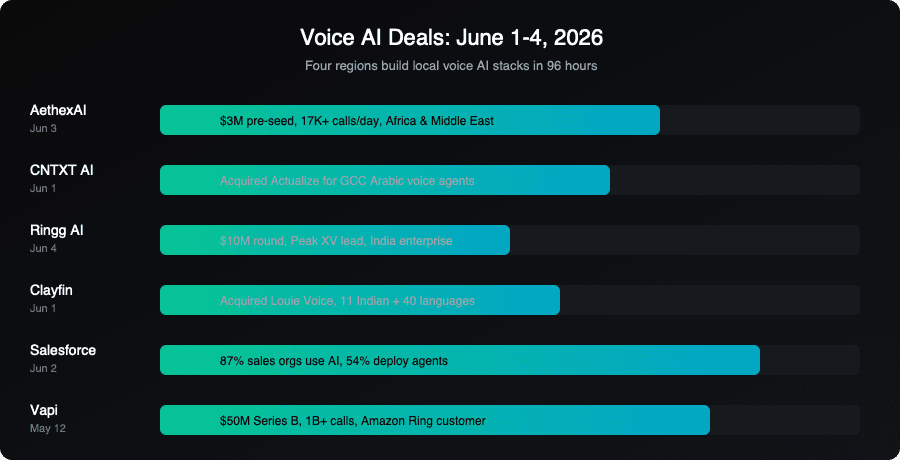
AethexAI raised $3 million in pre-seed to build voice agents for Africa and the Middle East. CNTXT AI acquired Actualize to add Arabic dialect-aware voice agents for the Gulf. Peak XV moved to lead a $10 million round in Ringg AI, a Bengaluru startup making voice agents for Indian enterprises. Clayfin bought Louie Voice to add voice banking in 11 Indian languages and 40 global ones.
Four regions. Four deals. One pattern: the companies that need voice AI the most are the ones least served by the platforms dominating the market.
What AethexAI built and why it matters
AethexAI's founders, Mariama Diallo (ex-Goldman Sachs) and Ayooluwa Odemuyiwa (ex-Meta, Caltech), didn't start by picking a technology. They started by looking at what was failing on the ground.
In Egypt, a call center had automated a large share of its calls, then rolled the system back because the results were bad. Several African support centers told them that hiring engineers to wire up automation at local price points was a recurring problem. The latency and jitter on automated calls in the region were, in Odemuyiwa's words, "outrageous."
So they built their own models. The Kora series ranges from 300 million to 1.7 billion parameters. That is a fraction of the size of the LLMs powering Western voice AI, which is the point. Smaller models mean lower latency, lower compute costs, and the ability to run on infrastructure that isn't optimized for US or European data centers.
They trained Kora on anonymized call center recordings and audio data they collected by shipping hard drives to radio stations across Africa. A contributor network of university students annotated data and pronounced local names. AethexAI now processes more than 17,000 calls per day. Costs drop to around $0.03 per minute.
The use cases are specific and unglamorous: debt collection, customer activation, KYC verification for banks and telecoms. These are the high-volume, repetitive interactions where Western voice AI companies aren't competing because the economics and infrastructure don't work for them.
Arabic voice agents get their own stack
On the same day AethexAI announced its funding, CNTXT AI in Abu Dhabi completed its acquisition of Actualize, a startup building dialect-aware Arabic voice agents for the GCC.
The problem Actualize solved is specific but large. Most Arabic voice AI handles Modern Standard Arabic reasonably well. That's the formal version used in news broadcasts and official documents. People in the Gulf don't talk like that. They speak Gulf Arabic, Saudi dialects, Emirati Arabic. These are different enough from Modern Standard Arabic that a model trained on one will stumble on the other.
Actualize built voice models natively for GCC dialects, with what Middle East AI News described as "some of the most natural-sounding Arabic speech" in the market. The platform also handles task completion: bookings, updates, transactions. Not just responding to queries, but doing things.
CNTXT AI will integrate Actualize into Munsit, its Arabic voice AI platform. The founders, Muhammed Shabreen and Khalid Ghiboub, join as CTO and VP of AI Models. The GCC conversational AI market is projected to grow from roughly $400 million in 2025 to nearly $2.5 billion by 2034, according to the company's market estimates.
India's voice AI moment
Peak XV Partners, the venture firm formerly known as Sequoia India, is in talks to lead a $10 million round in Ringg AI, a Bengaluru startup that builds voice AI agents for enterprises. The firm already led a $50 million Series B in Vapi in May.
Ringg AI, founded by Siddharth Shankar Tripathi, Utkarsh Shukla, and Kali Charan Vemuru, had raised $5.5 million earlier this year. Peak XV's interest signals how fast the India voice AI market is moving: the Economic Times reports voice AI in India is growing at 60-70% month over month, driven by WhatsApp-led distribution and family adoption patterns where younger users introduce products to parents.
India matters for this sector because of its combination of mobile-first users, linguistic diversity, and mixed-language usage. For many Indian users, speaking is more natural than typing, especially in financial services, commerce, and customer support. The investor thesis is straightforward: the next wave of software adoption in India won't be led by typing.
The same week, Chennai-based Clayfin acquired Louie Voice, a voice banking platform that supports 11 Indian and 40 global languages. Louie Voice was founded by Pramit Bhargava, who lost his eyesight and built the platform to make digital services accessible through voice commands. The acquisition targets financial institutions that need to serve customers across literacy levels, language preferences, and accessibility needs.
The structural reason this is happening now
Salesforce's 2026 State of Sales report, released last week, gives the backdrop. 87% of sales organizations now use some form of AI. 54% of individual reps have deployed AI agents. 94% of sales leaders with agents installed call them critical for meeting business demands this year.
That data is drawn primarily from Salesforce's own customer base, which skews toward companies that can afford Salesforce. But even adjusted downward, the direction is clear. AI agents in customer-facing roles are past the adoption tipping point.
Now consider the gap. If 87% of sales organizations in Salesforce's survey are using AI, and those tools are built for English-speaking, high-bandwidth, GPU-rich environments, what happens to the enterprises operating in Lagos, Cairo, Bangalore, and Abu Dhabi? They process roughly three times the call volume of their Western counterparts, according to 4DX Ventures' Walter Baddoo, because voice remains the dominant channel in markets where not every customer is comfortable with text-based self-service.
Those enterprises can't use Vapi, ElevenLabs, or Salesforce Agentforce out of the box. The latency is too high. The dialect handling is too weak. The pricing doesn't work at their scale. The telephony integrations don't match their infrastructure.
That gap is what this week's four deals are filling.
What this means if you're evaluating voice AI
If you operate in a single English-speaking market with standard telecom infrastructure, the Western platforms will probably work for you. Zendesk, Salesforce, Intercom, Aircall: they're all shipping capable voice AI tools now.
If you operate in regions where customers speak in dialects, code-switch between languages, or interact primarily through phone calls rather than apps, the landscape is different. You need either a platform built for your specific market, or enough engineering resources to adapt a general-purpose one.
The practical questions haven't changed, but the answers are getting more regional:
- Latency target: under 400ms for conversational feel. If your provider routes through US or European servers, test round-trip time from your actual call centers, not from a demo environment.
- Dialect coverage: ask for live test calls with real customers, not scripted demos. AethexAI's approach of shipping hard drives to radio stations for training data is a good indicator of how much work dialect coverage actually requires.
- Cost per minute: AethexAI claims $0.03. Western platforms often charge $0.10 to $0.25 per minute for voice agent calls. At 17,000 calls per day, that gap compounds fast.
- Use case focus: start with one high-volume, repetitive workflow. Debt collection, KYC, appointment booking. Don't try to automate the entire call center on day one.
Where this goes next
The regional voice AI buildout follows a pattern we've seen before in fintech and mobile infrastructure. First, global platforms expand into new markets. Then, local companies build purpose-fit alternatives because the global platforms don't go deep enough on local requirements. Then, some of the local platforms become good enough to expand into adjacent markets.
AethexAI is targeting 1.5 billion people across Africa and the Middle East. CNTXT AI is aiming at the entire GCC, a market projected to grow sixfold by 2034. India's voice AI market is compounding at 60-70% monthly growth. None of these companies are trying to compete with Vapi or ElevenLabs in San Francisco. They're building for customers those companies can't serve profitably.
The deals this week are small by Silicon Valley standards. $3 million pre-seed. A $10 million round. An acquisition with undisclosed terms. But the pattern they form is worth watching: voice AI is splitting into regional stacks, and the companies building for their own markets are already handling production call volumes that would make many Western startups look like they're still in beta.
Sources:
- TechCrunch: AethexAI raises $3M for voice AI in Africa and the Middle East (June 3, 2026)
- Economic Times: Peak XV in talks to back Ringg AI (June 4, 2026)
- Middle East AI News: CNTXT AI acquires Actualize (June 4, 2026)
- PR Newswire: Clayfin acquires Louie Voice (June 1, 2026)
- Salesforce: State of Sales Report 2026
- Salesprep: AI agents in sales 2026 data points