Two Algorithm Shifts in 48 Hours: Why Search Visibility Split in Two
Google's May 2026 core update landed 48 hours after I/O's AI Search redesign. AI Overview citations from top-10 organic dropped from 75% to 17-38%. Here is what to measur
By Springvanta
If you track search rankings, this week has been disorienting on purpose. Google dropped the May 2026 core update on May 21, two days after wrapping an I/O conference where it announced the biggest Search redesign in over a decade. Two foundational changes, 48 hours apart. If your Search Console data looks chaotic right now, that is why.
The timing is not coincidence. The core update reshuffles organic rankings. The I/O announcements, powered by Gemini 3.5 Flash, reshape how those rankings get presented, synthesized, and surfaced inside AI-generated answers. One moves who shows up. The other moves how people see it. Together they make it nearly impossible to isolate which change caused what.
This matters because the gap between organic ranking and AI search visibility has been widening for months, and this week it cracked open further.
The numbers behind the split
AI Overviews now serve 2.5 billion monthly users. AI Mode hit 1 billion. Those are Google's own figures from I/O. At that scale, citation behavior is not a niche SEO concern. It is where your prospective buyers encounter your brand or do not.
Here is the part that should worry anyone still optimizing only for blue links: the overlap between organic top-10 results and AI Overview citations has collapsed. Late 2024 research showed roughly 75% of AI Overview citations came from pages in the organic top 12. BrightEdge put it at 54% in October 2025. Two independent 2026 studies (Ahrefs and ALM Corp) now put it between 17% and 38%.
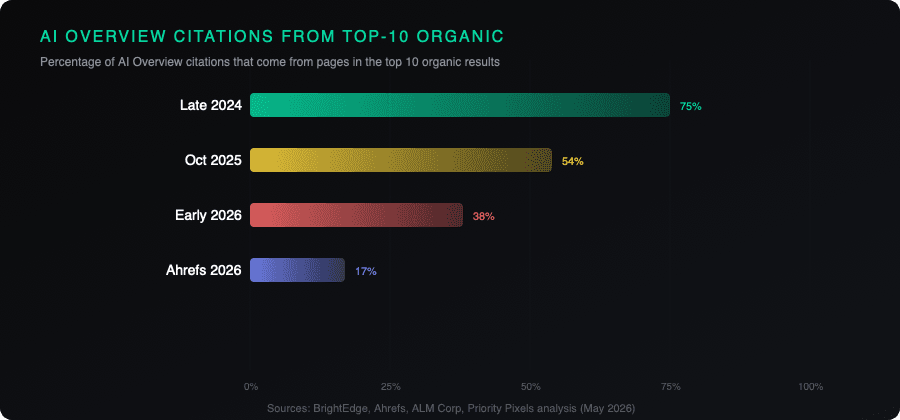
The driver is Google's fan-out query process. When someone asks a question in AI Mode, Google breaks it into multiple sub-queries and cites pages that perform well across that wider cluster. A page ranking sixth for the original query might get cited because it ranks first for a sub-query the user never typed. The old mapping between keyword position and citation is broken.
What Conde Nast saw before everyone else
Nine days before the core update dropped, Conde Nast CEO Roger Lynch went on TBPN and said something that rattled the industry. He told every brand in the company's portfolio to plan their businesses as if Google search traffic will be zero.
This was not hyperbole. Lynch said forecasts had underestimated actual traffic declines for three consecutive years. He blamed algorithm changes, AI Overviews eating click-through, and Google pushing more commercial results above organic listings. The Financial Times reported him calling Google search "no longer a meaningful driver" of traffic to Conde Nast properties, and describing AI Overviews as "another sort of death blow" to publisher referrals.
Conde Nast's response was telling. They did not double down on SEO. They raised subscription prices and leaned into direct audience relationships. Lynch described a "barbell effect": either be large and authoritative in a big category, or nail a specific niche with loyal paying readers. The middle ground, broad but shallow, is where the traffic collapse hits hardest.
That lesson translates beyond publishing. If you are a B2B company relying on search traffic for lead generation, the same forces are at work. AI answers summarize your content without sending the click. The question is what you build that does not depend on Google as a middleman.
Why Search Console is not enough this time
Most marketing teams watch one dashboard. Search Console measures organic appearance, clicks, impressions, and position for standard blue-link results. That covers maybe half of how people find you now.
What it does not cover: AI Overview citation, AI Mode appearance, or your visibility inside ChatGPT, Perplexity, and Copilot. Those use independent training and retrieval systems. A Google core update tells you nothing about them.
During this rollout, some sites will see organic traffic hold steady while AI Overview citations drop by half. Others will lose organic positions and gain citations. Both outcomes are real. Neither shows up if you only watch one surface.
Google's recommendation is the same as always: wait one full week after rollout completes (roughly June 11) before drawing conclusions. That is sound advice, but this time you need to extend it across three measurement layers: Search Console for organic baseline, AI Overview citation tracking for Google's AI surfaces, and AI share of voice across the independent LLMs. One dashboard cannot answer questions that span all three.
What to actually do right now
First, do not make structural changes during the rollout. Sites that delete or restructure content in week one regularly regret it when the dust settles. Treat the next two weeks as observation only.
Second, separate your Search Console data. Web, Images, Video, and News each have their own dynamics during a core update. Mixed data obscures what is actually happening.
Third, start tracking citation share for your priority query clusters on a week-over-week basis. Aggregate citation counts are noisy. Citation share (you vs. competitors for the same queries) is more stable and more actionable.
Fourth, measure your visibility beyond Google. If ChatGPT, Perplexity, or Copilot are part of how your prospects research vendors, you need a baseline for those too. The changes from this core update will lag into those surfaces by days or weeks as each LLM refreshes its index on its own schedule.
The bigger picture
The May 2026 core update is not just another ranking shuffle. It is the first core update to land after Google fully committed to an AI-first Search interface. The intelligent search box, information agents, generative UI: these are not experiments. They are the product now. Blue links are the fallback.
For businesses that sell through search, the operating assumption needs to shift. Ranking well is still worth pursuing, but it is no longer sufficient. You need to show up in the synthesized answer, not just the link list. Those are two different optimization problems with two different sets of inputs, and solving only one leaves half your visibility on the table.
Conde Nast's Lynch had it roughly right. You probably will not hit zero search traffic tomorrow. But planning as if the trend continues is the realistic bet right now. Build what works when Google is not the gatekeeper.
Sources: Search Engine Land, Search Engine Journal, Priority Pixels, Search Engine Roundtable, Search Engine Journal (Conde Nast), AdTech Radar