Vertical AI Hit $200M ARR This Week While Most Companies Were Still Piloting
EliseAI hit $200M ARR, AppFolio connected agents to Claude, and Cohere Health expanded clinical AI to five functions. Vertical AI stopped piloting and started running.
By Springvanta
Vertical AI Hit $200M ARR This Week While Most Companies Were Still Piloting
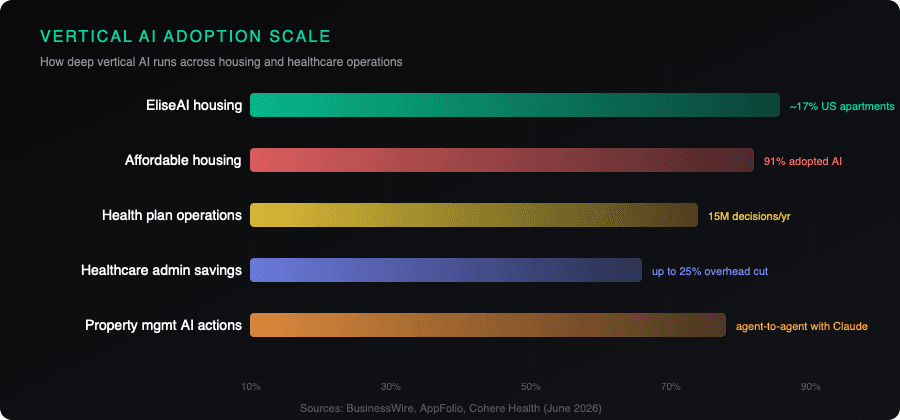
Three things happened in the same 72-hour window. On Monday, June 9, AppFolio announced an agent-to-agent connector between its Realm-X AI suite and Anthropic's Claude, letting property managers trigger real operational work from a chat interface. On the same day, Cohere Health expanded its Unify platform from utilization management into five more health plan functions, backed by 15 million annual clinical decisions. On Tuesday, June 10, EliseAI announced it crossed $200 million in annual recurring revenue, having doubled every year for five years. One in six apartments in the United States now runs on EliseAI.
These are product announcements on their own. Together they answer a question that every operator evaluating AI automation keeps running into: does vertical AI actually work at scale, or are we still in the pilot phase?
It works. And the companies proving it are not horizontal AI vendors selling generic agents. They are domain-specific platforms that spent years inside the messy, compliance-heavy workflows of housing and healthcare, and are now emerging with revenue curves that look more like enterprise SaaS than startup experiments.
EliseAI: $200M says it works
Five consecutive years of 100% year-over-year growth is rare at any stage. Doing it while serving housing and healthcare, two industries that resist standardization, is harder still. EliseAI's $200 million ARR comes from automating the full resident lifecycle: leasing inquiries, maintenance requests, renewal follow-ups. In healthcare, the same platform handles appointment scheduling, patient intake, and prior authorizations.
CEO Minna Song said something that stuck with me: "The industries where AI matters the most are not the ones getting the most attention." Housing and healthcare together account for more than 40% of the average American household budget, according to Bureau of Labor Statistics data. Healthcare administrative costs alone exceed $600 billion annually in the US, with $150 billion attributable to missed appointments.
The affordable housing angle is where this gets real. Vesta Corporation's Joshua Greenblatt described operating conditions that will sound familiar to anyone running lean operations in regulated industries: strict compliance requirements, thin teams, and residents with no safety net if something breaks. EliseAI's value there is not incremental efficiency. It is operational consistency that the organization literally could not staff its way into.
EliseAI claims its healthcare platform cuts overhead by up to 25% and reduces abandoned calls. For practices facing staffing shortages and rising call volumes, the company positions itself as the layer where the patient experience begins, not an add-on.
AppFolio: agents talking to agents
AppFolio's Realm-X connector with Anthropic's Claude is interesting because of what it does not do. It does not expose API endpoints that return query results. Instead, it exposes operational jobs that Claude can trigger and that execute inside AppFolio's existing platform, governed by the same accounting rules, permissions, and compliance guardrails that property managers already use.
Realm-X understands property management operations natively. When Claude receives a request from a property manager (say, "process all renewal offers for buildings with occupancy above 95%"), it hands off to Realm-X, which executes that request within the customer's established workflows. Every action inherits existing platform guardrails. The distinction matters: this is structured work execution, not a chatbot querying a database.
Kyle Triplett, AppFolio's Chief Product Officer, framed it as giving property managers access to the platform "whether they are at their desk or mobile." Travis Bryant from Anthropic called it "moving beyond simple chat to sophisticated agents that can execute meaningful work within complex industries."
The connector debuts at the National Apartment Association's Apartmentalize conference on June 17-19. A public conference demo of production agent-to-agent workflows is a pretty clear signal that property management AI has moved past the experimentation phase.
Cohere Health: from one function to five
Cohere Health's Unify expansion got the least attention of the three. It may be the most ambitious. The platform already handled utilization management and payment accuracy. Now it extends the same clinical intelligence layer into appeals, care management, claims operations, and quality measurement.
CEO Siva Namasivayam made a distinction that cuts against how most enterprises approach AI: "Health plans have been told to add AI to existing broken processes. Cohere Health offers a different path: redesigning how clinical operations work." Retrofitting AI onto fragmented workflows gives you fragmented AI. Cohere's bet is that a unified clinical intelligence layer, built by people who actually ran health plan operations, grows more valuable as it covers more functions.
The scale backs this up. Cohere's agentic skills library spans 15 million clinical decisions annually, 4,500 clinical policies, 100,000 clinical indications, and 27 million unique patient profiles. The platform holds HITRUST, NCQA, and URAC certifications. This is a scaled operation extending its reach, not a startup searching for product-market fit.
What this means if you are evaluating AI
-
Domain depth beats model capability. None of these companies compete on whose LLM is smarter. They compete on how deeply they understand leasing workflows, prior authorization rules, or property management accounting. The model is infrastructure. The domain knowledge is the product.
-
Compliance is a feature, not an obstacle. EliseAI handles state-by-state housing compliance. Cohere Health built for HIPAA, HITRUST, and NCQA from the start. AppFolio's agent connector inherits existing platform permissions. They did not bolt compliance on after the fact. They started inside regulated workflows and built outward.
-
Revenue is the proof. $200 million ARR with 100% annual growth is not a vanity metric. It means paying customers are getting measurable value. Vesta Corporation described the shift as moving staff from paperwork to people. That is the ROI case in one sentence.
-
Agent-to-agent is here. AppFolio's Realm-X connector is early, but the direction is clear. AI agents will call each other, hand off work, and execute multi-step processes within governed environments. Property management is the test case. Legal, healthcare intake, and financial services are next.
-
The industries that need AI most get the least attention. Song's observation applies beyond EliseAI. The highest-value AI automation opportunities live in industries with complex compliance, thin staffing, and high transaction volumes. Real estate, healthcare administration, legal intake. Not generative content creation.
Sources
- EliseAI Hits $200M ARR After Five Consecutive Years of 100% Growth — BusinessWire, June 10, 2026
- AppFolio Connects Realm-X to Anthropic's Claude — AppFolio press release, June 9, 2026
- Cohere Health Gives Health Plans a Path Beyond Retrofitting AI to Redesigning Operations — Cohere Health, June 9, 2026