From Conversation to Action: Voice AI's Week of Reckoning
Aircall buys Piper AI, NiCE makes agentic AI native to CX, and Fin ships Voice 2. Three moves in one week betting on the same thesis: voice AI must do more than talk.
By Springvanta
From Conversation to Action: Voice AI's Week of Reckoning
Three companies made bets on the same thing this week. Aircall bought a revenue intelligence startup to turn calls into pipeline. NiCE rewired its entire CX platform around agentic AI. And Intercom's Fin shipped a voice model built specifically for resolving support tickets, not just chatting.
The shared thesis: voice AI that only talks is a dead end. The next generation has to do something with what it hears.
Aircall acquires Piper AI: from phone calls to revenue pipeline
Aircall announced June 3 that it has acquired Piper AI, a Spain-based revenue intelligence company, for an undisclosed sum. The deal extends Aircall beyond the conversation layer and into the revenue execution layer.
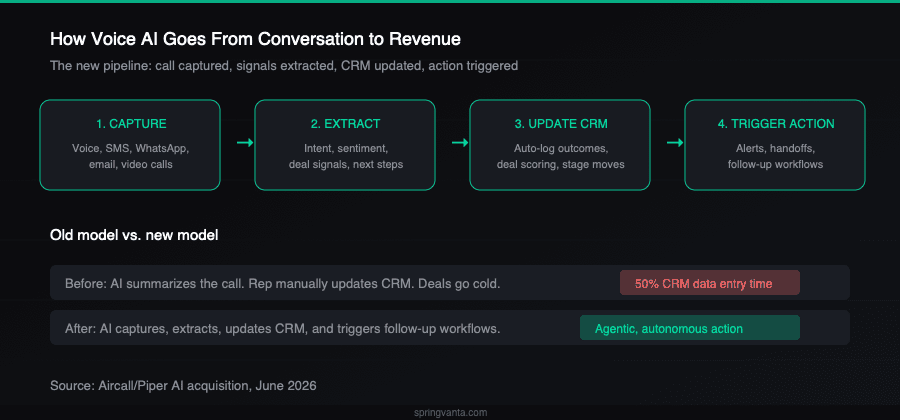
Here is what changes. Aircall already handles voice, SMS, and WhatsApp for 23,000 businesses. Its AI Assist suite coaches reps during calls, logs outcomes, and drafts follow-ups. Piper adds the connective tissue between those conversations and the CRM: it captures signals from calls, video meetings, emails, and messaging, then converts them into structured CRM updates, deal scores, and automated workflows.
Piper's customers report cutting CRM data entry time by more than 50 percent in the first month and improving forecast accuracy by 50 percent. That is the kind of number that gets attention from revenue leaders who have been burned by "AI-powered" tools that generate summaries nobody reads.
The structural play matters. As Aircall CEO Scott Chancellor put it: "AI becomes truly valuable for sales teams not when it stops at a summary, but when it turns every customer interaction into action, pipeline clarity, and time back for reps to sell." No other revenue intelligence company owns the communications channel itself. Aircall does. Piper turns that into a pipeline advantage.
For SpringVanta buyers running intake and lead qualification, this matters because the gap between "had a conversation" and "updated the CRM" is where leads die. Piper's agentic workflow engine triggers alerts, routes handoffs, and executes next steps when deal conditions change, not when a rep remembers to follow up.
NiCE goes all-in on agentic CX
On June 9, NiCE (NICE Ltd.) announced it has made agentic AI native to its entire CX platform. This is not a feature added on top of an existing contact center product. AI now runs as the core intelligence layer across voice, digital channels, self-service, agent assistance, analytics, and workflow orchestration.
NiCE Cognigy's Agentic AI operates as what NiCE calls the "brain" of the platform, reasoning across channels, orchestrating actions, and powering AI agents that can move from conversation to resolution. The platform has four layers:
- NiCE AI Agents handle autonomous resolution across voice and digital channels, understanding intent and completing workflows end to end.
- The Agentic Engagement Plane orchestrates interactions between customers, human agents, personal AI agents, and enterprise systems.
- NiCE Guardian AI monitors both AI and human actions in real time, applying compliance guardrails and detecting risk.
- Agentic Analytics moves beyond reporting what happened to identifying what should happen next.
The governance angle matters. NiCE holds SOC 2 Type II, ISO 27001, PCI DSS, and FedRAMP authorization. Enterprises in regulated industries cannot deploy AI agents without audit trails. Citi, Fabletics, and Arizona State University are already running production deployments.
NiCE's annual recurring revenue grew 66 percent year over year in Q1 2026. The company was the sole vendor named a Customers' Choice in the 2025 Gartner Peer Insights Voice of the Customer for Enterprise Conversational AI Platforms. That production track record separates serious platforms from demo-ware.
Jeff Comstock, President of CX Product and Technology at NiCE: "Running AI at the scale, security, and compliance that enterprise customer operations demand takes more than a demo. It takes AI built into the architecture rather than added on top."
Fin Voice 2: a model built to resolve, not just talk
Also on June 9, Intercom's Fin launched Voice 2, a new version of its AI phone support agent running on Apex Flash, a voice AI model developed specifically for customer support rather than adapted from a general-purpose conversational model.
Fin claims a 24.5 percent improvement in resolution rates and a 0.5-second reduction in response latency compared to the previous version. Those are the two metrics that determine whether a voice AI agent gets deployed or shelved. Resolution rate is whether it works. Latency is whether customers can tell it is a machine.
Intercom CEO Eoghan McCabe was blunt: "Voice is just extremely hard. And while we all know the future of customer experiences will be agent-driven voice, we are not there yet. That changes today."
The platform connects directly to business systems, completing tasks and resolving inquiries without transferring to another channel or human agent. It also provides real-time visibility into unresolved conversations, so CX leaders can spot friction points and intervene where the AI falls short.
For businesses evaluating voice AI for support, the model specialization angle is important. General-purpose models are good at sounding natural but mediocre at resolving issues. A model trained on support-specific data has a better chance of getting the right answer on the first try.
The pattern: voice AI stops being a listener
These three moves share a common thread. Voice AI spent 2024 and early 2025 proving it could have natural-sounding conversations. The bar was low: sound human, respond fast enough that the caller does not hang up.
That problem is mostly solved.
The new problem is action. What does the AI do with what it heard? Does it update the CRM? Does it trigger a follow-up workflow? Does it escalate to a human before the deal goes cold? Does it actually resolve the customer's issue, or just collect information and hand it off?
Aircall's answer: own the conversation channel and the revenue intelligence layer. NiCE's answer: make AI the architecture, not a feature. Fin's answer: build a model for one job and measure resolution rates, not sentiment scores.
For SMBs evaluating voice AI, the practical question is the same across all three. When you demo a voice AI tool, ask what happens after the call ends. If the answer is "it generates a summary," keep looking. If the answer involves CRM updates, workflow triggers, deal scoring, or autonomous resolution, you are in the right conversation.
Sources
- Aircall Acquires Piper AI (Aircall, June 3, 2026)
- NiCE Announces the Future of AI-Powered CX (NiCE, June 9, 2026)
- Fin Launches Voice AI Agent for Customer Support (CXM Today, June 9, 2026)
- fonio.ai raises $17M for omnichannel AI platform (Tech.eu, June 9, 2026)