One week, two AI tracks: who builds, who buys
Kirkland & Ellis is spending $500M on proprietary AI. Cognizant and HouseWhisper opened agent platforms. Three industries, one week, two different strategies.
By Springvanta
Kirkland & Ellis is spending half a billion dollars on AI it will own outright. Cognizant just opened its healthcare platform to any agent that can call an API. HouseWhisper turned its real estate assistant into an outbound lead machine.
These three announcements landed between May 27 and May 29. Read together, they map a split in vertical AI that's worth understanding before you pick a direction for your own organization.
Kirkland's $500M bet on institutional knowledge
Kirkland & Ellis reported $10.6 billion in revenue last year, making it the highest-grossing law firm in the world. On May 28 it said it would invest $500 million over three to four years, starting with $100 million in 2026, to build a custom AI platform. The platform draws on input from 250 lawyers, including 100 partners, and more than 180 technology professionals. Kirkland will own all of the intellectual property. Outside companies involved in the build cannot resell it.
Chair Jon Ballis explained the logic plainly: widely available AI was "raising the floor for everyone," but "we don't get hired for the floor."
That's an honest read. Kirkland's clients pay for judgment, precedent knowledge, and deal instinct that no off-the-shelf tool reproduces. If the firm can encode how its partners think about complex transactions and litigation, it creates something proprietary. Something Harvey and Legora can't sell to the firm across the street.
The legal AI market is splitting along this line. Most large firms are licensing. Harvey keeps signing new customers. Freshfields partnered with Anthropic in April to co-develop legal AI tools. Cleary Gottlieb acquired generative AI company Springbok in March 2025 to build in-house. Kirkland is going further than anyone: keep it proprietary, own the IP, don't share.
The math works at scale. $500 million over four years is roughly 1.2% of Kirkland's top line. For a 20-person plaintiff firm doing $8 million in annual revenue, the proportional spend would be around $100,000 a year, which might cover two software licenses and a part-time consultant. That firm can't build. It can buy. And the tools it can buy are getting better.
Cognizant's API model: agents as platform users
Cognizant went the opposite direction on May 29. Instead of building proprietary AI for a single organization, it opened TriZetto Unify, its healthcare platform spanning payer and provider workflows, to any AI agent that can call an API.
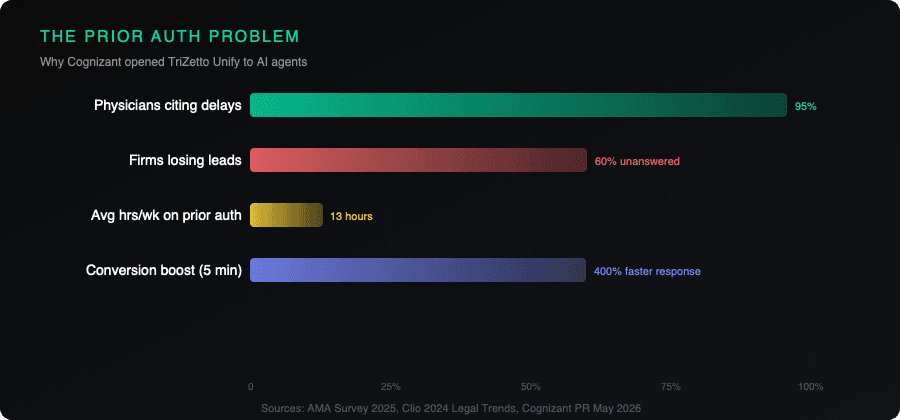
The scale is worth pausing on. TriZetto platforms support more than 200 million healthcare members in the U.S. and process over $500 billion in annual healthcare spend across claims, eligibility, prior authorization, and payment integrity.
The first live solution is Electronic Prior Authorization. Three FHIR-based API resources let an agent check whether prior authorization is needed for a given procedure, identify the required documentation, and submit the request. The APIs also support the Model Context Protocol, the emerging standard for how AI agents interact with external tools.
Prior authorization is one of the worst administrative bottlenecks in U.S. healthcare. The American Medical Association's most recent survey found that 95% of physicians say prior auth delays access to necessary care. Physicians and their staff spend an average of 13 hours per week completing these requests. CMS is pushing hard: interoperability and prior authorization compliance obligations begin this year, with electronic prior auth API mandates taking effect in 2027.
Cognizant's move tells its payer and provider customers that they don't need to build an AI layer. Their agents can now work directly inside the platform that already processes their claims and eligibility. Clinical decisions stay with physicians. The agents handle the data retrieval, documentation assembly, status checks, and follow-ups.
For health systems and payers, the question shifts from "should we build an AI prior auth tool?" to "how fast can we configure agents on the platform we already run?"
HouseWhisper: from AI chat to lead lifecycle
Real estate followed the same pattern on May 27. HouseWhisper launched Lead Engine and Rules Engine, turning its AI assistant from an inbound conversation tool into a system that actively re-engages dormant contacts, nurtures them through personalized outreach, and routes qualified prospects to the right agent.
The company has onboarded 250 teams and 7,000 agents since launching in 2025. Founder and CEO Luis Poggi framed the problem directly: "Real estate teams are sitting on a huge untapped opportunity in their databases and are losing money, and consumers are losing out when no one follows up at the right moment."
Lead Engine pulls from existing CRM and lead sources, then initiates one-to-one conversations tailored to each contact's profile and interaction history. When a contact crosses an intent threshold, the system hands them off to a human agent. Rules Engine handles the routing by geography, price range, language, agent availability, and ZIP code. Team leads get a dashboard showing pipeline health, agent response rates, and stalled leads.
Follow Up Boss, Sierra Interactive, and Lofty already offer automated drip campaigns, lead scoring, and rules-based routing. HouseWhisper's bet is that large language models can make the outreach feel less formulaic than traditional drip sequences. It's the same platform equation as Cognizant, aimed at a buyer with a smaller budget but the same need: deploy AI on top of existing infrastructure without building from scratch.
The split
Organizations with nine-figure AI budgets and proprietary knowledge to protect are building. Kirkland's platform will encode institutional judgment that no other firm can access. That's a defensible position if they pull it off.
Organizations below that tier are plugging in. Cognizant's customers get agent-ready APIs for healthcare workflows. HouseWhisper's customers get AI-driven lead lifecycle management. In both cases, the buyer configures, customizes, and deploys. They don't build.
If you're running an SMB or mid-market firm in healthcare, legal, real estate, or adjacent verticals, you are almost certainly on the platform side. The decision that matters isn't whether to build AI infrastructure. It's which vertical platform has the deepest integration with the workflows that eat your staff's time, and how fast you can deploy agents that handle those workflows while your people handle the judgment calls.
The tools shipped this week. Some of them sit on top of $500 billion in annual healthcare spend. Others are re-engaging dormant leads for 7,000 real estate agents. The gap now is between organizations that configure and the ones still reading analyst reports.
Sources:
- Kirkland & Ellis $500M AI platform (Reuters/Financial Times, May 28, 2026)
- Cognizant opens TriZetto Unify to AI agents (PR Newswire, May 29, 2026)
- HouseWhisper launches Lead Engine and Rules Engine (PRWeb, May 27, 2026)
- Kirkland AI build analysis (Point Blank, May 28, 2026)
- Cognizant TriZetto Unify platform details (Stock Titan, May 29, 2026)