AI Outbound Agents Went Self-Serve: The Price Dropped 10x
Artisan dropped Ava 2.0 to $250/mo. Coldi shipped voice AI with full telecom. Twig showed a 4-min AI qualification call. Outbound agents are now for everyone.
By Springvanta
On May 26, three companies shipped autonomous AI agents for outbound sales on the same day. Artisan dropped Ava 2.0 at $250/month (down from $2,500). Coldi launched a turnkey voice AI platform with telecom infrastructure baked in. Twig published a detailed breakdown of how its AI SDR qualifies leads in under 60 seconds.
None of these are copilot features or chatbot add-ons. They run the full outbound loop: find prospects, make contact, handle objections, book meetings. The price drop is what caught my attention.
Artisan Ava 2.0: the $250/month BDR
Artisan rebuilt its entire platform for this release. The previous version found leads and sent sequences, but a human still reviewed every reply, booked every meeting, and managed campaign performance by hand. Ava 2.0 closes that loop on its own.
It handles replies (including objections, out-of-office messages, and follow-up questions), writes multi-channel sequences across email, social, and phone, and books meetings directly onto your reps' calendars. It pulls from a 300M+ contact database with enrichment from 15 providers. An ML-based scoring model prioritizes which leads to chase.
The pricing shift is the headline. Going from $2,500/month to $250/month with $300 in free credits and no credit card required makes it accessible to teams that could never justify the old price. Self-serve onboarding takes under 10 minutes.
Artisan says its customers' go-to-market teams grow after deploying Ava, not shrink. The BDR role is notoriously brutal: average tenure is about 14 months, with burnout as the top reason people leave. The argument is that software should handle the repetitive parts so humans can focus on the phone conversations where connection matters.
[Source: Artisan blog, May 26, 2026]
Coldi: voice AI with the telecom stack included
Coldi took a different approach. Instead of a self-serve SaaS product, it launched a managed platform that bundles AI voice agents with full telephony infrastructure, carrier coverage, and what it calls a "Campaign Brain" for outbound orchestration.
The Campaign Brain is the interesting part. Most voice AI products give you the agent and leave you to figure out dialing logic, retry cadence, timezone management, voicemail handling, DNC compliance, and carrier reputation on your own. Coldi encoded years of call center operational knowledge into the outbound engine. It decides which lead to call next, at what hour, in which timezone, how to handle no-answers and callbacks, and when to escalate.
For businesses running outbound at scale (fintech, insurance, BPO, field service), this addresses the gap between "we have a voice AI demo" and "we have a voice AI operation that actually moves pipeline." The analytics layer includes an Attempts Breakdown showing where leads convert in retry cycles, and a Calls Heatmap for synchronizing agents with peak contact windows.
Coldi plugs into existing VoIP environments rather than forcing a rip-and-replace. For companies already invested in a phone system, that matters.
[Source: PR Newswire / Coldi, May 26, 2026]
Twig: the 4-minute qualification call
Twig published a detailed walkthrough of how its AI SDR, Sera, handles inbound lead qualification. The transcript reads like a competent sales development rep: it asks discovery questions, pulls budget signals, maps the decision team, and books a meeting with the right account executive.
A call that takes a human SDR 8-12 minutes takes the AI 4 minutes. Sera pushes structured qualification notes into Salesforce or HubSpot, including company info, pain points, timeline, budget signals, competition mentioned, decision-makers, and an ICP fit score.
The speed-to-lead angle is where Twig makes its strongest case. MIT, HBR, and InsideSales research converges on the same finding: contacting a lead within 5 minutes increases conversion 100x compared to 30 minutes. Under 1 minute boosts it another 4x over the 5-minute mark. Human SDRs rarely hit those windows. AI hits sub-60-second response for every lead, including weekends and after hours.
Twig supports standard qualification frameworks (BANT, MEDDIC, MEDDPICC, SPICED) or custom ones, and integrates with Salesforce, HubSpot, Pipedrive, Chili Piper, and most calendar/booking tools.
Twig is honest about where AI falls short: complex multi-stakeholder enterprise deals, creative outbound prospecting, and negotiation. The pattern most teams are settling into is AI for inbound qualification and nurture, humans for outbound, complex deals, and closing.
[Source: Twig blog, May 2026]
What this means for service businesses
Three things stand out from this week's launches.
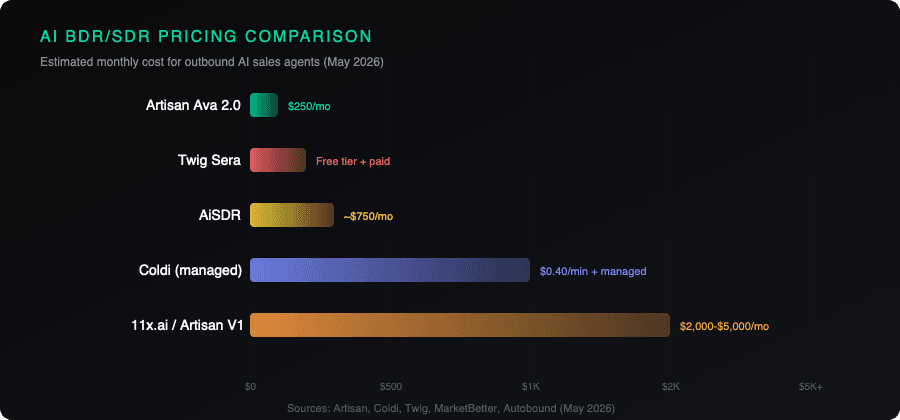
First, pricing for autonomous outbound agents dropped by roughly 10x. Artisan went from $2,500 to $250. Twig offers a free tier. This is no longer enterprise-only territory. A small professional services firm or a local business running lead generation can now test an AI BDR for less than the cost of a single SDR's weekly payroll.
Second, the tech is moving from "copilot" to "autopilot." These agents don't just suggest subject lines or draft email templates. They run the full workflow from lead identification to booked meeting. That's a meaningful shift. The bar for "AI sales tool" just went up.
Third, the competitive landscape is crowding fast. Artisan, 11x.ai, AiSDR, Coldi, Twig, MarketBetter, and Apollo are all competing for the AI BDR slot. That competition is what's driving prices down and capability up. Good news for buyers.
If you're running intake or lead qualification with static forms and manual follow-up, this is the moment to start testing. The free tiers and trial credits mean you can run a real pilot without budget approval. The question isn't whether AI agents can handle first-touch qualification (they can), it's whether your CRM data and lead routing are clean enough to let them do it well.
Sources: