Three Companies, Three Bets on What Platform Means for Vertical AI
Assort Health raised $120M for proprietary data. Perplexity bet on integration breadth. Intapp argued the moat is firm operations. Three theses, 72 hours.
By SpringVanta
Three definitions of "platform" landed in the same window
Between June 24 and 25, three companies in healthcare and legal each announced their version of what a "platform" means for vertical AI. They disagree.
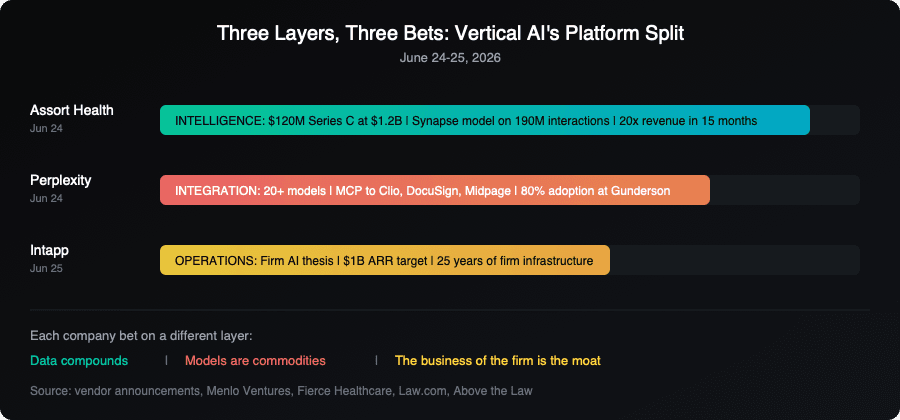
Assort Health raised $120 million at a $1.2 billion valuation to expand a proprietary intelligence layer built on 190 million patient interactions. Perplexity launched Computer for Counsel, a model-agnostic system that routes across 20-plus frontier models and connects to the legal tools lawyers already use. Intapp published a blueprint for "Firm AI," arguing that the real opportunity in professional services is neither the model nor the integration but the business operations infrastructure firms have spent decades building.
Three bets, three layers, three philosophies about where the durable value lives. The divergence itself is the story. If you are a health system, a law firm, or a property management company evaluating AI platforms right now, which layer you actually need determines which vendor you should bet on.
Assort Health: the intelligence layer compounds
Assort Health closed a $120 million Series C led by Menlo Ventures on June 24, hitting a $1.2 billion valuation. Revenue grew 20x in 15 months. The company started as a voice AI agent that could schedule a specialty appointment, which sounds simple until you try to do it for orthopedics.
The company now spans scheduling, intake forms, referrals, document processing, medication refills, real-time eligibility, lab requests, and payments. The connective tissue is Synapse, a proprietary AI model trained on 190 million patient interactions, 62,000 care protocols, and 1.6 million decision pathways. Jon Wang, co-founder and co-CEO, told Fierce Healthcare that one key differentiator is that proprietary dataset: "Our proprietary model learns the patterns of specialty workflows and gets sharper with every deployment."
Menlo Ventures partner Matt Murphy framed the investment thesis around compounding: "The value of Assort's platform compounds with every patient interaction. Each one surfaces a new edge case and a new way to improve care, and the platform gets better for the next patient, automatically."
Menlo's investor blog added a concrete metaphor. Walk into any outpatient practice and you find "the binder" — inches thick, worn soft, stuffed with Post-it notes containing the rules for how patients actually get access to care. New referral or post-op follow-up? Workers' comp or self-pay? Which provider, which day, which intake form? None of it lives in any electronic system. Assort's pitch is that its platform absorbs that binder. When a practice deploys Assort, the institutional knowledge that used to live in the heads of tenured schedulers gets absorbed into the platform. It does not walk out the door when people leave.
The funding will take Assort from large provider groups into enterprise health systems, starting with John Muir Health. That move upmarket is the test: the binder gets thicker at academic medical centers.
Perplexity Computer for Counsel: the integration layer, not the model
Perplexity announced Computer for Counsel on June 24. The thesis is almost the opposite of Assort's. Instead of building a proprietary model on proprietary data, Perplexity routes across 20-plus frontier models and picks the best one for each task. The platform's value proposition is not intelligence. It is breadth of connection.
Computer for Counsel connects to the tools lawyers already use: Midpage for legal research, DocuSign for contract management, Clio's Vincent for citable authority across a corpus of more than one billion documents, LegalZoom for templates, Deel for employment compliance. The connections run through Model Context Protocol (MCP) connectors, the emerging standard for linking AI agents to external systems.
Above the Law's Joe Patrice captured the tension: "Is there Biglaw appetite to hand over more power to a vendor curating a buffet of models? And a vendor that doesn't sit on a moat of proprietary data like century-plus mainstays like Thomas Reuters."
Perplexity's answer is that the moat is the integration network, not the data. Every output links back to a verifiable source — a case, a statute, a regulation, a filing. For a profession where attorneys have been sanctioned for filing briefs citing cases that do not exist, that architecture matters. Gunderson Dettmer rolled out Perplexity Enterprise firmwide and reported 80% attorney adoption.
Clio's partnership announcement the same day reinforced the strategy. John Foreman, Clio's Chief Product Officer, described "an evolution of the legal AI stack" where "AI models are increasingly being connected to specialized intelligence systems that provide domain expertise, authoritative data, and professional-grade validation." Vincent becomes a legal intelligence layer inside Perplexity's platform, not a standalone product.
The bet: models are commodities. Integrations and source-grounding are the defensible layer.
Intapp Celeste: the operations layer nobody else is building
On June 25, Intapp published a blog post introducing "Firm AI" and explaining why it built Celeste. The framing is a direct challenge to both Assort's data thesis and Perplexity's integration thesis.
Intapp argues there are not two categories of AI (horizontal and practice) but three. Horizontal AI (Claude, Copilot, ChatGPT) serves the general knowledge worker. Practice AI (Harvey, Legora, Rogo) serves the individual professional's craft. Both have value. But the third category, Firm AI, serves the firm itself: origination, intake, conflicts clearance, client onboarding, pricing, staffing, pipeline tracking, cross-sell, fundraising, LP reporting.
Intapp's blog puts it bluntly: "Two years of AI on every desk has moved the needle so little in firm economics because a firm is more than a collection of individual contributors."
The argument is structural. Putting AI in the hands of individual lawyers makes them faster. But firm growth, margins, and risk management depend on the operational infrastructure: the processes, institutional knowledge, compliance posture, and relationship networks that let hundreds of experts operate as one firm. That layer accounts for "two-thirds of firm cost and nearly all of its competitive leverage."
Celeste is the agentic platform that runs those workflows. It includes a Context Engine that processes firm data, terminology, relationships, and work patterns, and a governed AI framework that applies professional compliance standards (ethical walls, material non-public information rules, independence requirements) to every agent action. Intapp targets $1 billion ARR by fiscal year 2029 with a platform-fee plus consumption pricing model.
The bet: the practice tools are table stakes. The business operations infrastructure is where the money and the moat are.
Which layer is your bottleneck?
These three launches do not compete. They address different problems at different depths.
If your healthcare organization's bottleneck is that schedulers cannot handle the complexity of specialty referrals, and that knowledge walks out the door when staff leave, Assort's intelligence layer is the answer. The proprietary model compounds with every patient interaction. The $120 million says investors believe the compounding is real.
If your law firm's bottleneck is that lawyers spend hours on administrative tasks like research, document gathering, and contract triage, and you already have tools like DocuSign, Clio, and a document management system, Perplexity's integration layer connects them. The 20-model approach means you are not betting on a single AI vendor. But you are also not building proprietary intelligence.
If your professional services firm's bottleneck is that growth, compliance, and profitability depend on operational infrastructure that no individual AI tool touches (origination, conflicts, staffing, pricing), Intapp's operations layer is the only one of the three that addresses it. The tradeoff is that it requires you to see the firm as a platform, not as a collection of practitioners with AI assistants.
The question buyers should ask is not "which platform is best" but "which layer is broken in my organization." The answer determines which of these bets is yours.
Sources: Assort Health Series C announcement; Menlo Ventures investment thesis; Fierce Healthcare; MobiHealthNews; HitConsultant; Perplexity Computer for Counsel blog; Law.com/Legaltech News; Above the Law; Clio partnership; DocuSign integration; Intapp Firm AI blog; Intapp Celeste announcement; Yahoo Finance/MarketBeat; MarkTechPost; TechTimes