Voice AI agents go vertical: $71M week signals intake automation shift
A single week in May 2026 brought $71M in vertical voice AI funding and 500+ legal AI agents. Here is what it means for intake automation.
By SpringVanta
In the span of one week in May 2026, the vertical AI market sent a clear signal: voice agents are no longer generic phone bots. They are purpose-built intake workers for law firms, healthcare providers, and real estate teams — and investors are placing large bets on that thesis.
Two funding rounds, a landmark product launch, and a major practice-management integration landed between May 6 and May 13. Together they paint a picture of where intake automation is heading and what service businesses should watch next.
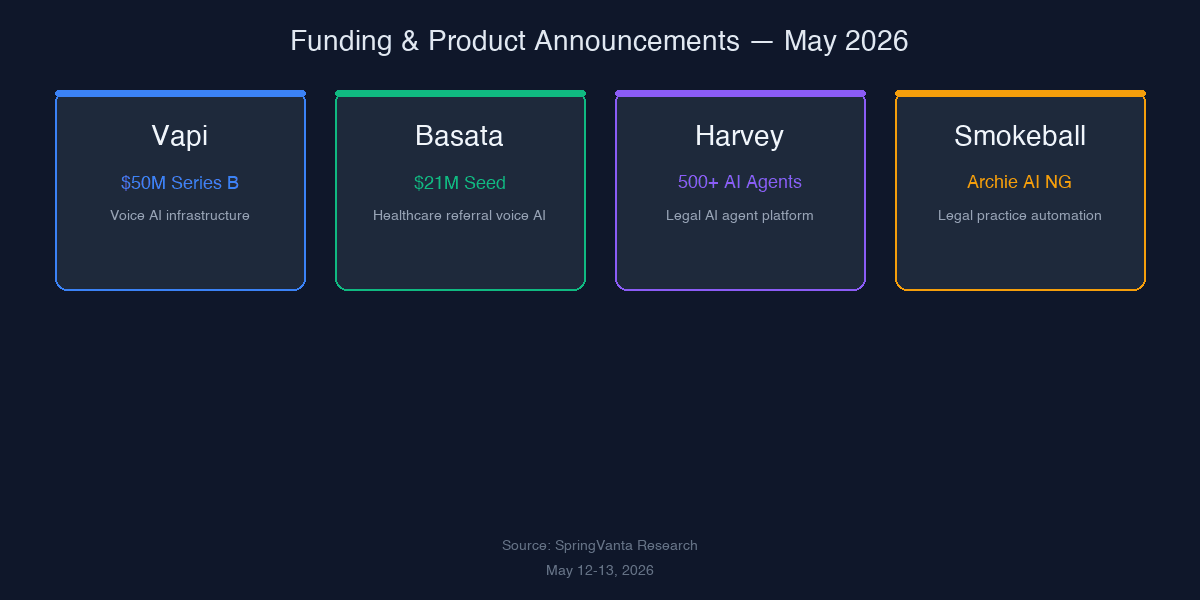
Vapi raises $50M Series B to power vertical voice infrastructure
Voice AI platform Vapi closed a $50 million Series B on May 12, bringing its total funding past $70 million. The round was led by Benchmark with participation from Abstract Ventures and Y Combinator.
What makes Vapi relevant to intake automation is its positioning: the company does not build end-user products. It provides the telephony, speech recognition, and agent-orchestration layer that other companies use to create vertical voice applications.
That infrastructure-first model mirrors what happened in payments (Stripe) and communications (Twilio). When the plumbing gets cheap and reliable enough, vertical players can afford to build domain-specific solutions — legal intake bots, healthcare referral coordinators, real estate qualifying agents — without reinventing the phone stack each time.
Vapi said the funding will go toward expanding its model-agnostic runtime, adding enterprise compliance features, and growing its partner ecosystem of vertical voice builders.
Basata lands $21M seed for healthcare referral voice AI
Also on May 12, Basata announced a $21 million seed round to build voice AI agents that handle healthcare referral workflows. The round was led by Andreessen Horowitz.
Basata's agents sit between referring providers and specialists, managing the phone-based coordination that still dominates healthcare referrals in the United States. That includes verifying insurance, scheduling appointments, and confirming documentation — tasks that currently require hours of manual phone work per referral.
For SpringVanta buyers thinking about intake automation, Basata validates a core thesis: the highest-value voice AI use cases are not answering FAQs. They are completing multi-step intake workflows that involve forms, verification, scheduling, and CRM updates.
Harvey ships 500+ specialized legal AI agents
Legal AI company Harvey, now valued above $3 billion, announced it has deployed more than 500 specialized AI agents for legal workflows as of early May 2026. These agents handle contract analysis, due diligence, regulatory research, and — critically for intake — client matter screening and conflict checks.
The scale matters. A handful of legal AI tools have existed for years, but Harvey's 500-agent milestone signals that legal AI has moved from pilots to production. Law firms are not just testing an intake chatbot; they are deploying agents across dozens of practice areas simultaneously.
For firms evaluating intake automation, this means the ecosystem is mature enough that you can expect integrations with existing practice management platforms rather than standalone tools.
Smokeball launches Archie AI Next Generation
Legal practice management platform Smokeball released its Archie AI Next Generation update on May 12, embedding AI-driven intake and document automation directly into its practice management workflow.
Archie AI can now pre-populate intake forms from caller data, generate engagement letters from templates, and route new matters to the right attorney based on practice area and workload. Because it runs inside Smokeball's existing platform, firms do not need a separate intake tool.
This is part of a broader pattern: practice management platforms are becoming the distribution channel for AI intake. Instead of buying a standalone voice bot, firms get intake automation as a feature of the software they already use.
What the vertical shift means for service businesses
Four developments in one week reinforce a trend that SpringVanta has been tracking:
-
Infrastructure is commoditizing. Platforms like Vapi make it cheap to build domain-specific voice agents. The differentiator is no longer the phone tech — it is the workflow expertise.
-
Healthcare and legal are leading adoption. These verticals have the most painful phone-based intake processes and the clearest compliance requirements, making them early winners for AI automation.
-
Embedded AI is replacing standalone tools. Smokeball's Archie AI and Harvey's platform integrations show that intake automation is becoming a feature of practice management, not a separate product category.
-
Funding velocity is accelerating. $71 million in one week for just two voice AI startups suggests that investors see vertical intake automation as a large, near-term market — not a speculative bet.
For businesses evaluating AI intake today, the practical takeaway is straightforward: the technology is ready, the integrations are catching up, and the cost of waiting is rising as competitors adopt these tools.