Your phone system wants to be your receptionist
Ooma, Aline, Twilio, and Microsoft all shipped AI voice capabilities in the same two-week window. What it means when phone systems answer themselves.
By Springvanta
Something shifted in the first two weeks of May. Four separate companies — a UCaaS provider, a vertical CRM, an infrastructure platform, and the largest enterprise software vendor — each shipped AI voice capabilities aimed at the same problem: phones that know what to do when they pick up.
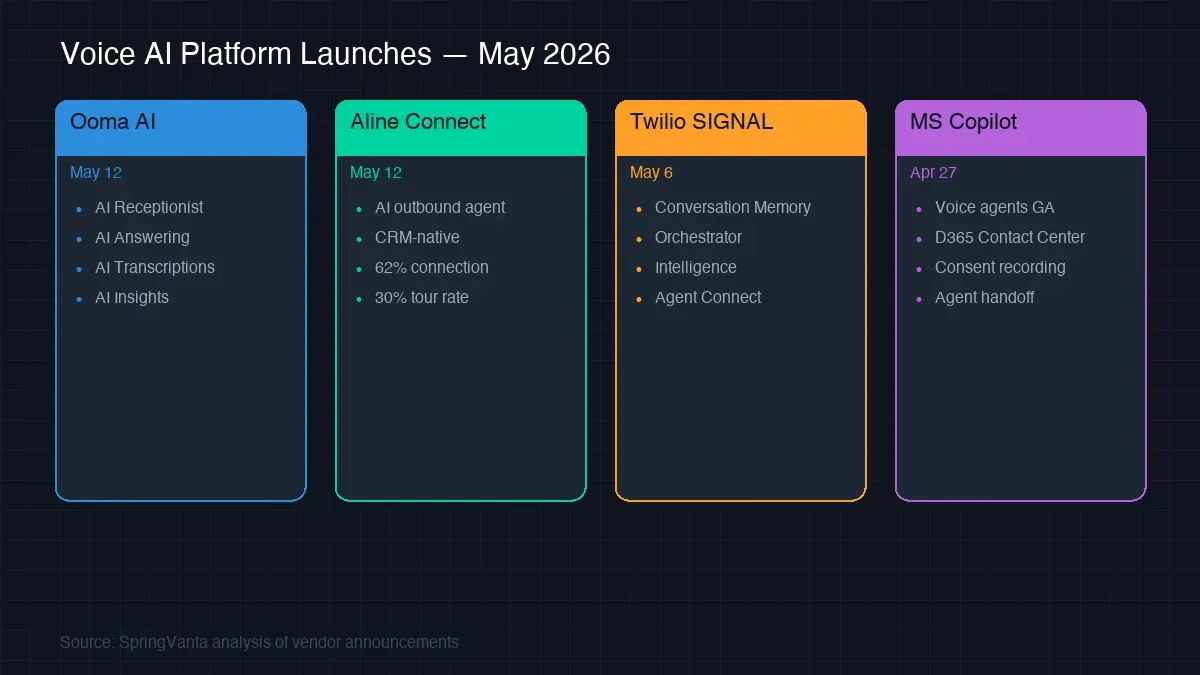
The announcements came in a cluster. Ooma embedded an AI receptionist into its small-business phone platform on May 12. Aline, a CRM for senior living operators, launched an AI outbound agent the same day. Twilio's SIGNAL conference on May 6 introduced a conversation memory layer that persists context across calls, texts, and channels. Microsoft's Copilot Studio voice agents hit general availability on April 27, complete with consent-based recording for compliance-heavy environments.
None of these are chatbots. They're phone systems, CRMs, and infrastructure layers that now include AI voice as a first-class feature rather than a bolt-on integration.
What Ooma shipped
Ooma AI is a suite of five capabilities added to Ooma Office, the company's UCaaS platform for small and mid-sized businesses. The most relevant pieces:
- AI Answering Service picks up missed calls and captures caller details for follow-up. Not voicemail — a conversational agent that asks questions and logs the responses.
- AI Receptionist (currently in beta) extends that into an always-on front desk that can manage scheduling and routing.
- AI Transcriptions converts recordings into searchable text with an "Ask AI" feature for pulling specific details out of past calls.
- AI Insights (also beta) surfaces call topics, sentiment, and category trends across all conversations.
AI Transcriptions ships at no extra charge for Ooma Office Pro Plus subscribers. The AI Receptionist and AI Insights are in beta with broader availability expected soon. Ooma also added an OpenAI API integration for businesses that already subscribe to OpenAI and want to build custom workflows on top of their call data.
For a 5-to-50 person business that currently lets calls go to voicemail during peak hours, this is the phone system answering on its own for the first time.
What Aline Connect does differently
Aline Connect launched on the same day with a narrower focus and a more concrete data set. It's an AI outbound agent built directly into Aline's CRM for senior living operators. When a web form submission or lead aggregator inquiry enters the CRM, Aline Connect calls the prospect within minutes and runs a 90-day, 20-attempt outreach cadence by phone and text.
The architectural choice matters. The AI agent lives inside the CRM — not connected to it via integration, not layered on top as a third-party tool. It works from the same prospect record that human sales counselors use. When it qualifies a prospect, it warm-transfers the call to a counselor with the full conversation already logged.
Aline shared aggregate early-access numbers:
- Median time to first outreach: 2 minutes
- Lead connection rate: 62% (vs. 40% industry average for digital leads)
- Tour conversion rate for web form inquiries: 30% (vs. 17% industry average)
- Connection rate after 6+ touches: +200%
Those numbers come from Aline's own portfolio data and haven't been independently audited. But the direction is consistent with what voice AI lead-qualification vendors report across industries: calling within five minutes of inquiry roughly doubles contact rates compared to waiting an hour.
Twilio's infrastructure bet
At SIGNAL on May 6, Twilio announced three generally available products that sit below any individual voice agent or chatbot:
Conversation Memory creates a persistent, identity-resolved profile that connects customer data with conversation history. Every interaction — phone, SMS, WhatsApp, web chat — feeds the same memory. The next call picks up where the last text left off.
Conversation Orchestrator coordinates interactions across channels without custom integration code. It manages handoffs between AI agents and human agents while keeping the conversation thread intact.
Conversation Intelligence provides real-time understanding of live interactions using LLM-based operators, surfacing intent, sentiment, and key entities as calls happen.
The framing is infrastructure, not product. Twilio isn't building the AI receptionist — it's building the layer that lets anyone else's AI receptionist remember who called last week, what they asked, and whether the issue was resolved. Twilio reported 49% year-over-year growth in voice AI revenue in 2025.
Microsoft's compliance layer
Microsoft's contribution to the same trend is quieter but addresses a real blocker for regulated industries. Dynamics 365 Contact Center now includes consent-based recording for voice agents. When an AI voice agent asks "May we record this call?" and the caller says no, that consent decision is enforced system-wide — including when the call gets handed off to a human agent. No manual checks, no agent judgment calls.
This shipped alongside the general availability of real-time voice agents in Copilot Studio, which Microsoft says over 80% of Fortune 500 companies are already using in some form.
Why the timing matters
The voice recognition market hit $18.4 billion in 2025 and is projected to reach $61.7 billion by 2031, growing at 22.4% annually. Twilio's vice-president of product management Andy O'Dower described a shift: businesses that rushed to automate with generic LLMs two years ago are now pairing top-tier speech recognition with localized models for production voice AI.
That matches what these four announcements show. The 2023-2024 wave was chatbots and pilot programs. The May 2026 wave is phone systems shipping AI as a default capability, CRM platforms embedding outbound agents without integration, infrastructure providers building conversation persistence, and enterprise vendors solving the compliance layer.
For businesses that handle inbound calls — clinics, law firms, real estate brokerages, senior living communities, home services companies — the question moved from "should we try voice AI?" to "which of our vendors is already including it?"
What to watch
Three things to track from here:
- Pricing convergence. Ooma includes AI transcriptions at no extra charge. Aline Connect is priced per community, not per call. As more UCaaS and CRM vendors bundle voice AI, the per-interaction cost model may get squeezed.
- Handoff quality. The hard part isn't the AI conversation — it's what happens when the AI transfers to a human. Aline and Twilio are both building around this explicitly. Watch for measurable first-contact resolution data.
- Vertical depth. Aline works because it knows senior living intake. Ooma works because it knows small-business phone workflows. Generic voice AI is getting cheaper; vertical voice AI is where the margin is.
Sources:
- Ooma AI announcement, BusinessWire, May 12, 2026
- Aline Connect launch, PRNewswire, May 12, 2026
- Twilio SIGNAL 2026 platform announcements, May 6, 2026
- Microsoft Copilot Studio voice agents GA + consent recording, April 27 – May 8, 2026
- Voice AI market data: AssemblyAI, Computer Weekly, No Jitter