Aircall buys Vogent, Vapi hits $500M: voice AI is consolidating
Aircall acquired Vogent. Vapi hit $500M. Amazon Connect launched agentic AI. What the voice AI consolidation means for intake and support.
By SpringVanta
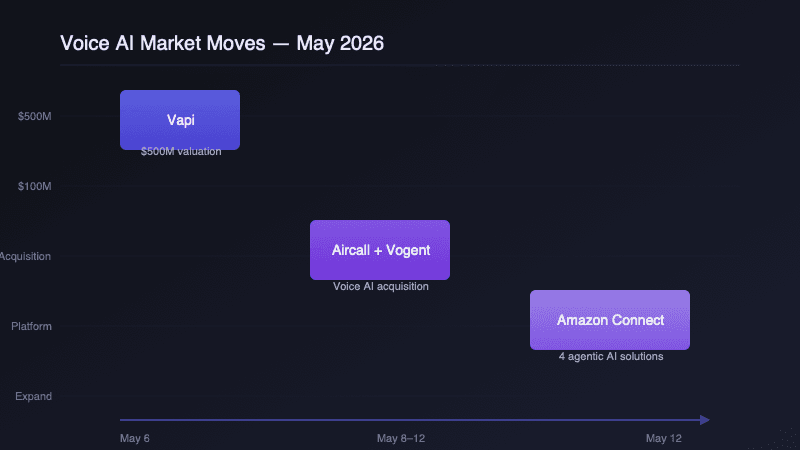
On May 6, Aircall announced it had acquired Vogent, a San Francisco startup that builds specialized voice AI infrastructure. Six days later, Amazon expanded Connect into four agentic AI solutions. In the same window, Vapi closed a $50M Series B at a $500M valuation after routing 100% of Amazon Ring's inbound calls through its platform during the 2025 holiday surge.
These are not isolated events. They point to a voice AI market that is moving from experimentation into acquisition and scale.
What Aircall gets from Vogent
Aircall already had an AI Voice Agent product. It answers inbound calls, handles FAQs, qualifies leads, and hands off to human agents when a call gets complicated. The product works across Salesforce, HubSpot, Zendesk, and 250 other integrations. What Vogent adds is the underlying infrastructure: custom speech models, turn detection, interruption handling, and latency management. Aircall CEO Scott Chancellor framed it as deepening the AI stack, not bolting on a feature. Vogent's CTO Vignesh Varadarajan said the company had spent years on the pipeline that separates a demo from something you can trust on a real customer call. That framing is telling. Aircall serves 23,000 businesses. Most of them are not enterprise contact centers. They are mid-market sales and support teams that want voice automation without hiring a speech engineer. Vogent's tech gives Aircall a path to better containment rates and fewer awkward handoffs, without asking customers to change how they work. For businesses considering voice AI for intake or support, the acquisition matters because it signals where the product category is going. Voice AI that lives inside your phone system and writes directly into your CRM is becoming table stakes, not a premium add-on.
Vapi's $500M validation
Vapi's raise is a different signal. Where Aircall is building for businesses that want voice AI configured, not coded, Vapi sells developer-first infrastructure. Amazon Ring chose Vapi over 40 competing vendors and routed all inbound calls through it during peak season. Vapi now processes 1 to 5 million calls per day. A $500M valuation for a voice AI infrastructure company, 18 months after Y Combinator, is aggressive. But the Ring deployment is real, not projected. The takeaway for businesses: the underlying plumbing for voice AI is maturing fast enough that enterprise buyers are willing to bet their busiest season on it.
Amazon Connect goes agentic
On May 12, Amazon expanded its Connect platform beyond customer service into four purpose-built agentic AI solutions: Connect Decisions (supply chain), Connect Talent (hiring), Connect Customer (engagement), and Connect Health (clinical support). Each draws on Amazon's own operational data. The important shift is architectural. Connect is no longer a contact center tool. It is a set of agents that understand, reason, and take action across voice and messaging channels. For businesses already in the AWS ecosystem, this expands the scope of what a voice AI deployment can cover, from answering phones to orchestrating multi-step workflows like hiring and scheduling. Early adopters include Wells Vehicle Electronics and TVS Motors using Connect Decisions for supply chain optimization.
What this means for intake automation
Three separate moves in one week, all pointing in the same direction: voice AI is leaving the pilot phase. For businesses evaluating voice AI for intake, support, or lead qualification, the practical implications are:
- Voice AI is becoming a platform feature, not a standalone tool. Aircall embedded it in business phones. Amazon embedded it in Connect. If your phone system or CRM does not have a native voice AI option today, it probably will within a quarter.
- The bar for production readiness is rising. Vogent's entire pitch was that demos and production are different things. Aircall buying them means the market is starting to reward actual call-handling performance over conversational novelty.
- Intake is the natural first use case. Voice AI handles repetitive inbound calls well: qualify the lead, capture the details, book the appointment, write it into the CRM. These are bounded workflows with clear outcomes, which is where current voice AI performs best.
Sources
- Aircall acquires Vogent (Aircall, May 6, 2026)
- Vapi hits $500M valuation after Amazon Ring partnership (AI Invest, May 2026)
- Amazon Connect expands into agentic AI solutions (Amazon, May 12, 2026)
- Martech Edge: Aircall–Vogent analysis (Martech Edge, May 2026)
- 9 AI voice agents for customer support (Assembled, 2026)