Fewer clicks, higher conversions: the AI search paradox
AI search sends 93% fewer clicks but converts 42% better. Google's Expert Advice feature and Adobe data explain why citation now matters more than traffic.
By SpringVanta
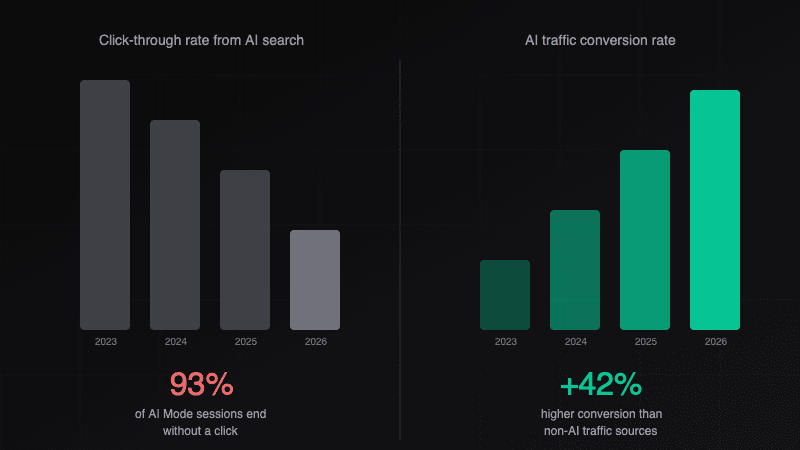
Something odd is happening to website traffic from search. The number of people clicking through from Google is shrinking. The value of those who do click has never been higher. Semrush data from late 2025 shows that 93% of AI Mode sessions end without a single click to an external website. Google AI Overviews now appear in over 25% of all searches, up 57% from the previous quarter. Pew Research found that when an AI summary appears, only 8% of users click on the regular search results below it. Those numbers sound like a disaster for anyone who depends on search traffic. They're not.
The conversion flip
In April 2026, Adobe released retail traffic data that caught most marketers off guard. AI-referred traffic to US retail sites surged 393% year-over-year in Q1 2026. More striking: those visitors converted at rates 42% higher than visitors from non-AI sources. Session durations ran 48% longer. Engagement measured 12% higher.
A year earlier, AI traffic had been the underperformer, converting 38% below paid search and email. The reversal happened in twelve months.
The explanation is straightforward. Someone who asks an AI assistant "what's the best CRM for a five-person law firm" and then clicks through to a product page has already moved past the awareness stage. The LLM did the comparison shopping for them. They arrive with intent, not curiosity.
Google doubles down on community sources
On May 6, Google rolled out a new section inside AI Overviews and AI Mode called "Expert Advice" (the label changes to "Community Perspectives" or "Community Experiences" depending on the query). It pulls quotes from Reddit threads, WordPress blogs, and niche forums directly into the AI-generated response, with the creator's name and community handle visible. Google said the change addresses that "people are increasingly seeking out advice from others" when searching. Anyone who has typed "best X reddit" at the end of a search query will recognize the behavior. Google is building it into the AI layer instead of making users hunt for it. For businesses, this creates a new visibility pathway. Your content can appear inside an AI response in two ways: as a cited source in the generated answer, or as a quoted community voice in the Expert Advice panel. Both happen without the user clicking through to your site. Both build awareness.
What to actually do
Three things, based on the current data. Audit machine readability. Adobe found that 33% of homepages, product pages, and FAQ sections are unreadable by AI crawlers. Missing metadata, unclear page structure, and thin content are the main culprits. Fixing these is table stakes. If an LLM can't parse your page, it can't cite you. Build presence on secondary platforms. LLMs pull from Reddit, review sites, and social media to cross-reference their answers. Adobe's Vivek Pandya noted that brands need "a high-quality presence across these secondary platforms to validate AI recommendations." A well-maintained Reddit thread about your service, a thorough Google Business profile, detailed review responses. These feed the models. Write for extractability, not just readability. Content that uses clear headings, direct answers to common questions, and structured data (schema markup) gets picked up by AI systems more reliably than long-form prose without signposts. The Digital Bloom GEO report from Q1 2026 found that digital PR accounts for 25% of all LLM citations despite being used by only 6% of practitioners. Getting mentioned in third-party articles that LLMs trust matters more than publishing another blog post on your own site.
The shift in what to measure
Traditional SEO tracking focused on position, impressions, and click-through rate. Those still matter. But they miss the growing share of visibility that happens inside AI responses, where no click occurs. Semrush, Conductor, and a wave of newer GEO platforms (now 20+ dedicated tools, industry average $337/month per Conductor's benchmarks) now track AI citation frequency, brand mention rates in LLM outputs, and AI referral traffic as distinct channels. Google Search Console still can't separate AI Mode traffic from regular search traffic. Until it does, third-party tools and UTM-tagged AI referral data are the closest approximation. The old funnel assumed search brought people to your site, then you convinced them. The new version has an AI assistant doing most of the convincing before the first visit. The visitor who shows up at your door has already decided they're interested. Your site just needs to be readable enough for the AI to have found it in the first place.
Sources:
- The Verge: Google's AI search summaries will now quote Reddit
- eMarketer: From SEO to GEO: How AI traffic became retail's highest-converting channel
- Engadget: Google's AI search results will now turn to Reddit for expert advice
- Semrush: AI Search Statistics 2026
- Mashable: Google AI mode labels some Reddit and social media posts as Expert Advice
- Conductor: The 2026 AEO/GEO Benchmarks Report