Chrome Will Route Searches to AI Mode. Clicks Are Already Optional.
Google tested a Chrome flag that sends all searches to AI Mode. Search Console reports omit click data. The UK forced a publisher opt-out. Three days, one trajectory.
By Springvanta
Three things happened between Tuesday and Friday that, taken together, tell you more about where search is headed than any single announcement from Google I/O.
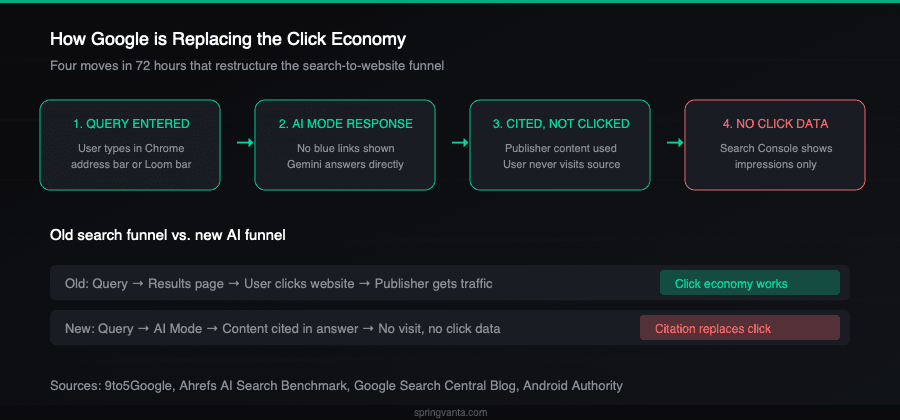
On Tuesday, Google launched AI visibility reports in Search Console, the first time site owners could see how often their pages appear in AI Overviews and AI Mode. The reports show impressions, pages, countries, and devices. They do not show clicks. Google confirmed this omission explicitly, telling Search Engine Land that click data "will be explored" later.
On Wednesday, the UK's Competition and Markets Authority imposed a binding order requiring Google to let publishers opt out of having their content surface in AI-generated search summaries. First regulatory mandate of its kind. The CMA described it as giving publishers "more control and stronger bargaining power over the use of their content." Google has nine months to comply.
Then on Thursday, a flag appeared in Chrome Canary labeled "Fulfill Searchbox Queries in AI Mode." Enable it, and every query typed into the Chrome address bar skips the traditional results page entirely. No blue links. No AI Overview at the top with regular results below. Just a conversational AI response. Google VP of Search Engineering Rajan Patel responded on X within hours, calling the flag "an error" and saying the company has "no plans to make AI Mode the default for Chrome searches."
The same day, Android Authority confirmed a separate Canary experiment: a floating search bar called "Project Loom" that lives outside the browser window. Press Ctrl+Shift+Space, type a question, and Gemini answers without Chrome even being open. The prompt reads "Ask anything" instead of "Search Google or type a URL."
The pattern behind "just exploring"
Google's wording around the Canary flag deserves attention. The Chromium commit says: "This is just for exploration. There are no current plans to push this live."
That sentence is nearly identical to the language Google used before AI Overviews rolled out to 2.5 billion users, and before AI Mode hit 1 billion monthly users within a year of launch. "Just exploring" is how Google describes things until they ship.
The flag itself is polished. It respects keyboard modifiers for opening searches in new tabs. It works on the address bar and the New Tab Page search box. That level of implementation detail does not usually accompany a throwaway experiment.
Chrome controls roughly 60% of the desktop browser market. The address bar is the single largest entry point for Google Search. Redirecting it from results pages to AI Mode conversations is not a UI tweak. It is a change to how billions of people encounter the web.
What the Search Console reports leave out
The new AI visibility reports give site owners something they have wanted since AI Overviews launched: a dedicated view of how their content appears inside Google's generative AI features. You can see impressions by page, country, device, and time range.
But the reports deliberately exclude click data. You cannot see how many people clicked from an AI Overview to your site, or whether anyone clicked at all. Google's spokesperson told Barry Schwartz at Search Engine Land that the company is "still in talks with website owners to see which insights will best serve their strategies."
The timing is hard to ignore. Three days before these reports shipped, Ahrefs published its AI Search Benchmark Report showing that AI Overviews cut clicks to top-ranking content by 58%. Pew Research tracked actual browsing behavior and found that users clicked through on just 8% of searches when an AI Overview was present, compared to 15% without one. Only 1% of users click a link inside the AI Overview itself.
Publishers have been asking for click data since AI Overviews appeared. Google responded with impressions. That tells you what Google considers the unit of measurement now.
The UK regulator steps in
The CMA's order is worth reading in full. Google controls more than 90% of the UK search market. For almost 30 years, publishers relied on Google referrals to drive traffic and revenue. AI Overviews and AI Mode broke that arrangement by answering queries directly, citing publisher content inside the AI response while the user never visits the source.
The opt-out system lets publishers exclude their content from AI-generated summaries. The CMA described this as leverage: if a publisher opts out, they can negotiate separate payment deals for the content Google's AI would otherwise use for free.
The UK-first rollout of both the opt-out and the Search Console AI reports is not a coincidence. Both are regulatory responses. Google is building infrastructure for an AI-first search experience globally, and the UK is where regulators forced the first concessions.
The floating search bar that skips the browser
Project Loom, the floating omnibox spotted in Canary builds on June 4, is the one to watch most closely. A system-wide keyboard shortcut summons a search bar that connects directly to Gemini. It accepts text, images, and files. It can generate images. It works whether Chrome is open or not.
The Gerrit commit notes say the feature "is not intended to launch any time soon." If that phrasing sounds familiar at this point, it should.
Microsoft tried something similar with Edge's floating search bar years ago. The difference is Google's version routes everything through Gemini by default. The prompt text ("Ask anything") positions it as an assistant rather than a search engine. If this ships, Google will have an AI interface that intercepts queries before the browser even opens, before any website has a chance to appear.
Where this leaves businesses that depend on search traffic
If you run a business that gets leads or customers through Google Search, these four developments form a clear picture:
- Google is testing ways to replace the results page with AI conversations at the browser level.
- The analytics Google provides for AI features measure visibility, not visits.
- The only jurisdiction where publishers got a meaningful concession is the one where a regulator forced it.
- Users are already leaving. DuckDuckGo broke its single-day search record on June 1. US installs are up 61% since Google I/O. Its "No AI" search page traffic has tripled.
Ahrefs data shows Google still sends 190 times more visitors than ChatGPT across 76,000 measured sites. The blue-link economy has not disappeared. But the direction is unmistakable. AI referral traffic is now roughly 1% of total web visits, up from 0.1% a year ago. A 10x increase in 12 months. The click is becoming optional. The citation is becoming the primary unit of value.
For businesses building AI intake forms, voice agents, and automated lead qualification, the implication is direct. If your discoverability strategy relies entirely on ranking in traditional search results, you are optimizing for a shrinking surface. The businesses that will perform best in AI search are the ones with structured data, original research, and content that AI engines want to cite rather than summarize.
Three days. One trajectory.
Sources:
- 9to5Google: Google Chrome tests sending users straight to AI Mode
- Gagadget: Chrome Canary tested auto-redirecting searches to AI Mode — Google calls it an 'error'
- Android Authority: Google could make AI Mode the default way to search in Chrome
- Android Authority: This new Chrome shortcut could be the fastest way to use Google search yet
- WebProNews: Google's AI Mode Takes Root in Chrome Canary
- Cited By AI: Google Just Launched AI Visibility Reports in Search Console
- BBC: Publishers in UK can opt out of Google AI search results
- Ahrefs AI Search Benchmark Report via SEO Francisco
- TechCrunch: DuckDuckGo makes its 'no-AI' search engine easier to access