Zendesk and Salesforce Make AI Agents Standard
Zendesk opens agentic AI to every plan. Salesforce ships multi-agent orchestration. The biggest CX platforms just made AI agents the default.
By SpringVanta
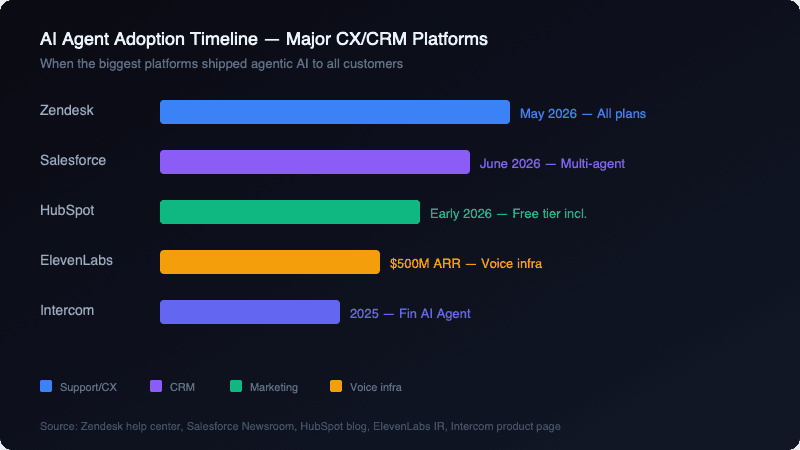
Two weeks ago, Zendesk started rolling its most advanced AI agent capabilities into every support plan it sells. No extra tier. No upgrade path. The agentic features that were behind a paywall are now standard, starting May 11 for new accounts and May 25 through June 12 for existing ones.
The move coincides with Salesforce's Summer '26 release, available June 15, which introduces multi-agent orchestration inside Agentforce. Multiple AI agents can now coordinate across service, sales, and marketing workflows, triggered from Slack or from customer-facing channels. The release also brings Tableau querying directly from Claude and a new Agent Script language that defines explicit if/then workflows for agents that need consistent outcomes.
Separately, ElevenLabs disclosed that it surpassed $500 million in annual recurring revenue, up from roughly $350 million at the end of last year. The voice AI company added $100 million in net new ARR during Q1 2026 alone and signed enterprise contracts with Deutsche Telekom, Revolut, and Klarna in the past quarter.
What Zendesk actually changed
Zendesk's announcement, published on its help center, says the company is "simplifying AI agents packaging and expanding access to our most advanced, agentic capabilities across all Zendesk Suite and Support plans." The practical effect: any Zendesk customer can now deploy AI agents that resolve multi-step customer issues, not just answer FAQs. The platform is sunsetting its legacy bot builder and basic messaging responses. Technical development on those older tools stops August 31, with full shutdown scheduled for December 10, 2026. Zendesk is also moving toward outcome-based pricing, though details on exact per-resolution rates have not been published yet.
What Salesforce's multi-agent orchestration does
The Summer '26 release is built around the idea that enterprises need more than one agent doing one thing. Salesforce is shipping multi-agent orchestration inside Agentforce, where different agents handle different parts of a customer request: one authenticates the user, another pulls order history from the CRM, a third initiates a refund workflow. The release includes Agent Script, a declarative language that defines explicit if/then logic for agents. Early adopters reported a shift from agents that "usually" do the right thing to agents that "always" hit the target outcome, according to Salesforce's announcement. Agentforce now also integrates with Slack for internal IT and HR service agents, and with Tableau for analytics queries surfaced directly in conversations.
Why this matters for intake-heavy businesses
The two announcements hit at roughly the same time. Zendesk makes AI agents available by default to roughly 100,000 customers. Salesforce makes multi-step agent coordination available to its enterprise base. Both are treating AI agents not as a future feature but as the current interface for customer interaction. For businesses that handle intake through phone, forms, or chat, this changes the procurement question. Six months ago, the question was "should we add an AI agent to our support stack?" Now the platforms are shipping agents whether you asked for them or not. The question becomes how to configure them, what data they need access to, and whether your CRM records are clean enough for an agent to work with. That last part is the part most teams skip. Gartner's data, cited in multiple vendor reports, suggests that 60% of AI projects will be abandoned through 2026 because the underlying data isn't ready. Agents plugged into messy CRM records produce confident wrong answers.
The ElevenLabs signal
ElevenLabs' revenue growth ($350M to $500M ARR in under six months) is a separate indicator that voice AI infrastructure has moved past the experimentation phase. The company is valued at $11 billion and counts Deutsche Telekom, Nvidia, and Salesforce Ventures among its investors. Its enterprise contracts with Revolut and Klarna point to financial services as an early adoption vertical for production voice agents. CEO Mati Staniszewski said the company is building "human-level AI voice models," positioning voice quality as a trust factor rather than a nice-to-have. For businesses evaluating voice intake, the infrastructure layer is maturing fast enough that latency and naturalness are no longer the main blockers. Integration with existing CRM and intake workflows is.