ChatGPT sells ads, Perplexity drops them: AI search splits in two
OpenAI opens self-serve ChatGPT ads while Perplexity removes theirs entirely. Two paths to AI visibility are emerging, and businesses need both.
By SpringVanta
Something unusual happened in AI search this month. OpenAI opened a self-serve ads manager for ChatGPT on May 5, letting any U.S. business buy placement inside conversational responses. The same week, OpenAI confirmed expansion to the U.K., Mexico, Brazil, Japan, and South Korea. Meanwhile Perplexity, which spent 2024 testing sponsored placements, quietly removed all advertising in February 2026 and said it has no plans to bring it back. Two of the most-used AI search products picked opposite business models inside a ten-week window. That split has real consequences for how businesses should think about being found online.
What ChatGPT ads actually look like
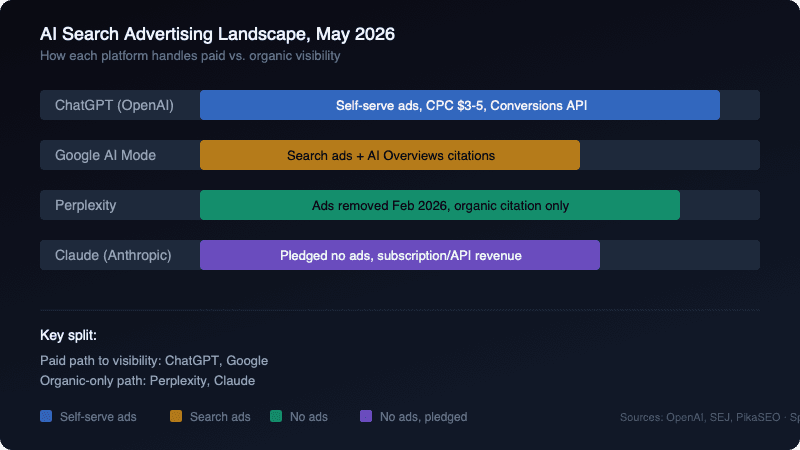
OpenAI began testing ads in ChatGPT in February 2026 with a closed pilot that required a $200,000 minimum spend. By April, the minimum dropped to roughly $50,000. On May 5, the self-serve Ads Manager opened to all U.S. businesses with no minimum. The platform now supports CPC bidding at a recommended $3-5 per click alongside the original $60 CPM model. OpenAI added a Conversions API and pixel-based tracking for purchases, sign-ups, and lead submissions. Agency partners include Dentsu, Omnicom, Publicis, and WPP. Tech partners include Adobe, Criteo, and Pacvue. Ads appear below AI responses for Free and Go tier users. Paid subscribers see no ads. OpenAI says ads do not influence ChatGPT's answers and that advertisers receive only aggregate performance data. David Dugan, Head of Global Solutions at OpenAI, described the approach in a LinkedIn post as "a new ads model" built on "answer independence, privacy, and user control."
Why Perplexity went the other direction
Perplexity tested sponsored placements through late 2024 and into 2025. The program generated roughly $20,000 in total ad revenue in 2024, against $34 million in overall company revenue. By August 2025, the executive running ad monetization had left. By February 2026, Perplexity stopped accepting new advertisers and wound down existing placements.
A Perplexity executive told the Financial Times that ads created a fundamental trust problem: "A user needs to believe this is among the best possible answer to keep using the product and be willing to pay for it." The company is valued at $18-20 billion and processes roughly 780 million monthly queries. Its revenue comes from Pro subscriptions, not from selling visibility.
For brands, this means there is no paid shortcut into Perplexity results. Organic citation is the only path.
The citation gap: why one ranking doesn't cover you
The data from multiple studies in early 2026 points to a uncomfortable fact for marketers: the AI platforms barely share source material. A study of 680 million AI citations found only 11% of domains were cited by both ChatGPT and Perplexity. Whitehat SEO's independent analysis of 118,000 responses confirmed the same number. Ahrefs put cross-platform overlap with Google's top 10 at roughly 12%. Three different research methodologies, same conclusion. ChatGPT draws roughly 87% of its citations from Bing's index and leans heavily on Wikipedia. Perplexity runs real-time web searches per query and surfaces more Reddit and community sources. Google AI Overviews pull from the existing Google index with strong E-E-A-T weighting. Optimizing for one does not transfer to the others. The citation graphs are almost completely disjoint.
Where Anthropic and Google sit
Anthropic CEO Dario Amodei has repeatedly said the company will not run ads in Claude. Revenue comes from enterprise API access and Claude Pro subscriptions. That position is more than a PR stance. It means Claude's answer engine has no commercial incentive to prefer paying sources over organic ones. Google's AI Mode sits somewhere between the paid and organic poles. It carries Google's existing search ad infrastructure, and AI Overviews now reach roughly 2 billion monthly users across 200+ countries. But 93% of AI Mode sessions end without a click to an external website, according to Semrush data published this month. Citation inside the AI response is the primary visibility opportunity, and there's no separate paid placement for it.
What this means in practice
If you run a service business, a SaaS product, or any operation that depends on inbound inquiries, the AI search split creates a fork in the road. For ChatGPT visibility, you now have two levers. You can buy ads directly at a可控 CPC. You can also invest in content that earns organic citation, though the 6-12 week lag between publishing and appearing in ChatGPT responses makes this a longer play. For Perplexity and Claude visibility, there is only one lever. Content has to be structured for extraction: clear claims, specific data points, direct answers to questions your customers actually ask. H2/H3 headings, FAQ schema, and factual specificity are what Perplexity rewards. A study by Qwairy found that clear heading structure makes content roughly 40% more likely to be cited. For Google AI Mode, the prerequisite is organic ranking. Pages already in Google's top 10 for a given query are the ones most likely to appear in AI Overviews. That hasn't changed. What has changed is that appearing there no longer guarantees a click. Ahrefs documented a 58% reduction in click-through rates for top-ranking pages when AI Overviews are present, nearly double the 34.5% decline from a year earlier.
The tactical checklist
If you're building an AI visibility strategy this quarter, here's what the data supports: Content structure matters more than word count. AI engines extract claims, not essays. Every section of your site should answer a specific question with a clear, citable statement. Freshness is the strongest signal. Half of Perplexity citations link to content published in 2025, according to PikaSEO analysis. Original data and recent research perform better than republished or evergreen material. Each platform needs its own strategy. Bing optimization for ChatGPT. Google organic ranking for AI Overviews. Real-time structured content for Perplexity. Depth and primary sources for Claude. There is no single "AI SEO" playbook that covers all four. Track citations, not just rankings. The metric that matters in AI search is whether your brand appears inside the answer, not where you rank in a list of blue links. Tools like Semrush, Ahrefs, and newer platforms like QuickSEO and Profound now track AI citation data. Paid ads buy reach, not trust. ChatGPT ads can put your brand in front of someone actively comparing options. But the organic citation next to your ad, if you earn one, is what builds credibility. You need both.
Sources
- OpenAI, "Testing ads in ChatGPT," May 7, 2026
- Search Engine Journal, "OpenAI Launches Self-Serve Ads Manager for ChatGPT," May 6, 2026
- PikaSEO, "Perplexity Drops Ads: Organic Citation Is Now the Only Way In," February 2026
- QuickSEO, "ChatGPT vs Perplexity for AI Visibility in 2026," May 5, 2026
- Semrush, "26 AI SEO Statistics for 2026," updated May 2026
- Ahrefs, "AI Overviews Reduce Clicks," February 2026
- Search Engine Journal, "Google AI Mode In Chrome Isn't Killing SEO; It's Exposing Weak SEO," April 2026