73% Deploy, 7% Govern: The Math Behind Enterprise AI's Governance Gap
Three reports converge on the same finding: organizations deploy AI agents at scale while governance barely exists. But companies with governance get 12x more projects...
By Springvanta
The numbers are in, and they paint a stark picture of where enterprise AI actually stands in mid-2026. Multiple independent research reports released this quarter converge on the same uncomfortable truth: organizations are deploying AI agents at scale while the governance to control them barely exists.
The headline finding from the 2026 AI Risk & Readiness Report (Netskope/Cybersecurity Insiders, survey of 1,253 cybersecurity professionals) is a 66-point structural deficit: 73% of organizations now deploy AI tools, but only 7% enforce security policy in real time. That gap is not narrowing. AI adoption continues to accelerate faster than controls can keep up.
The enforcement gap in one chart
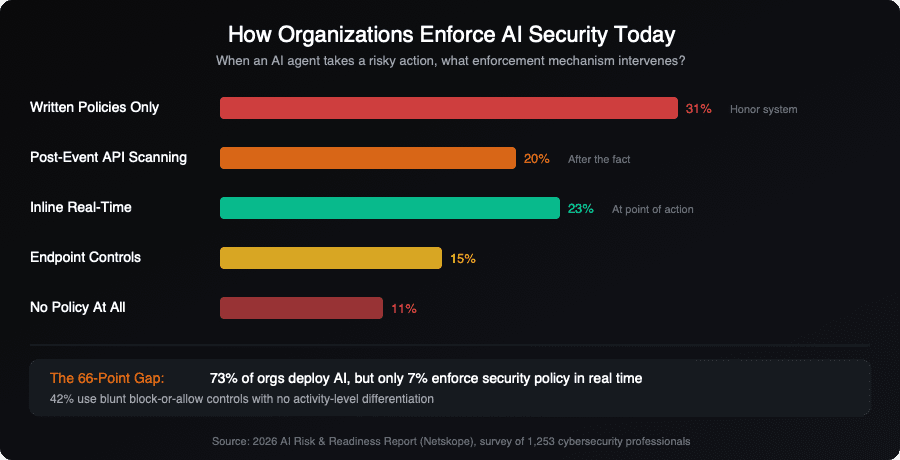
The largest single enforcement category is the honor system: 31% rely on written policies and employee compliance. Another 20% catch violations only after the action completes. Only 23% enforce AI security inline, at the point of action. Eleven percent have no AI security policies at all.
What this means for agent operations
This is not just a compliance problem. It is a production readiness problem. When AI agents can modify records, create accounts, send emails, and push code through API calls that complete before any human reviews them, every ungoverned deployment becomes a security incident waiting to happen.
The Netskope report quantifies the exposure:
- 53% of AI tools have write access to collaboration suites
- 40% have write access to email
- 25% have write access to code repositories
- 8% have write access to identity providers (an agent with identity write access can create service accounts, raise privileges, and grant itself external access)
- 91% of organizations only discover what an agent did after it has already executed the action
The Gravitee State of AI Agent Security 2026 report (900+ respondents) reinforces the picture: only 14.4% report that all AI agents go live with full security and IT approval. Meanwhile, 88% of organizations experienced confirmed or suspected AI agent security incidents in the past year. In healthcare, that figure jumps to 92.7%.
The confidence paradox
Perhaps the most dangerous finding is the disconnect between executive perception and operational reality. Gravitee found that 82% of executives feel confident their existing policies protect them from unauthorized agent actions. Meanwhile, the practitioners on the ground report that security teams cannot protect what they cannot see, and 94% report gaps in AI activity visibility according to the Netskope data.
This is a confidence paradox driven by the distance between the boardroom and the SOC floor. Executives see budget increases (90% raised AI security spending this year) and assume progress. Practitioners see legacy tools that were designed for known file formats, predictable data flows, and human-speed interactions, none of which apply to autonomous agents.
The production multiplier
Here is where the story shifts from risk to opportunity. The Databricks 2026 State of AI Agents report (20,000+ organizations, 60% of the Fortune 500) found something striking:
Companies that use AI governance tools get over 12x more AI projects into production. Companies using evaluation tools see 6x more production deployments.
Governance is not the bottleneck. The absence of governance is the bottleneck. Organizations that invest in real-time policy enforcement, inline monitoring, and identity-aware controls are not just safer; they are dramatically more productive. Governance enables velocity rather than constraining it.
Government frameworks are catching up
The regulatory is responding to this gap:
- Singapore's IMDA published the Model AI Governance Framework for Agentic AI in January 2026, the world's first governance framework specifically designed for AI agents. It covers four dimensions: risk assessment and bounding, meaningful human accountability, technical controls and processes, and end-user responsibility.
- CISA and international partners released Careful Adoption of Agentic AI Services in May 2026, urging organizations to adopt a measured, security-first approach starting with low-risk use cases.
- Databricks released DASF v3.0, adding 35 new security risks and 6 mitigation controls for agentic AI, including guidance for MCP tool servers and multi-agent system risks.
These frameworks share a common message: start with limited, controlled deployments, enforce policy at the point of action, and treat agents as first-class security principals, not extensions of human users.
What this means for businesses automating intake and workflows
For organizations considering AI-powered intake forms, lead qualification, voice agents, or CRM automation, the governance gap is not an abstract concern. Every agent that touches customer data, writes to a CRM, or makes a routing decision is a governance surface. The question is not whether to deploy agents, but whether your governance infrastructure can keep up.
The data is clear on three priorities:
- Visibility first. You cannot govern what you cannot see. Start by mapping every AI tool and agent in your environment, including shadow deployments.
- Inline enforcement. Move from written policies and post-event scanning to real-time policy enforcement at the point of action.
- Identity-aware controls. Treat every agent credential with the same rigor as a human identity. Audit write access and establish approval gates for high-risk actions.
The organizations that close the 66-point gap fastest will be the ones that scale AI agents successfully. The ones that don't will discover the cost of ungoverned autonomy the hard way.
Sources:
- 2026 AI Risk & Readiness Report (Netskope/Cybersecurity Insiders)
- State of AI Agent Security 2026 (Gravitee)
- 2026 State of AI Agents (Databricks)
- Model AI Governance Framework for Agentic AI (Singapore IMDA)
- Careful Adoption of Agentic AI Services (CISA)
- Databricks AI Security Framework DASF v3.0 (Databricks)